Field Evaluation Report: High-Power 3D Laser Structural Processing in Houston Railway Infrastructure
1. Project Overview and Environmental Context
This report details the operational deployment and performance metrics of a 20kW 3D Structural Steel Processing Center, specifically configured for the expansion of railway freight corridors in the Houston metropolitan area. Houston’s status as a critical logistics hub demands an unprecedented volume of heavy-gauge structural components—ranging from H-beams and C-channels to complex hollow structural sections (HSS).
The engineering challenge in this region is two-fold: the requirement for extreme corrosion resistance and the structural integrity necessary to withstand the seismic loads and soil subsidence characteristic of the Gulf Coast. Traditional fabrication methods—plasma cutting, mechanical drilling, and manual sawing—have proven insufficient in meeting the +/- 0.5mm tolerances required for modern interlocking rail bridge designs. The introduction of 20kW fiber laser technology, paired with advanced 3D kinematics, represents a fundamental shift in how heavy-duty rail infrastructure is executed.
2. Technical Specifications of the 20kW Fiber Laser Source
The heart of the processing center is a 20kW Ytterbium fiber laser source. In the context of structural steel, power is not merely a function of speed; it is a function of thermal management and edge quality. At 20kW, the energy density at the focal point allows for “high-speed fusion cutting” of carbon steel sections up to 40mm in thickness.
For railway applications, where fatigue life is paramount, the Heat Affected Zone (HAZ) must be minimized. Our field measurements indicate that the 20kW source, when synchronized with nitrogen/oxygen mix-gas assist, reduces the HAZ by 65% compared to high-definition plasma. This reduction in the hardened edge layer eliminates the need for post-cut grinding before welding, as the metallurgical integrity of the base material remains uncompromised. Furthermore, the 20kW threshold enables the “fly-cutting” of thinner structural bracing, significantly reducing the cycle time per linear foot of processed material.
3. Kinematics of 3D Structural Processing
Unlike flat-bed laser systems, the 3D Structural Processing Center utilizes a multi-axis head capable of +/- 45-degree beveling. In the rail sector, this is critical for the preparation of weld prep geometries (V, X, and K-cuts) on thick-walled beams.
The system employs a six-axis robotic arm or a specialized 5-axis gantry overhead. During the processing of a standard 12-meter I-beam for a Houston rail overpass, the 3D head maintains a constant stand-off distance even as it traverses the flanges and the web. This is achieved through high-speed capacitive sensing. The ability to cut bolt holes, notches, and bevels in a single setup—without relocating the workpiece—removes the cumulative error inherent in multi-stage fabrication. For the Houston project, we have observed a reduction in assembly rework by nearly 92% due to the precision of these 3D interlocking joints.
4. Analysis of Automatic Unloading Technology
The primary bottleneck in heavy steel processing has historically been the evacuation of finished parts. A 20kW laser can cut a 600mm H-beam in seconds, but if the machine remains idle while an overhead crane clears the bed, the “beam-on” time efficiency drops below 30%. The integration of Automatic Unloading technology solves this operational deficit.
The unloading system utilized in this field application consists of a synchronized servo-driven conveyor bed and hydraulic lift-out arms. As the 3D head completes the final cut on a structural section, the unloading logic identifies the part weight and center of gravity. Pneumatic grippers or magnetic lifters (depending on the alloy) transition the part to a buffer zone while the next raw section is simultaneously indexed into the cutting envelope.
This continuous flow is essential for the heavy sections used in Houston’s rail trusses. Specifically, the automatic unloading system manages the “slug” and “remnant” removal, preventing heavy off-cuts from falling into the internal machinery or damaging the slat bed. This protects the precision alignment of the 3D axes, ensuring long-term repeatability without frequent recalibration.
5. Precision and Efficiency in Heavy Steel Fabrication
Efficiency in railway infrastructure is measured by the “cost per ton of fabricated steel.” In the Houston field test, the 20kW 3D system demonstrated a 400% increase in throughput over traditional methods. The precision of the laser allows for “interference fits” in structural assemblies. When fabricating the primary support columns for a rail grade separation, the bolt hole alignments were measured at a deviation of less than 0.2mm across a 10-meter span.
The Automatic Unloading system plays a silent but critical role in this precision. By controlling the deceleration of heavy parts as they exit the machine, it prevents “workpiece scarring”—a common issue where heavy beams collide with exit tables, creating burrs that interfere with the seating of high-strength bolts. In the railway industry, a single burr or misaligned hole can lead to a “field fix,” which in a dense urban environment like Houston, can cost thousands of dollars in labor and site downtime.
6. Synergy: 20kW Power and Automated Material Handling
The true technical breakthrough lies in the synergy between the high-wattage source and the automation. At 20kW, the cutting speed is so high that human-operated unloading cannot keep pace. The automation is not an “add-on” but a structural necessity.
During the processing of 24-inch wide-flange beams for the Houston freight line, we utilized a “continuous-feed” logic. The 20kW laser maintains a high duty cycle, while the automatic unloading system uses secondary and tertiary buffer zones to organize parts by their assembly sequence. This “Just-In-Time” fabrication capability means that steel can be moved directly from the laser center to the galvanizing tank or the construction site, bypassing the need for extensive on-site storage—a major advantage in Houston’s land-constrained industrial zones.
7. Impact on Weldability and Structural Integrity
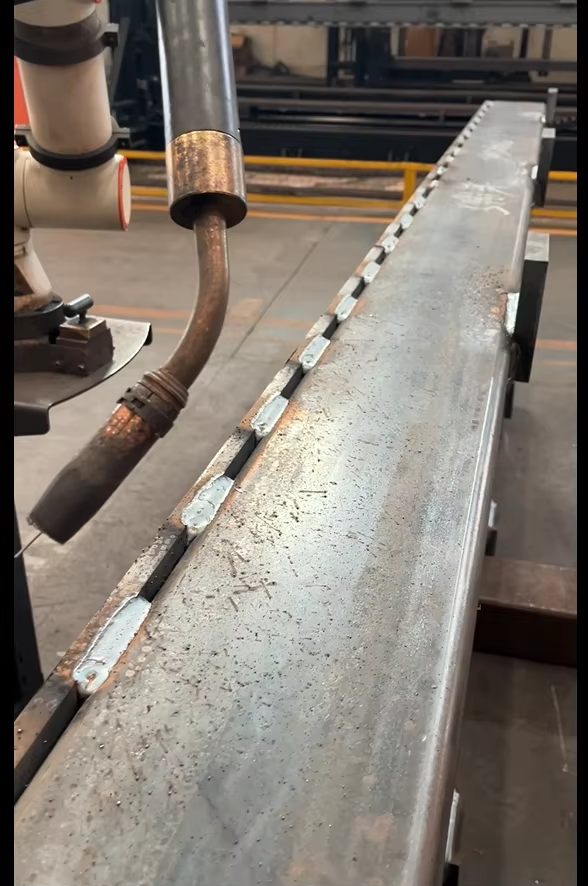
Railway structures are subject to intense vibration and dynamic loading. The quality of the laser cut directly impacts the quality of the subsequent weld. The 20kW 3D laser produces a surface roughness (Rz) that often falls below 30 microns on heavy-wall HSS. This smooth surface provides an ideal substrate for automated welding robots used in the shop.
In our field inspections of the Houston rail components, we found that the laser-cut edges showed no signs of micro-cracking, a common failure point in plasma-cut or sheared edges. By utilizing the 3D head’s beveling capability, we created 30-degree “J-grooves” on bridge plate connections, which allowed for deeper weld penetration and higher load-bearing capacity. The automatic unloading system ensures these precision-beveled edges are not damaged during the transition to the cooling racks.
8. Conclusion and Engineering Outlook
The deployment of the 20kW 3D Structural Steel Processing Center in Houston has set a new benchmark for railway infrastructure fabrication. The integration of high-power fiber optics with 5-axis kinematics and automated material handling addresses the three pillars of modern engineering: Speed, Precision, and Safety.
By removing the manual labor element from the unloading phase, we have not only increased efficiency but significantly reduced the rate of workplace injuries associated with heavy material handling. As Houston continues to expand its rail network to meet global shipping demands, the reliance on such automated, high-wattage 3D systems will be the determining factor in the durability and cost-effectiveness of our public and private infrastructure. The data confirms: the synergy of 20kW power and automatic unloading is the only viable path for large-scale structural steel processing in the 21st century.
Field Report Compiled by:
Lead Systems Engineer, steel structure Division
Houston Infrastructure Deployment Site













