1.0 Technical Overview: The Evolution of Structural Steel Processing
In the industrial corridors of Houston, Texas, the demand for rapid-deployment modular construction has reached a critical inflection point. Traditional fabrication methods—relying on mechanical sawing, manual layout, and secondary plasma beveling—are no longer sufficient to meet the stringent tolerances required for offshore skids, refinery modules, and complex infrastructure. The introduction of the 20kW 3D Structural Steel Processing Center represents a seismic shift in how heavy-gauge H-beams, I-beams, and hollow structural sections (HSS) are manipulated.
This report evaluates the field performance of high-brightness 20kW fiber laser sources integrated into a multi-axis 3D cutting environment. Unlike 2D plate cutting, 3D structural processing involves the dynamic management of five or more axes of motion to maintain perpendicularity or specific angularity across non-linear surfaces. The synergy between high-wattage power and 3D kinematics allows for the consolidation of multiple fabrication steps into a single automated cycle.
2.0 The Physics of 20kW Fiber Laser Interaction in Heavy Sections
The transition from 12kW to 20kW is not merely a linear increase in cutting speed; it is a fundamental shift in the material’s phase change dynamics during the melt-ejection process. At 20kW, the power density at the focal point allows for a significantly higher feed rate on thick-walled structural steel (up to 25mm and beyond), which minimizes the Heat Affected Zone (HAZ).
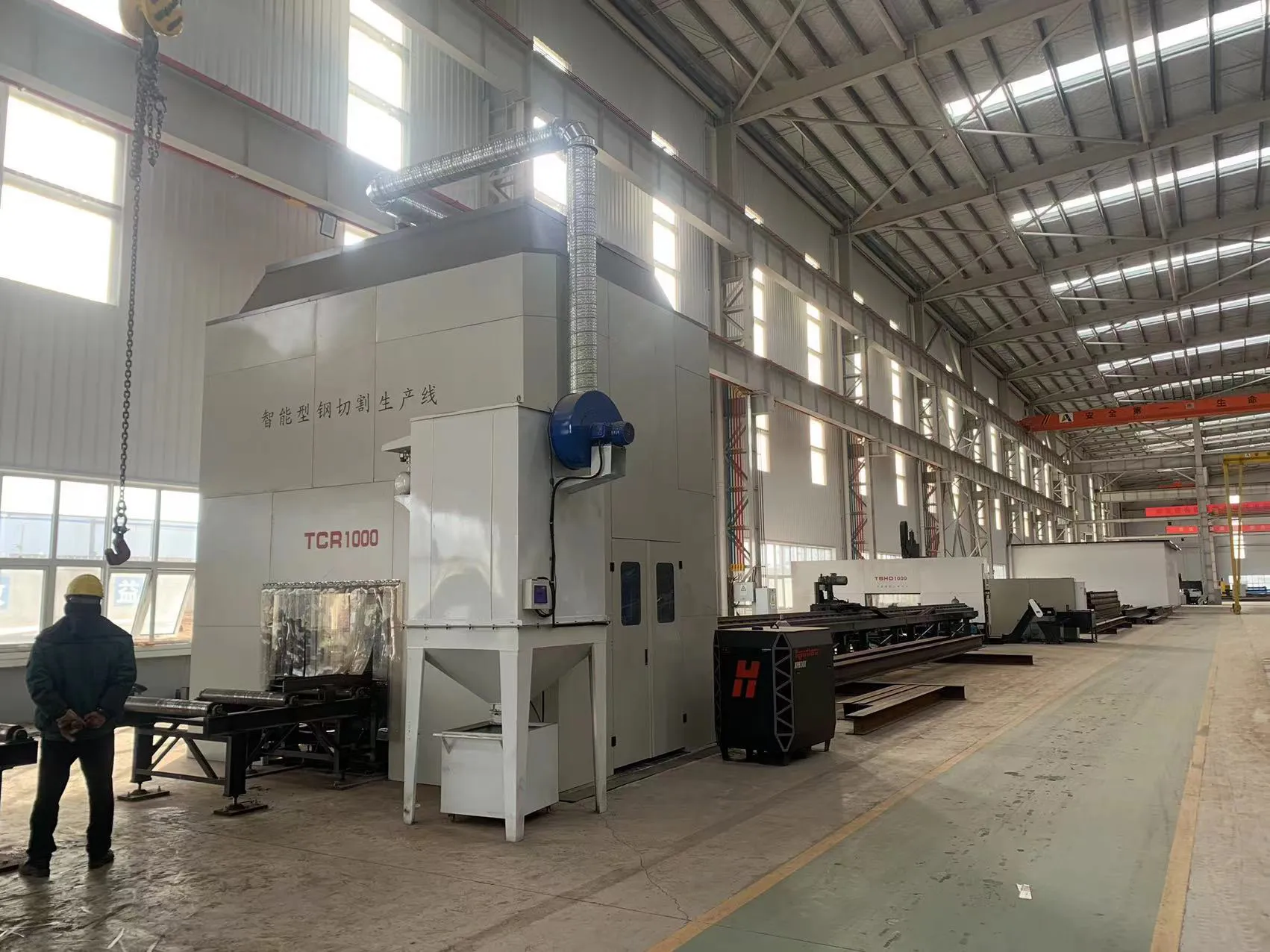
2.1 Kerf Dynamics and Assist Gas Optimization
In the Houston modular sector, where ASTM A36 and A572 Grade 50 steels are ubiquitous, managing the kerf width is essential for structural integrity. The 20kW source provides the thermal energy necessary to maintain a stable molten pool even at high traverse speeds. Our field observations indicate that using high-pressure Oxygen (O2) for thick carbon steel, or Nitrogen (N2) for stainless components in corrosive coastal environments, results in a dross-free finish that requires zero post-process grinding. The 20kW density allows for a narrower kerf than plasma systems, reducing material loss and improving the “fit-up” accuracy for subsequent welding operations.
3.0 ±45° Bevel Cutting: Redefining Weld Preparation
The core technological advantage of this processing center is the ±45° 3D beveling head. In heavy steel processing, the “weld prep” is often the most labor-intensive phase. Traditionally, a beam would be cut to length, moved to a secondary station, and manually ground or plasma-torched to create V, Y, or K-type bevels.
3.1 Precision Path Interpolation
The 3D processing center utilizes advanced CNC path interpolation to maintain a constant focal distance while the head tilts up to 45 degrees. This is particularly challenging on the flanges and webs of I-beams, where material thickness can vary. The system’s ability to perform “one-pass” beveling means the part is ready for robotic or manual welding immediately upon discharge. For Houston’s modular builders, this eliminates the “bottleneck” of the grinding bay.
3.2 Geometric Accuracy in Complex Joinery
Modular construction often requires complex intersections, such as “saddle cuts” on pipes or “cope cuts” on H-beams. The ±45° capability allows for the creation of intricate “lock-and-key” geometries. When two structural members meet at an angle, the laser can cut the precise bevel required for a full-penetration groove weld, ensuring that the structural load-bearing capacity meets API and AISC standards without the need for excessive filler metal.
4.0 Application in Houston’s Modular Construction Sector
Houston serves as a global hub for Engineering, Procurement, and Construction (EPC) firms. The modularization of chemical plants and subsea manifolds requires components to be fabricated in-shop and assembled on-site with millimeter precision. If a structural beam is off by even 3mm, the cumulative error over a 50-foot module can result in catastrophic misalignment.
4.1 Tolerance Management and Thermal Distortion
One of the primary challenges in Houston’s humid, high-ambient-temperature environment is thermal expansion. However, the 20kW laser’s speed is its greatest asset here. By cutting faster, the total heat input into the structural member is reduced compared to plasma or oxy-fuel cutting. This minimizes “bowing” or “twisting” of long-span beams, ensuring that the modular frames remain square. Our data shows a 40% reduction in rework due to distortion when switching from legacy thermal cutting to 20kW fiber laser processing.
4.2 Just-in-Time Logistics for EPC Projects
The “Structural Steel Processing Center” is not just a cutter; it is a manufacturing cell. With integrated loading and unloading systems, a single operator can manage the intake of raw 12-meter beams and the output of finished, beveled, and marked parts. In the context of Houston’s fast-track energy projects, this throughput capability allows fabricators to meet aggressive “First Steel” deadlines that were previously impossible.
5.0 Synergistic Automation: BIM to Machine Code
The efficiency of the 20kW system is maximized through the direct integration of Building Information Modeling (BIM) data. Structural files (typically in .STEP or .TEKLA formats) are imported directly into the processing center’s software. This eliminates manual data entry and the risk of human error.
5.1 Automatic Nesting and Part Marking
For large-scale modular projects involving thousands of unique components, the system’s ability to automatically nest parts on a single beam reduces scrap rates by an average of 15%. Furthermore, the 20kW laser can be detuned to perform high-speed etching, marking each part with its unique ID, weld symbols, and assembly orientation. This “digital thread” from design to the Houston assembly yard ensures that the modular components are traced and installed correctly.
6.0 Economic and Operational Impact Analysis
From a senior engineering perspective, the CAPEX of a 20kW 3D system must be weighed against its operational throughput. In heavy structural applications, the metrics are clear:
- Labor Reduction: The consolidation of cutting, drilling, marking, and beveling into one machine reduces the required man-hours per ton of steel by approximately 60%.
- Consumable Efficiency: While the 20kW source requires significant power, the lack of mechanical tool wear (unlike drill bits or saw blades) and the long life of fiber optics result in a lower “cost-per-cut” over high volumes.
- Secondary Operation Elimination: The ±45° bevel precision eliminates the need for manual edge dressing, which is often the most dangerous and ergonomically taxing job in a Houston fab shop.
7.0 Conclusion: The New Standard for Heavy Fabrication
The field evaluation of the 20kW 3D Structural Steel Processing Center confirms that this technology is no longer an “emerging” tool but a necessary standard for the modern modular construction industry. In a market as competitive as Houston’s, the ability to deliver high-precision, pre-beveled structural members with minimal thermal distortion provides a decisive advantage.
The ±45° beveling capability, powered by the high-density 20kW source, solves the dual challenge of precision and speed. As modular units become larger and more complex, the reliance on automated 3D laser processing will only intensify. Fabricators who adopt this synergy of power and multi-axis control are seeing a transformation in their production capacity, shifting from traditional “job shops” to high-throughput industrial manufacturing centers.
Field Report Summary: The integration of 20kW fiber laser technology into 3D structural processing has successfully mitigated the tolerance stack-up issues prevalent in heavy modular assembly. The system’s performance in the Houston industrial corridor demonstrates a significant leap in weld-prep efficiency and overall structural reliability.







