The Dawn of High-Power Fiber Lasers in Turkish Infrastructure
Istanbul stands at a unique geographical and engineering crossroads. As a megacity spanning two continents, its reliance on robust bridge engineering is not merely a matter of convenience but of national economic survival. The transition from traditional plasma cutting and mechanical sawing to 12kW fiber laser systems represents a fundamental evolution in how these massive structures are built.
For decades, bridge components—gusset plates, diaphragms, and transverse stiffeners—were fabricated using technologies that required significant secondary processing. Plasma cutting, while effective for thickness, often left a large Heat Affected Zone (HAZ) and dross that required manual grinding. The 12kW fiber laser changes this equation entirely. With a power density capable of vaporizing thick steel in milliseconds, the 12kW system provides a “bolt-ready” finish directly off the machine bed, drastically reducing the lead times for Istanbul’s ambitious infrastructure projects.
Technical Architecture of the 12kW Universal Profile System
The “Universal” designation in these laser systems refers to their multi-axis versatility. Unlike standard flatbed lasers, a 12kW Universal Profile system is equipped with a rotary axis or a 3D head capable of processing not just flat sheets, but structural profiles including I-beams, H-beams, U-channels, and L-angles.
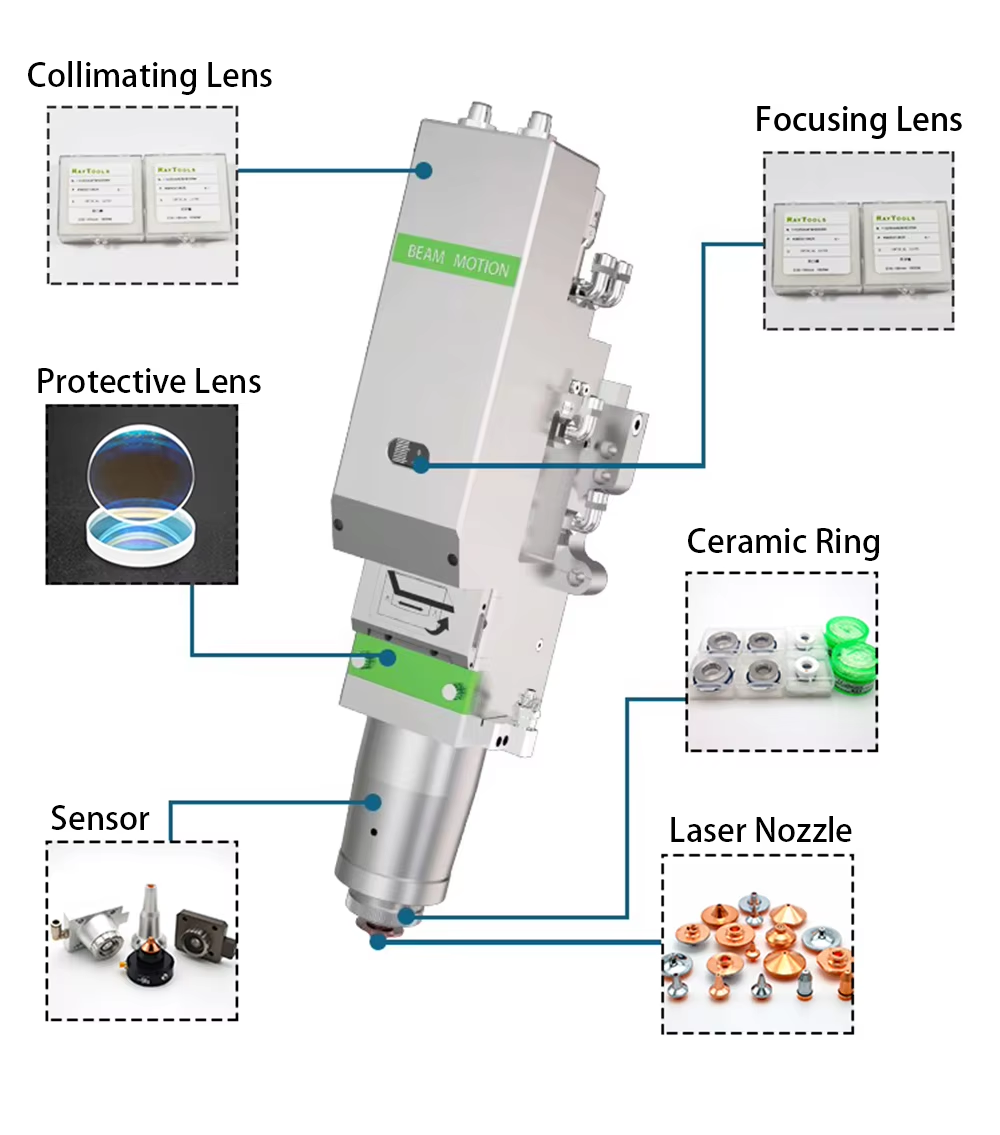
At the heart of this system is the 12kW ytterbium fiber laser source. At this power level, the beam quality (measured by the Beam Parameter Product or BPP) must be meticulously controlled. For Istanbul’s bridge engineers, this means the ability to cut carbon steel up to 50mm thick with high precision. The 12kW threshold is particularly significant because it allows for “High-Speed Nitrogen Cutting” on medium thicknesses (10mm-20mm), which prevents oxidation on the cut edge. This is critical for bridge components that will be painted or galvanized, as it ensures superior coating adhesion without the need for acid pickling or sandblasting.
Zero-Waste Nesting: The Intersection of AI and Metallurgy
In the context of bridge engineering, where a single project can require thousands of tons of steel, material wastage is a catastrophic financial leak. “Zero-Waste Nesting” is a sophisticated software-driven approach that utilizes heuristic algorithms to pack parts onto a steel plate or profile with mathematical density that nears 95-98% utilization.
In Istanbul’s high-cost energy and raw material market, the Zero-Waste Nesting feature of the 12kW system provides a competitive edge. The software performs “Common-Line Cutting,” where two adjacent parts share a single cut path. This not only saves material but also reduces the total “pierce count,” which is the most time-consuming part of the laser process. For complex bridge joints and interlocking components, the software can even nest smaller bracket parts within the scrap skeletons of larger structural members, effectively turning what would be “waste” into usable inventory.
Seismic Resilience and Precision Engineering
Istanbul is situated near the North Anatolian Fault, making seismic resilience the primary directive for any bridge engineering project. The 12kW fiber laser contributes to this by providing unmatched geometric accuracy. When fabricating friction-pendulum bearings or seismic dampener mounts, a deviation of even half a millimeter can compromise the structural integrity of the bridge during a tectonic event.
The laser’s CNC control system compensates for thermal expansion in real-time, ensuring that bolt holes are perfectly circular and slots are perfectly aligned across spans that may exceed 100 meters. This precision ensures that when the steel reaches the construction site over the Golden Horn or the Bosphorus, the fit-up is seamless. In bridge engineering, a seamless fit-up means less field welding; less field welding means fewer potential points of fatigue failure, directly resulting in a safer structure.
Processing Structural Profiles: Beyond the Flat Sheet
The “Universal Profile” capability is perhaps the most transformative feature for Istanbul’s steel fabricators. Traditionally, an I-beam required a layout artist to mark it, a saw to cut it to length, and a magnetic drill to create holes. A 12kW Universal laser system performs all these tasks in a single automated cycle.
Equipped with a 4-chuck system for stability, the laser can rotate a 12-meter I-beam and cut complex miter joints, cope cuts, and web openings with a 12kW punch that maintains speed even through the thickest flanges. This is particularly useful for the intricate “arch” designs often seen in modern Turkish pedestrian bridges, where aesthetic form must meet rigid structural function. The ability to laser-cut the radius of a massive pipe or tube allows for “slot-and-tab” construction, where structural members practically snap together before welding, ensuring the geometry of the bridge is locked in by the precision of the laser rather than the variability of manual measurement.
Economic Impact on Istanbul’s Manufacturing Hubs
Districts like İkitelli and Gebze have become the backbone of Turkey’s industrial output. The deployment of 12kW laser systems in these hubs has turned Istanbul into a regional center for “Steel Service Excellence.” By investing in 12kW technology, local firms are no longer just suppliers; they are sophisticated engineering partners for global contractors.
The high throughput of a 12kW system—cutting up to 5 times faster than a 4kW system on 20mm plate—allows Istanbul-based firms to take on international bridge contracts with aggressive timelines. The reduction in labor costs, combined with the material savings from Zero-Waste Nesting, allows these firms to outcompete European and Asian fabricators who may still be relying on slower, less efficient legacy technologies.
The Environmental Imperative: Green Bridge Building
Sustainability is no longer an optional “extra” in international bridge engineering. The 12kW fiber laser is inherently greener than the technologies it replaces. Fiber lasers have a wall-plug efficiency of approximately 35-40%, compared to the 10% efficiency of older CO2 lasers.
Furthermore, the Zero-Waste Nesting capability directly reduces the carbon footprint of a bridge. Every ton of steel saved is a ton of steel that doesn’t need to be produced in a high-emission blast furnace or transported across the Marmara Sea. By minimizing scrap, Istanbul’s bridge builders are aligning themselves with global “Green Steel” initiatives, making their projects more attractive to international financiers and environmental oversight bodies.
Future Outlook: Automation and Industry 4.0
The future of bridge engineering in Istanbul lies in the full integration of the 12kW laser system into an Industry 4.0 workflow. We are moving toward a “BIM-to-Laser” (Building Information Modeling) pipeline. In this scenario, a bridge designer in an office in Levent can send a 3D model directly to the laser’s nesting software in a factory in Dilovası.
The 12kW system, equipped with sensors and IoT connectivity, provides real-time feedback on cutting gas consumption, power usage, and part completion. This data allows for predictive maintenance, ensuring the laser is never down during a critical bridge assembly phase. As Istanbul continues to expand its transit networks, including the “Kanal Istanbul” bridges and further metro expansions, the 12kW Universal Profile Steel Laser System will be the silent engine driving the city’s structural evolution.
Conclusion
The 12kW Universal Profile Steel Laser System is more than just a cutting tool; it is a catalyst for engineering excellence in Istanbul. By synthesizing the power of 12,000 watts with the intelligence of Zero-Waste Nesting, the city’s bridge builders are achieving a level of precision, economy, and speed that was previously unimaginable. As the skyline of Istanbul continues to be defined by its soaring bridges and complex steel structures, fiber laser technology remains the foundational force ensuring these icons are built to last for centuries.