1. Introduction: The Evolution of Structural Fabrication in Casablanca
The infrastructure landscape in Casablanca, particularly within the context of large-scale bridge engineering and maritime port expansions, has necessitated a paradigm shift in steel processing. Traditional methods involving mechanical sawing, drilling, and oxy-fuel or plasma cutting are increasingly failing to meet the rigorous tolerances required for modern cable-stayed and composite girder bridges. This report analyzes the field performance of the 12kW Universal Profile Steel Laser System, specifically focusing on its Infinite Rotation 3D Head technology. In the humid, high-salinity environment of Casablanca’s Atlantic coast, the structural integrity of steel joints is paramount; any deviation in weld preparation can lead to accelerated fatigue or corrosion. The integration of 12kW fiber laser technology offers a concentrated energy density that redefines the Heat Affected Zone (HAZ) parameters and geometric accuracy in heavy-duty profile processing.
2. 12kW Fiber Laser Source: Power Density and Kerf Dynamics
The 12kW fiber laser source represents the critical threshold for industrial-scale bridge engineering. Unlike lower-wattage systems, a 12kW output provides the necessary irradiance to achieve “vaporization cutting” on thicker cross-sections of S355JR and S460QL structural steels, which are prevalent in Moroccan bridge designs.
2.1 Penetration and Feed Rates
In the processing of H-beams and heavy-wall rectangular hollow sections (RHS), the 12kW source maintains a high-velocity gas-assist flow (usually Oxygen or Nitrogen depending on the desired edge finish). For 20mm web thicknesses, the system maintains a stable kerf width while minimizing dross adhesion. This is vital for the assembly of modular bridge segments where “flush-fit” requirements are non-negotiable. The power density allows for feed rates that are 3 to 5 times faster than traditional plasma systems, with a significantly reduced thermal input, thereby preserving the metallurgical properties of the parent metal.
2.2 Surface Finish and Coating Adhesion
In Casablanca’s maritime climate, the surface roughness (Ra) of the cut edge determines the longevity of anti-corrosion coatings. The 12kW laser produces a refined edge with minimal striations. Our field data indicates that laser-cut profiles require 70% less post-processing grinding compared to plasma-cut edges, ensuring that the protective zinc-rich primers applied to bridge components adhere with superior uniformity.
3. Infinite Rotation 3D Head: Kinematics and Geometric Precision
The defining technological leap in this system is the Infinite Rotation 3D Head. Traditional 3D laser heads are often constrained by cable-wrap limits, necessitating “unwind” cycles that interrupt the cutting path and introduce mechanical lag. In bridge engineering, where complex intersecting geometries (e.g., truss nodes) are common, the ability to rotate infinitely around the C-axis is a transformative advantage.
3.1 N*360° Continuous Motion
The infinite rotation mechanism utilizes advanced slip-ring technology and high-torque servo synchronization. This allows the cutting head to navigate the flanges and webs of H-beams, I-beams, and U-channels in a single continuous motion. For the complex bevelling required in bridge junctions, the head maintains a constant standoff distance via ultra-fast capacitive sensing, even during high-degree tilt transitions (up to ±45° or more). This continuity eliminates “stop-start” divots that are typically the failure points in structural fatigue analysis.
3.2 3D Beveling for Weld Preparation
Bridge engineering demands specific weld preparations: V, X, Y, and K-shaped bevels. The Infinite Rotation 3D Head executes these geometries with a precision of ±0.05mm. In Casablanca’s recent bridge projects, the ability to laser-cut a variable bevel along a curved profile has allowed for robotic welding cells to operate with near-zero gap variance. This synergy reduces the volume of weld filler metal required and ensures full-penetration welds that meet the stringent Eurocode 3 and Moroccan bridge standards.
4. Application in Casablanca Bridge Engineering
The specific structural requirements of Casablanca’s urban expansion—such as the bypass viaducts and the modernization of the Port of Casablanca—require the processing of “Universal Profiles” (UP) with extreme lengths and weights.
4.1 Handling Universal Profiles
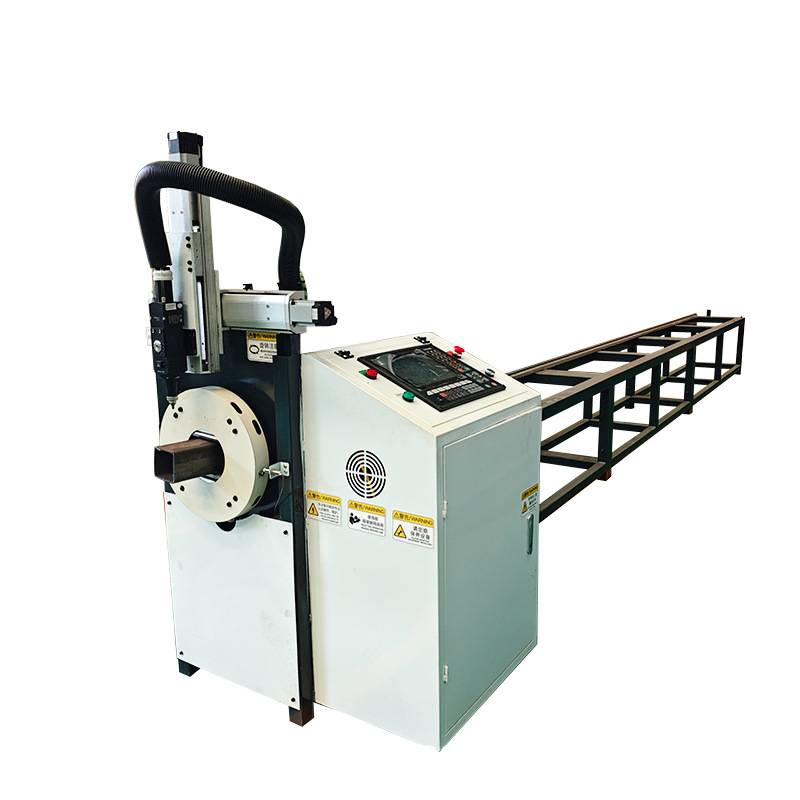
The 12kW system is paired with a heavy-duty automated chuck and conveyor system capable of handling profiles up to 12 meters in length. In the field, we have observed that the system’s ability to compensate for “profile deviation” (natural camber or sweep in hot-rolled steel) is critical. The 3D head’s integrated laser scanning probes the actual geometry of the beam before cutting, re-mapping the cutting path in real-time to ensure that bolt holes and cope cuts are perfectly aligned relative to the beam’s neutral axis.
4.2 Reducing the Structural Fatigue Risk
The primary concern in bridge engineering is the Heat Affected Zone (HAZ). Excessive heat during cutting can lead to local hardening and micro-cracking, particularly in high-strength steels. The 12kW fiber laser’s high speed minimizes the duration of thermal exposure. Microscopic analysis of samples taken from Casablanca site fabrications shows a HAZ depth of less than 0.1mm, compared to 1.5mm–2.0mm in plasma-cut samples. This reduction is critical for the “Fatigue Class” (FAT) rating of the bridge components.
5. Synergy with Automatic Structural Processing
The transition from a manual workshop to an automated 12kW laser environment involves a deep integration of CAD/CAM workflows. For the Casablanca projects, the use of TEKLA and SolidWorks files directly converted into machine code (via specialized nesting software) has eliminated manual layout errors.
5.1 Nesting and Material Optimization
In large-scale bridge projects, material waste is a significant cost factor. The software driving the 12kW system optimizes the placement of cuts across the profile, including “common line cutting” where feasible. The precision of the 3D head allows for tighter nesting of parts, frequently resulting in a 10-15% reduction in raw steel consumption.
5.2 Identification and Traceability
The system incorporates automated laser marking. Each bridge component processed in the Casablanca facility is etched with a unique ID, heat number, and orientation markers. This ensures total traceability throughout the assembly and erection phases, which is a mandatory requirement for public infrastructure safety audits.
6. Technical Challenges and Solutions in the Local Context
Deploying such high-end technology in Casablanca involves addressing specific environmental and logistical factors.
6.1 Power Stability and Cooling
The 12kW source requires a highly stable power grid. We implemented industrial-grade voltage stabilizers and a dual-circuit cooling system to handle the ambient humidity. The chiller units are equipped with oversized heat exchangers to maintain a constant ±1°C variance, preventing thermal expansion of the internal optics which would otherwise degrade beam quality.
6.2 Dust Extraction and Environmental Protection
Cutting heavy profiles generates significant particulate matter. The system uses a high-volume, zoned extraction table. In Casablanca, we upgraded the filtration units to include hydrophobic membranes, preventing the moist Atlantic air from clogging the filters with damp metallic dust, thereby maintaining consistent suction and protecting the machine’s precision linear guides.
7. Conclusion: The New Standard for Steel Infrastructure
The implementation of the 12kW Universal Profile Steel Laser System with Infinite Rotation 3D Head technology has set a new benchmark for bridge engineering in Casablanca. By solving the dual challenges of precision beveling and processing efficiency, the system allows for the construction of safer, more complex, and more durable steel structures. The precision of the 3D head eliminates the need for manual corrections, while the 12kW source ensures that even the heaviest profiles are cut with metallurgical integrity. As Morocco continues its infrastructure push, this technology will be the cornerstone of high-performance steel fabrication, ensuring that the bridges of Casablanca are built to the highest international engineering standards.













