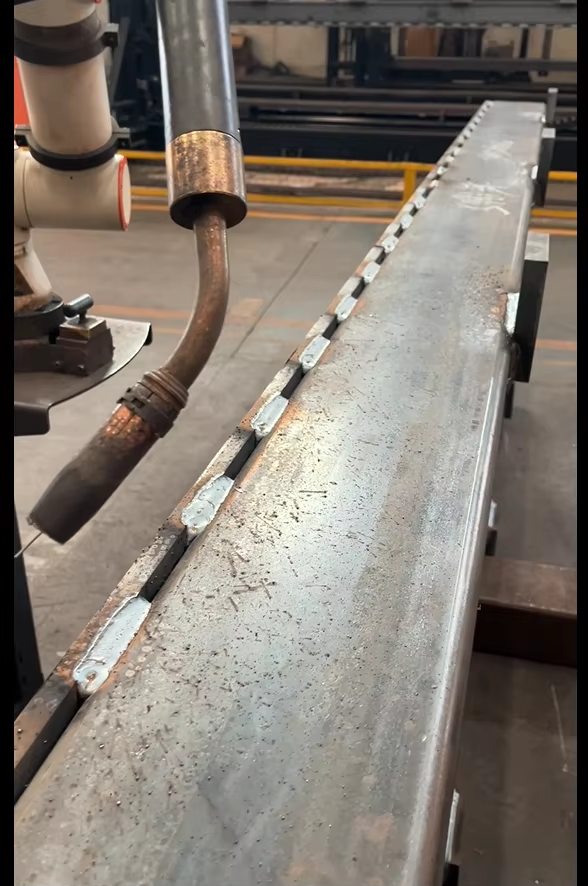
The Dawn of High-Power Fiber Lasers in Pune’s Industrial Belt
Pune has long been recognized as the “Detroit of India,” but its identity as a structural engineering powerhouse is rapidly evolving. With the surge in national infrastructure projects, the demand for fabricated structural steel has outpaced traditional mechanical processing methods. Enter the 12kW Universal Profile Steel Laser System. As a fiber laser expert, I have witnessed the transition from 4kW systems to the current 12kW standard, and the difference is not merely incremental; it is transformative.
At 12kW, the photon density at the focal point allows for the clean piercing and cutting of carbon steel profiles up to 40mm or more, depending on the gas mix. In the context of Pune’s manufacturing ecosystem—stretching from Chakan to Pimpri-Chinchwad—this power level allows local fabricators to handle the thick-walled sections required for bridge girders and support columns that were previously the domain of plasma cutting or oxy-fuel systems. The fiber laser’s advantage lies in its wavelength (typically 1.06 microns), which is absorbed more efficiently by steel, leading to faster cutting speeds and a significantly smaller Heat Affected Zone (HAZ).
Understanding the “Universal Profile” Capability
Traditional laser systems are often limited to flat sheets. However, bridge engineering relies on 3D structural shapes: H-beams, I-beams, C-channels, and heavy-duty square tubing. A “Universal Profile” system is equipped with multi-axis rotation and sophisticated chuck systems (often a 3-chuck or 4-chuck configuration) that can stabilize and rotate massive steel sections.
For a bridge engineer in Pune, this means that a single machine can handle the entire geometry of a structural member. Instead of moving a beam from a saw to a drill line and then to a manual layout station for coping, the 12kW laser performs all these functions in one setup. It cuts the beam to length, carves out complex “rat holes” for welding access, and pierces precision bolt holes that meet the stringent tolerances required for friction-grip bolts. The “universal” aspect refers to the software’s ability to interpret BIM (Building Information Modeling) files directly, translating complex 3D bridge designs into machine code with zero manual interpretation.
The Role of 12kW Power in Bridge Integrity
In bridge engineering, the structural integrity of every joint is non-negotiable. One might ask: why is 12kW the “sweet spot” for this application? The answer lies in the quality of the cut edge. Lower power lasers struggle with thick structural steel, often leaving “dross” or slag at the bottom of the cut, which requires secondary grinding.
A 12kW source provides the “thermal overhead” necessary to maintain a stable melt pool even when traversing the varying thicknesses of a tapered flange on an I-beam. This results in a surface finish that often meets ISO 9013 Grade 2 or 3 standards—eliminating the need for edge dressing before welding. Furthermore, the precision of a 12kW fiber laser ensures that bolt holes are perfectly cylindrical with minimal taper, which is critical for the load distribution in bridge trusses. In the humid and varied climate of the Maharashtra region, ensuring a clean, oxide-free edge (when using nitrogen or specialized air-cutting) also improves the adhesion of anti-corrosive coatings, a vital factor in bridge longevity.
Automatic Unloading: The Silent Productivity Multiplier
While the laser head gets all the glory, the “Automatic Unloading” system is what makes the 12kW system commercially viable for Pune’s high-volume fabricators. Structural profiles are heavy, often weighing several tons. Manual unloading using overhead cranes is slow, dangerous, and prone to damaging the finished part.
The automatic unloading module uses a series of synchronized conveyors and hydraulic lift-tables to transition the finished profile from the cutting zone to a storage rack. In a 12kW environment, where cutting speeds are incredibly fast, a machine without automatic unloading would spend 60% of its time idle, waiting for a crane. By automating this tail-end of the process, Pune-based firms can achieve near-continuous “lights-out” manufacturing. This is particularly important for meeting the aggressive deadlines of the Maharashtra State Road Development Corporation (MSRDC) or the Indian Railways, where project delays carry heavy penalties.
Precision Engineering for Complex Bridge Geometries
Modern bridge architecture is moving away from simple linear designs toward more complex, curved, and modular structures. The 12kW Universal Profile Laser is uniquely suited for this. Its ability to perform 3D beveling—tilting the head up to 45 degrees—allows for the creation of “weld-ready” edges.
In Pune’s specialized engineering workshops, this means that a beam can be cut with a V, Y, or K-type bevel in a single pass. Traditionally, these bevels were created by hand-held oxy-fuel torches, leading to inconsistent gaps that required more weld filler and increased the risk of distortion. The laser’s precision ensures a perfect fit-up every time. When two massive bridge sections are brought together on-site, the “first-time fit” rate increases dramatically, reducing the need for costly field corrections.
The Pune Advantage: Ecosystem and Logistics
Why Pune for this technology? The city is not just a consumer of infrastructure; it is a hub for the talent required to run it. Operating a 12kW universal laser requires skilled CNC programmers and laser technicians who understand material science. Pune’s proximity to elite engineering institutions and a massive base of industrial service providers ensures that these machines are maintained and utilized to their full potential.
Additionally, Pune serves as a logistical gateway. Profiles processed in Pune can be easily transported to infrastructure sites across the Western Ghats or toward the booming industrial corridors of the South. The integration of high-power laser technology here creates a localized center of excellence for “Pre-Engineered Building” (PEB) and bridge components, reducing the reliance on imported pre-fabricated steel.
Economic Impact and Return on Investment (ROI)
For a Pune-based engineering firm, the capital expenditure of a 12kW system is significant. However, the ROI is calculated through the lens of total cost per part. By consolidating sawing, drilling, milling, and manual marking into a single laser process, the labor cost is slashed. Furthermore, the 12kW fiber source is remarkably energy-efficient compared to older CO2 technology, offering wall-plug efficiency of over 40%.
The “Automatic Unloading” feature further improves the ROI by maximizing the “on-beam” time. In a competitive bidding environment for government bridge contracts, the ability to produce more tons of fabricated steel per month than a competitor—with higher precision and lower scrap rates—is a decisive advantage. The reduced kerf width of the laser also means better material utilization; over the course of a thousand-ton bridge project, saving 2-3% of steel through smarter nesting and tighter cuts translates into millions of rupees in savings.
Conclusion: Setting a New Standard for Indian Infrastructure
The 12kW Universal Profile Steel Laser System with Automatic Unloading is more than just a tool; it is a statement of intent for the future of bridge engineering in Pune. As the city continues to expand and the nation demands faster, safer, and more durable infrastructure, the shift toward high-power laser automation is inevitable.
By embracing this technology, Pune’s fabricators are moving away from the “hammer and torch” era into a digital fabrication age where bridges are built with the precision of an aerospace component. The result is infrastructure that is not only faster to build but also safer for the millions who will cross it. As a laser expert, I see this as the pinnacle of current fabrication technology—a perfect marriage of raw power, 3D versatility, and logistical automation that will define the Pune industrial landscape for decades to come.