The Dawn of High-Power Fiber Lasers in Mexican Maritime Engineering
For decades, the fabrication of offshore platforms for the Mexican oil and gas industry relied heavily on oxy-fuel and plasma cutting. While reliable, these methods introduced significant Heat Affected Zones (HAZ) and required intensive secondary grinding to prepare edges for welding. The introduction of the 12kW fiber laser to the Mexico City industrial corridor changes this dynamic entirely.
As a fiber laser expert, I look at 12kW not just as a power rating, but as a “threshold of transformation.” At 12,000 watts, the laser beam possesses the power density to vaporize thick-walled carbon steel profiles used in offshore jackets and decks with a narrow kerf width that plasma cannot replicate. In the high-altitude environment of Mexico City (approximately 2,240 meters above sea level), the physics of gas-assisted cutting requires specific calibration, but the inherent efficiency of the fiber laser source—often exceeding 40% wall-plug efficiency—makes it the most sustainable and precise tool for modern heavy industry.
The Mechanics of the ±45° Beveling Head
In offshore construction, flat cuts are the exception, not the rule. Structural integrity in high-salinity, high-stress environments depends on full-penetration welds. This is where the ±45° beveling capability becomes critical. Traditional laser systems are restricted to 2D “top-down” cutting. A universal profile system equipped with a five-axis 3D cutting head allows the nozzle to tilt and rotate around the workpiece.
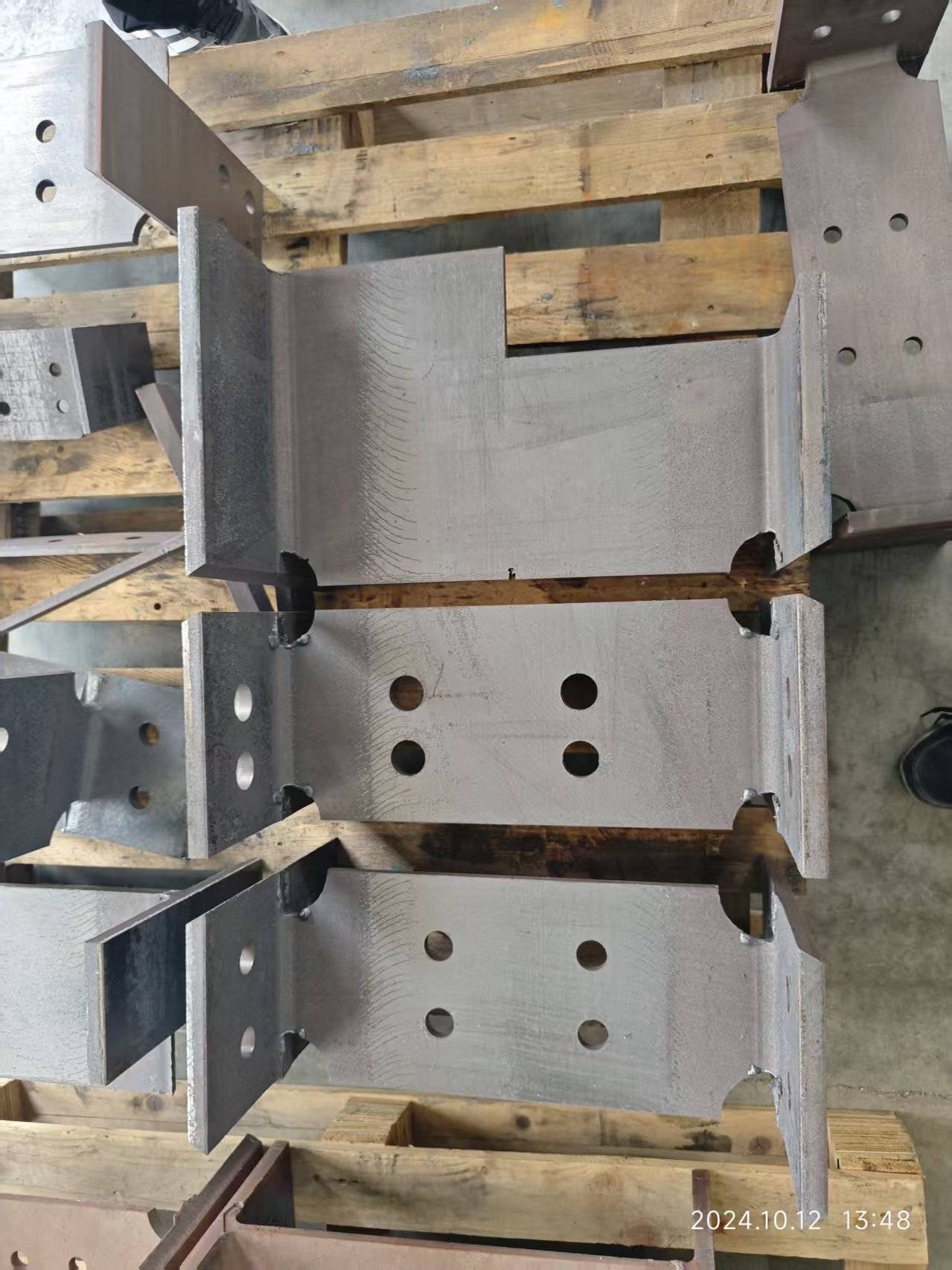
This motion allows for the creation of complex bevels (V, Y, X, and K-cuts) directly on the edges of structural steel. For a 12kW system, maintaining a constant focal point while the head is tilted at 45 degrees is a feat of optical engineering. The system must compensate for the increased material thickness encountered during a diagonal cut—a 20mm plate becomes effectively 28mm thick when cut at 45 degrees. The 12kW power reserve ensures that even at these increased effective thicknesses, the cutting speed remains economically viable, and the edge remains dross-free.
Processing Universal Profile Steel: Beyond Flat Plates
The “Universal Profile” designation refers to the system’s ability to handle more than just sheet metal. Offshore platforms are built on a skeleton of structural members: H-beams for main frames, I-beams for support, and large-diameter tubes for legs.
Traditional laser machines struggle with the geometry of a beam. A 12kW Universal Profile system utilizes a sophisticated chuck and roller system, combined with a 3D bridge, to rotate and position these heavy sections. In Mexico City’s high-tech fabrication shops, this allows for “one-pass” processing. Instead of a beam being cut to length, then moved to a drill line, then moved to a manual beveling station, the laser performs all these functions in a single programmed sequence. It cuts the profile to length, carves out the “bird-mouth” joints for intersecting pipes, drills the bolt holes, and bevels the welding edges—all with a tolerance of ±0.1mm.
Strategic Logistics: Why Mexico City for Offshore Platforms?
It may seem counterintuitive to locate a heavy maritime fabrication center in a landlocked capital. However, Mexico City serves as the intellectual and logistical heart of the country’s engineering sector. The city hosts the specialized labor force, the software engineers, and the primary electrical infrastructure required to run high-kilowatt fiber systems.
Furthermore, the proximity to the country’s main steel producers and the logistical arteries leading to the ports of Veracruz and Ciudad del Carmen makes it an ideal site for “pre-fabrication.” Components are precision-cut in the Mexico City valley and then shipped as “ready-to-assemble” kits to the coast. The 12kW laser facilitates this “LEGO-style” assembly approach; because the parts are cut with such high precision, the fit-up time at the shipyard is reduced by up to 60%.
Overcoming High-Altitude Challenges in laser cutting
Operating a 12kW laser in Mexico City presents unique atmospheric challenges that an expert must address. The lower atmospheric pressure affects the dynamics of the assist gases (Oxygen and Nitrogen). At 2,200+ meters, the density of the air is lower, which can alter the cooling rate of the molten metal and the behavior of the supersonic gas jet exiting the nozzle.
To compensate, these 12kW systems are often fitted with high-pressure gas delivery units and specialized optics that prevent “lens thermal shifting.” The cooling systems (chillers) must also be uprated, as thinner air is less efficient at heat exchange. When properly calibrated, however, the 12kW source provides a “brute force” advantage that overcomes these environmental variables, delivering a clean, silver-bright cut edge on stainless steel or a smooth, oxide-controlled edge on carbon steel.
Offshore Applications: Jackets, Decks, and Helidecks
The specific requirements of offshore platforms are grueling. A platform in the Gulf of Mexico must withstand hurricane-force winds and constant corrosive spray. Any imperfection in a cut—a micro-crack or a rough edge—can become a point of fatigue failure over a 30-year lifecycle.
The 12kW fiber laser produces a minimal Heat Affected Zone (HAZ). Unlike plasma, which can alter the grain structure of the steel several millimeters into the plate, the fiber laser’s concentrated energy path leaves the surrounding metallurgy largely untouched. This is vital for the high-strength steels (like DH36 or EH36) commonly used in offshore jackets. When the ±45° bevel is applied to these materials, the resulting weld prep is surgically clean, requiring zero post-process cleaning. This ensures that when the underwater sections of the platform are welded, the bond is as strong as the parent metal itself.
The Economic Impact: Efficiency and ROI
From an investment perspective, a 12kW Universal Profile Laser is a high-CAPEX asset, but the ROI (Return on Investment) in the Mexican energy sector is rapid. By consolidating five machines (saw, drill, mill, plasma, and manual grinder) into one, the floor space requirement is minimized—a precious commodity in Mexico City’s industrial zones.
Moreover, the “nesting” software used in these systems allows for the optimization of structural profiles, reducing scrap by up to 15%. In the context of the thousands of tons of steel required for an offshore platform, these savings are astronomical. The speed of a 12kW source also means that Mexican firms can compete for international contracts, offering lead times that were previously impossible when relying on manual labor and legacy cutting technologies.
Environmental and Safety Considerations
The shift to fiber laser technology also aligns with modern ESG (Environmental, Social, and Governance) goals. A 12kW fiber laser is far more energy-efficient than its CO2 predecessors. Additionally, the process is significantly cleaner. Modern systems are equipped with high-efficiency dust extraction and filtration units that capture the fine particulates generated during vaporization—an essential feature for maintaining air quality in the densely populated Mexico City metropolitan area.
For the worker, the safety benefits are clear. The automated nature of the Universal Profile system moves the operator away from the “hot zone.” Instead of handling heavy grinders and torches, the technician becomes a system programmer and quality controller, overseeing the process from a shielded CNC console.
Future Outlook: The 20kW+ Horizon
While 12kW is currently the “sweet spot” for structural profile cutting, the trajectory of fiber laser technology is moving toward 20kW, 30kW, and even 60kW. However, for the specific needs of the offshore industry in Mexico City, 12kW remains the most balanced option. It provides enough power to handle 95% of the profiles used in platform construction while maintaining a beam quality (BPP) that allows for the highest precision in beveling.
As the Mexican energy sector continues to evolve—potentially branching into offshore wind foundations in the coming decade—the 12kW Universal Profile Laser will be the cornerstone of this transition. The ability to cut complex, beveled geometries in thick-walled structural steel is not just a manufacturing capability; it is a strategic asset that elevates the entire Mexican engineering supply chain to a global standard.