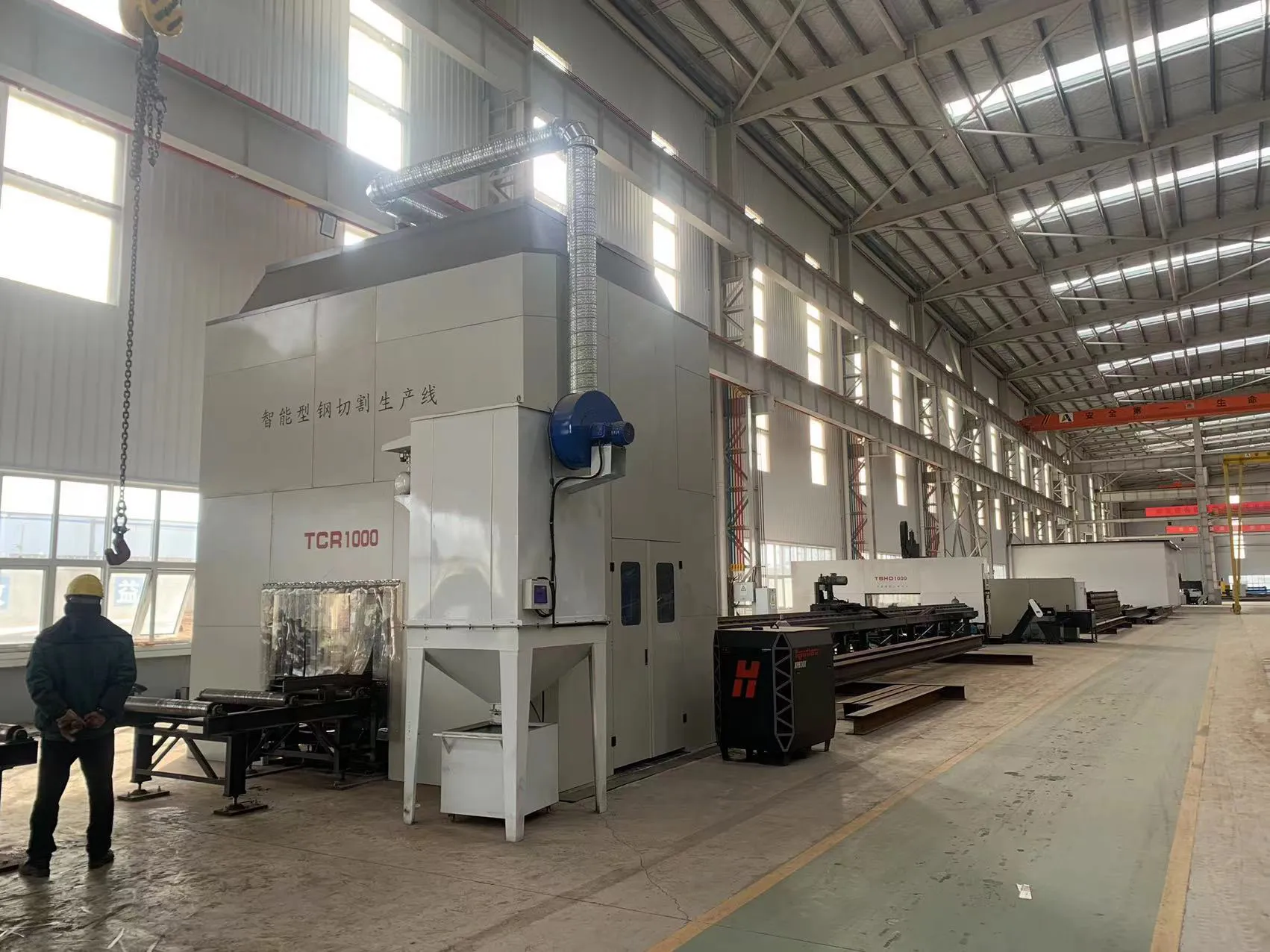
The Dawn of High-Power Structural Fabrication in Casablanca
Casablanca has long been the beating heart of Morocco’s industrial sector, serving as a gateway for trade between Africa and Europe. As the demand for sophisticated logistics hubs and massive cold-storage warehouses grows across the Maghreb region, the pressure on local manufacturers to produce high-quality storage racking has intensified. The transition from traditional plasma cutting and mechanical punching to 12kW fiber laser technology represents a leap in manufacturing maturity.
For a fiber laser expert, the 12kW threshold is significant. It is the point where the laser transcends thin-sheet applications and enters the realm of heavy structural engineering. In the context of I-beams, H-beams, and heavy channels used in racking, 12kW provides the photon density required to “vaporize” through thick steel flanges in seconds, rather than minutes. In Casablanca’s competitive market, this speed is the difference between winning a regional infrastructure contract and falling behind.
Understanding the 12kW Fiber Laser Advantage
The core of this machine is its 12kW fiber laser source. Unlike CO2 lasers of the past, fiber lasers utilize an optical fiber doped with rare-earth elements to amplify light. At 12,000 watts, the beam quality remains incredibly tight, focusing immense energy into a microscopic spot.
For the storage racking industry, which primarily utilizes structural carbon steel, the 12kW output allows for “high-speed nitrogen cutting” on medium thicknesses and “oxygen-assisted cutting” on heavy-duty sections. This power ensures that the edges of the I-beam are clean, square, and free of dross. In racking, where beams must be bolted together with perfect alignment, the absence of slag and the precision of the laser-cut holes mean that assembly teams in the field can work faster without the need for manual reaming or grinding.
The Infinite Rotation 3D Head: Engineering Freedom
The most technologically advanced component of this profiler is the Infinite Rotation 3D Head. Traditional 2D lasers move on X and Y axes, but structural I-beams are three-dimensional objects with varying thicknesses between the web and the flanges.
The “Infinite Rotation” capability refers to the head’s ability to rotate around the C-axis without the limitations of tangled internal cabling or “unwinding” cycles. This is crucial for:
1. **Bevel Cutting:** Creating V, U, X, and K-shaped bevels for weld preparations. For heavy-duty racking that supports thousands of tons, the integrity of the weld is paramount. The 3D head can cut these angles directly into the I-beam in a single pass.
2. **Complex Intersections:** Cutting holes that wrap around the radius of a beam or creating interlocking joints where one beam nests into another.
3. **Efficiency:** Because the head never needs to “reset” its rotation, the “arc-on” time is maximized, leading to a 20-30% increase in productivity compared to standard 3D heads.
Optimizing Storage Racking Production
Storage racking systems—specifically pallet racking, cantilever systems, and mezzanine structures—rely on the structural integrity of I-beams. In Casablanca’s booming logistics sector, these racks are becoming taller and more complex.
**Precision Hole Patterning:** Racking systems require hundreds of bolt holes. Traditional punching can deform the surrounding metal, creating stress points. The 12kW laser cuts these holes with a tolerance of +/- 0.1mm, ensuring that even in a 20-meter-high rack, every bolt aligns perfectly from the baseplate to the top beam.
**Material Versatility:** While I-beams are the primary focus, these heavy-duty profilers can easily switch to square tubing, C-channels, or angle iron. This versatility allows a single facility in Casablanca to produce every component of a warehouse racking system on one machine, reducing the need for multiple specialized workstations.
**Massive Weight Capacity:** A “Heavy-Duty” profiler is built with a reinforced bed and sophisticated chuck systems (often four chucks) to handle the immense weight of structural steel. These machines can often support beams weighing up to 1 ton per linear meter, ensuring that even the largest industrial profiles are handled with stability and safety.
Economic Impact on the Moroccan Market
Casablanca is strategically positioned to be a manufacturing hub for the “Plan d’Accélération Industrielle” (Industrial Acceleration Plan). By investing in 12kW laser technology, local firms can move from being importers of racking components to being exporters.
The reduction in labor costs is the first immediate benefit. A single 12kW laser profiler can often replace three separate machines: a band saw, a drill press, and a manual oxy-fuel torch. Furthermore, the nesting software associated with these lasers optimizes the layout of cuts on a single I-beam, significantly reducing material waste—a critical factor given the global fluctuations in steel prices.
Moreover, the “Made in Morocco” label gains prestige when the components are manufactured to the same tolerances as those in Germany or Japan. The 12kW laser ensures that the structural components for a warehouse in the Tangier Med port or a distribution center in Nouaceur are world-class.
Technical Challenges and Solutions in the Casablanca Climate
Operating a 12kW laser in a coastal city like Casablanca requires specific engineering considerations. The humidity and salt air can be corrosive to sensitive optical components.
**Environmental Sealing:** Expert-level profilers for this region are equipped with pressurized, air-conditioned cabinets for the laser source and the electrical components. This prevents the “salty” air from causing micro-corrosion on the circuit boards or fogging the laser optics.
**Chiller Efficiency:** A 12kW laser generates significant heat. The cooling systems (chillers) must be robust enough to handle Casablanca’s summer temperatures. Advanced machines use dual-circuit cooling—one for the laser source and one for the 3D cutting head—to maintain thermal stability and prevent beam “drift.”
The Shift Toward Industry 4.0
The 12kW I-Beam Profiler is not just a cutting tool; it is an IoT-enabled device. For the storage racking manufacturer, this means integration with BIM (Building Information Modeling) and ERP systems. A design created in Casablanca can be sent directly to the machine, which then automatically calculates the optimal cutting path, monitors gas consumption, and predicts when the protective window needs changing.
This level of data integration is vital for the traceability required in structural engineering. If a racking system is installed in a high-seismic zone (as parts of Northern Morocco are), the manufacturer can provide a digital “birth certificate” for every beam, proving that the cuts were made to exact specifications without thermal degradation of the steel’s properties.
Future Outlook: A Hub for Structural Excellence
The integration of 12kW power with infinite 3D rotation is more than an incremental upgrade; it is a paradigm shift. For Casablanca’s industrial sector, it means the ability to tackle massive infrastructure projects, from complex stadium roof trusses to the high-density storage systems that power modern e-commerce.
As a fiber laser expert, I see this technology as the “great equalizer.” It allows Moroccan manufacturers to compete on a global scale, offering precision that was previously only available in the most advanced European factories. The 12kW Heavy-Duty I-Beam Laser Profiler is the engine that will drive the next decade of Morocco’s structural steel evolution, turning Casablanca into a center of excellence for automated, high-precision fabrication.
In conclusion, the synergy of high-wattage fiber laser sources and multi-axis motion control is redefining what is possible in storage racking. By eliminating the friction between design and finished product, Casablanca is positioning itself at the forefront of the African industrial revolution, one perfectly cut I-beam at a time.