The Dawn of High-Power Fiber Lasers in Dammam’s Industrial Hub
Dammam has long been the heartbeat of Saudi Arabia’s heavy industry, serving as the primary logistics and manufacturing node for the energy sector. As the Kingdom accelerates its investment in renewable energy and grid expansion, the demand for structural steel—specifically I-beams, H-beams, and channels—has skyrocketed. However, the traditional methods of processing these massive components have historically been the bottleneck of the supply chain.
The arrival of the 12kW Heavy-Duty I-Beam Laser Profiler changes the calculus of fabrication. Unlike 2D laser systems designed for flat sheets, these heavy-duty profilers are engineered to handle the three-dimensional complexities of structural sections. The 12kW power source is the “sweet spot” for this application; it provides enough energy density to pierce through thick-walled structural steel (up to 25mm-35mm depending on the alloy) with a speed and edge quality that plasma simply cannot match. In the context of Dammam’s harsh industrial environment, these machines are built with reinforced gantries and specialized cooling systems to ensure 24/7 operational stability.
Mastering the Geometry: ±45° Bevel Cutting for Weld Preparation
In power tower fabrication, the structural integrity of every joint is non-negotiable. These towers must withstand extreme wind loads, thermal expansion, and the immense weight of high-voltage lines. This is where the ±45° bevel cutting capability becomes the most critical feature of the 12kW profiler.
Traditional I-beam processing requires a multi-step approach: the beam is sawed to length, holes are drilled for bolting, and then a manual operator uses a torch or a milling machine to create a bevel (or chamfer) for welding. The 12kW laser profiler collapses these steps into a single automated process. Utilizing a sophisticated 5-axis cutting head, the laser can tilt up to 45 degrees in any direction. This allows for the creation of precise V, Y, X, and K-shaped bevels directly during the cutting cycle.
Because the laser creates a “knife-edge” precision bevel, the subsequent welding process becomes significantly more efficient. Welders are presented with perfectly uniform grooves, which reduces the amount of filler wire required and minimizes the risk of weld defects. For Dammam-based fabricators, this translates to a drastic reduction in post-processing labor and a massive increase in the structural reliability of the finished power towers.
The Power Tower Application: Precision in High-Volume Production
Power towers, or transmission pylons, are complex assemblies of lattice structures and heavy support beams. The fabrication of these towers requires thousands of individual components, each with unique hole patterns and end-cut geometries. A 12kW laser profiler is uniquely suited for this high-volume, high-precision environment.
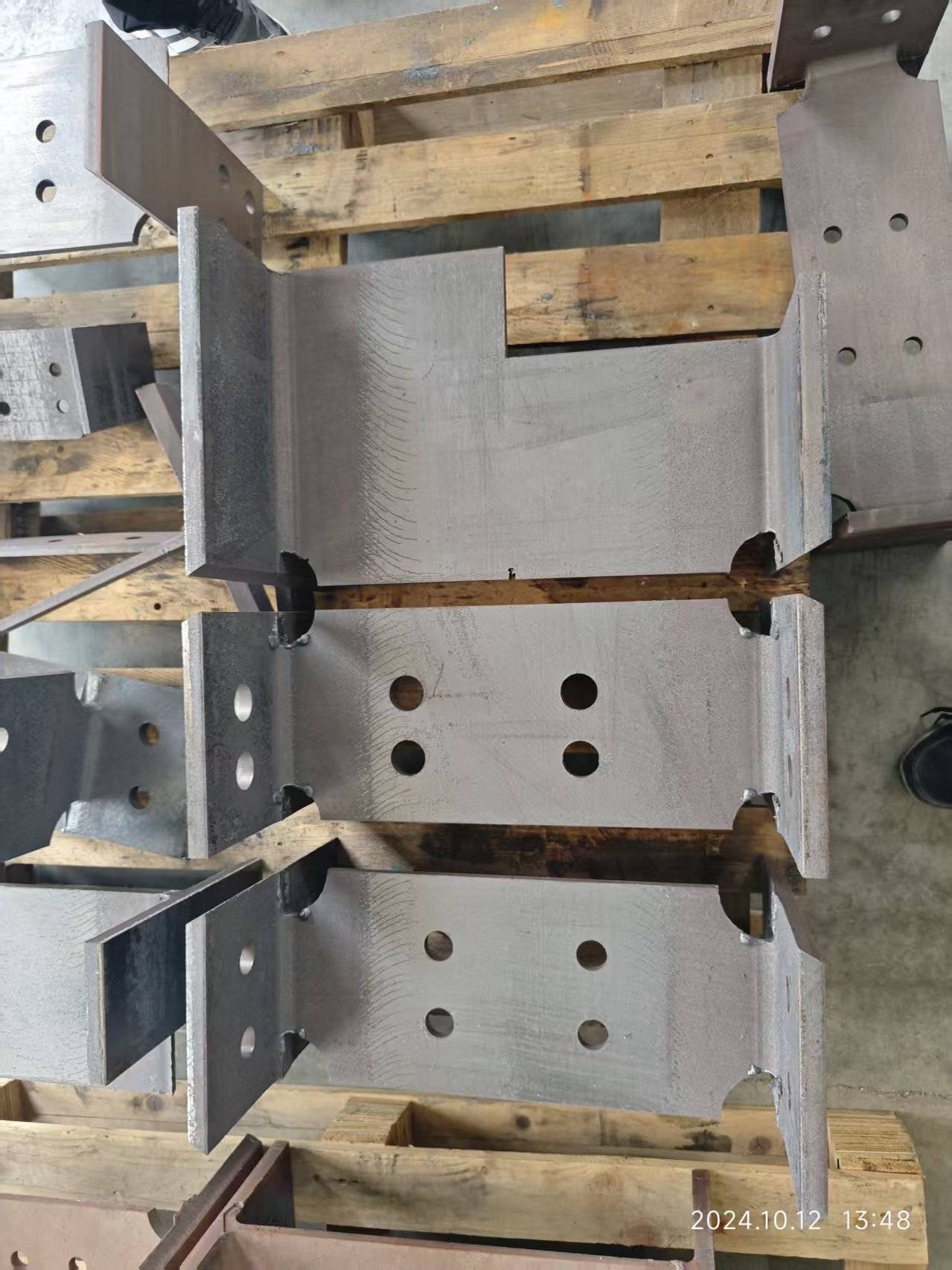
One of the standout advantages is the laser’s ability to cut “bolt-ready” holes. In structural steel, the tolerance for bolt holes is incredibly tight. Mechanical punching can distort the surrounding metal, and plasma cutting often leaves a hardened “nitride” layer that makes the hole brittle. The fiber laser, however, produces a clean, heat-affected zone (HAZ) so minimal that the holes are ready for immediate assembly without reaming.
Furthermore, the software integration of these machines allows for the direct import of TEKLA or CAD/CAM models used by structural engineers. This digital-to-physical workflow ensures that every I-beam destined for a power tower in the Saudi desert is cut to a tolerance of ±0.1mm. When you are assembling a 60-meter tower in the field, this level of precision prevents the “stack-up error” that often plagues manually fabricated structures.
Technological Synergy: The 12kW Engine and Heavy-Duty Kinematics
The “Heavy-Duty” designation of this profiler is not merely marketing; it refers to the machine’s ability to handle massive workpieces. A typical I-beam used in power infrastructure can weigh several tons and span 12 meters or more. The 12kW profiler utilizes a synchronized multi-chuck system—often three or four pneumatic or hydraulic chucks—that move the beam through the cutting zone with zero slippage.
The 12kW fiber laser source itself is a marvel of efficiency. Fiber lasers convert electricity to light at a much higher rate than CO2 lasers, which is vital for managing operational costs in large-scale facilities. The high brightness of a 12kW beam allows for “high-speed nitrogen cutting” on thinner sections of the beam and “oxygen-assisted cutting” for the thickest flanges. This versatility ensures that whether the shop is processing light-duty lattice members or the primary heavy-duty base beams, the machine remains optimized for speed.
Environmental Considerations for the Dammam Region
Operating high-precision laser equipment in Dammam presents unique challenges, primarily related to ambient temperature and airborne particulates. The 12kW Heavy-Duty Profiler is designed with these factors in mind. The laser source and the electrical cabinets are typically housed in climate-controlled environments (IP54 or higher ratings) to prevent the internal electronics from overheating during the summer months where temperatures can exceed 50°C.
Moreover, the optics in a 5-axis head are sensitive. Advanced profilers used in the region feature double-sealed pathways and high-pressure air curtains to keep dust and metal vapor away from the protective windows. For a fabricator in Dammam, these “hidden” features are what ensure the 12kW laser delivers a consistent beam quality year-round, regardless of the humidity or dust levels outside the factory walls.
Economic Impact and ROI for Saudi Fabricators
The capital investment in a 12kW bevel-cutting laser is significant, but the Return on Investment (ROI) is compelling when analyzed through the lens of modern production. By consolidating sawing, drilling, and beveling into one machine, fabricators can typically reduce their floor space requirements by 40% and their labor costs by up to 60%.
In the competitive landscape of the Middle East, speed is a primary differentiator. A 12kW laser can process an I-beam in a fraction of the time it takes for a conventional line to do the same. This allows Dammam-based companies to bid more aggressively on large-scale infrastructure projects, knowing they can meet tight deadlines with lower overhead. Additionally, the reduction in scrap—thanks to advanced nesting software that optimizes how parts are cut from a single beam—directly impacts the bottom line by saving tons of raw steel annually.
The Future: Automation and Industry 4.0
The 12kW Heavy-Duty I-Beam Laser Profiler is more than just a cutting tool; it is a data-driven hub. Modern systems in Dammam are increasingly being connected to cloud-based monitoring platforms. These platforms track gas consumption, cutting hours, and maintenance cycles in real-time.
As Saudi Arabia pushes toward a more digitized industrial sector, these lasers are becoming the centerpieces of “Smart Factories.” With the ability to track every beam via etched QR codes (also performed by the laser), fabricators can provide full traceability for every component of a power tower. This level of accountability is becoming a standard requirement for government-backed energy projects, ensuring that the infrastructure supporting the Kingdom’s future is built to the highest possible standards.
In conclusion, the 12kW Heavy-Duty I-Beam Laser Profiler with ±45° Bevel Cutting is not just an upgrade in power; it is a fundamental shift in how structural steel is conceived and executed in Dammam. For power tower fabrication, it represents the pinnacle of efficiency, precision, and structural integrity, positioning the Eastern Province as a global leader in advanced steel manufacturing.