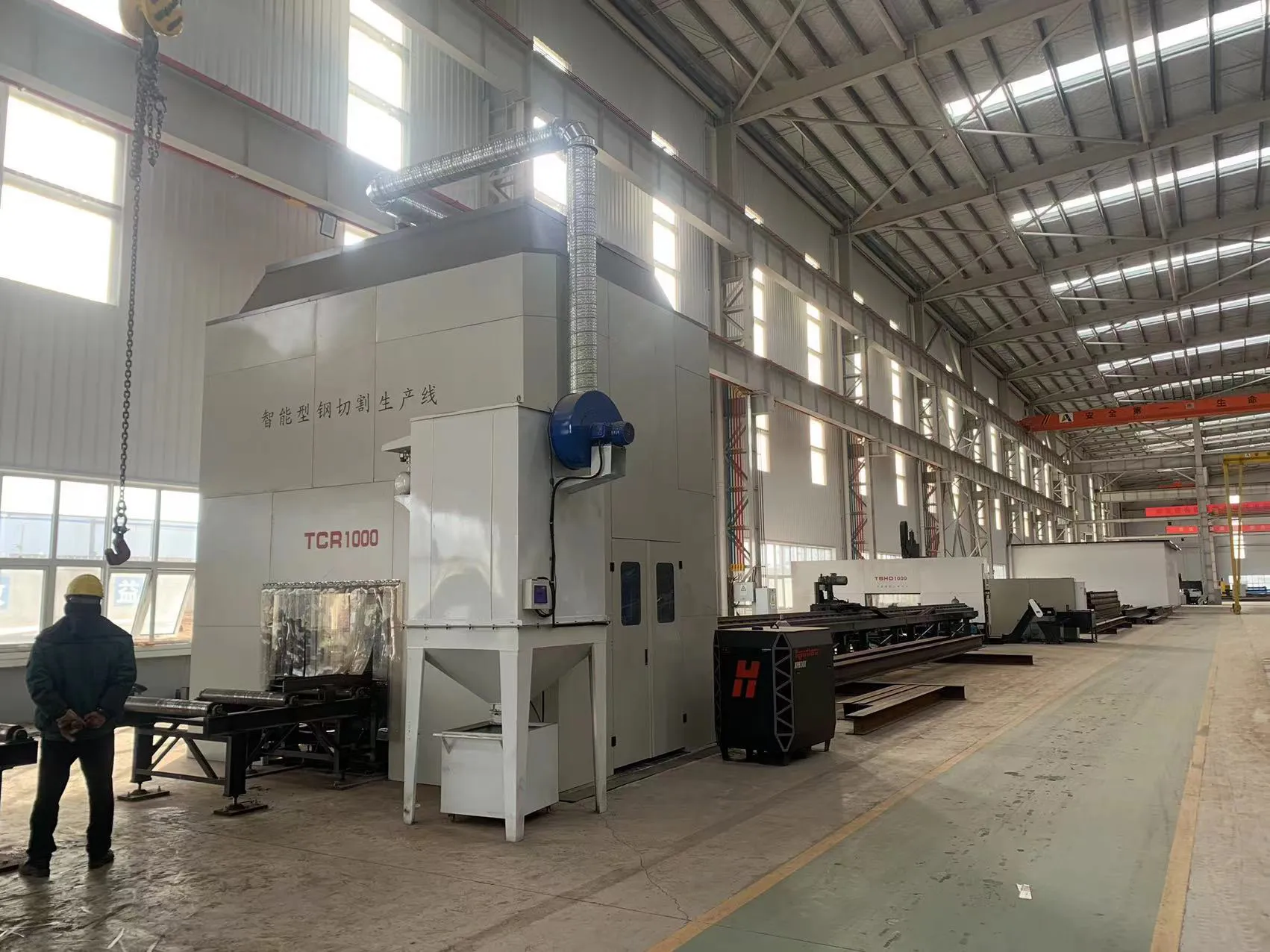
Field Technical Report: Implementation of 12kW Infinite Rotation 3D Fiber Laser Systems in Structural Steel Fabrication
1. Introduction and Regional Context
This report evaluates the operational integration of a 12kW CNC Beam and Channel Laser Cutter equipped with Infinite Rotation 3D Head technology within the heavy industrial corridor of Queretaro, Mexico. While Queretaro is traditionally recognized for aerospace and automotive precision, its emerging role as a fabrication hub for modular shipbuilding components necessitates a transition from traditional plasma/oxy-fuel methods to high-brightness fiber laser technology. The objective of this deployment was to address the geometric complexities and tolerances required for Grade DH36 and EH36 structural steels used in maritime assembly.
2. 12kW Fiber Laser Source: Power Density and Kerf Dynamics
The core of the system is a 12kW ytterbium fiber laser source. At this power level, the energy density at the focal point allows for the sublimation of heavy-walled structural sections (up to 25mm flange thickness) with significantly reduced heat input compared to legacy thermal cutting processes.
In the shipbuilding sector, minimizing the Heat Affected Zone (HAZ) is critical to maintaining the metallurgical integrity of the steel. The 12kW source provides a high-velocity vapor capillary (keyhole), which allows for cutting speeds that outpace thermal conduction into the surrounding material. This results in a microscopic HAZ, preserving the mechanical properties of the H-beams and C-channels without requiring secondary edge grinding to meet Welding Procedure Specifications (WPS).
3. Infinite Rotation 3D Head Kinematics
The primary bottleneck in traditional 5-axis structural cutting has been the cable management of the cutting head, which typically limits C-axis rotation to ±360 degrees. This requires “unwinding” movements that increase cycle times and introduce potential inconsistencies in the cut path.
The Infinite Rotation 3D Head utilizes a proprietary slip-ring or advanced internal conduit system for cooling, assist gas, and electrical signals, allowing for continuous $N \times 360^\circ$ rotation.
- Beveling Precision: The head achieves complex weld preparations (V, Y, X, and K-cuts) in a single pass. For Queretaro-based fabricators supplying modular hull sections, this eliminates the need for manual bevelling, which is prone to human error.
- Angular Velocity and Compensation: The 3D head maintains a constant standoff distance via high-speed capacitive sensing, even when navigating the radius transitions of a C-channel or the web-to-flange junctions of an I-beam.
4. Application in Shipbuilding: Structural Geometry and Interlocking Joints
Shipbuilding requires the processing of massive volumes of bulb flats, channels, and heavy beams. The Queretaro facility’s transition to the 12kW CNC system has enabled the use of “tab-and-slot” or “interlocking” structural designs.
4.1. Web and Flange Processing
Traditional methods often treat the web and flange as separate operations. The 3D laser system, however, processes the entire profile in one continuous program. The ability of the 12kW beam to maintain a stable kerf width across varying thicknesses—such as the transition from a 12mm web to a 20mm flange—is managed through real-time adjustment of focal position and gas pressure (Nitrogen for thin sections, Oxygen for thick-walled carbon steel).
4.2. Precision Notching for Fluid Drainage and Cabling
In maritime structures, longitudinal stiffeners must pass through bulkheads via “rat holes” or drainage notches. These geometries are complex and must be burr-free to prevent stress concentrations. The infinite rotation head allows the laser to maintain a perpendicular or specific angular orientation to the material surface at all times, ensuring the notch geometry is mathematically perfect relative to the ship’s curvature.
5. Automation and Workflow Integration
The Queretaro installation utilizes an automated material handling system integrated with the CNC laser. For heavy beams (up to 12 meters), the system uses a 4-chuck or multi-point clamping mechanism to mitigate material sag and vibration.
5.1. Nesting and Material Utilization
Advanced structural nesting software calculates the optimal placement of cuts across various beam lengths. By utilizing the 12kW laser’s narrow kerf (typically <0.5mm), the system achieves material utilization rates exceeding 95%. In the context of high-grade marine steel, this reduction in scrap significantly impacts the total cost of ownership (TCO).
5.2. Digital Twin and CAD/CAM Synchronization
The CNC system interprets TEKLA or ShipConstructor files directly. This end-to-end digital workflow ensures that every bolt hole, bevel, and marking on the beam in Queretaro matches the global digital twin of the vessel under construction. The 12kW system also includes a laser marking function, etching assembly coordinates and part numbers directly onto the steel, facilitating rapid assembly at the shipyard.
6. Thermal Management and Gas Dynamics in Heavy Sections
Processing heavy channels (UPN/IPN profiles) introduces challenges in gas dynamics. At 12kW, the assist gas must efficiently evacuate molten slag from deep within the cut.
- Nozzle Technology: High-speed, anti-collision nozzles are employed. The nozzle design minimizes turbulence, ensuring that the Oxygen jet remains laminar through the depth of the 25mm flange.
- Cooling Cycles: To prevent “self-burning” at sharp corners or complex 3D junctions, the CNC pulse-modulates the laser power. This intelligent thermal control is vital when processing the tight radii of structural channels.
7. Comparative Analysis: Laser vs. Plasma in Marine Fabrication
Data collected from the Queretaro field site indicates a clear shift in performance metrics:
- Dimensional Tolerance: Plasma typically maintains ±1.5mm on large sections; the 12kW laser achieves ±0.2mm. This precision is critical for automated robotic welding systems used further down the production line.
- Surface Finish: The laser-cut surface roughness ($Rz$) is significantly lower, removing the necessity for shot-blasting or edge cleaning prior to priming.
- Energy Efficiency: While the 12kW draw is high, the “wall-plug efficiency” of fiber sources (~35-40%) and the vastly increased cutting speed result in lower KWh per meter of cut compared to high-definition plasma.
8. Challenges and Engineering Solutions
The primary challenge identified in the Queretaro environment was the consistency of material quality. Structural steel with high scale or surface oxidation can affect laser absorption.
*Solution:* The implementation of a “Pre-pierce and Clean” cycle within the CNC logic, where the laser performs a low-power pass to ablate surface contaminants before the high-power cutting pass. This ensured consistent pierces and eliminated nozzle fouling.
9. Conclusion
The integration of 12kW CNC Beam and Channel Laser cutters with Infinite Rotation 3D technology represents a paradigm shift for structural steel processing in Queretaro’s industrial sector. By solving the limitations of traditional mechanical and thermal cutting—specifically regarding beveling efficiency and precision—this technology provides the shipbuilding industry with the capability to produce high-tolerance, “ready-to-weld” components. The synergy between high-wattage fiber sources and multi-axis kinematic freedom effectively removes the ceiling on structural design complexity, ensuring that Mexican fabrication facilities can meet the most stringent international maritime standards.













