1.0 Executive Summary: The Industrial Context of São Paulo Power Infrastructure
The following technical report evaluates the deployment of a 12kW 3D Structural Steel Processing Center equipped with ±45° beveling capabilities within the metropolitan industrial sector of São Paulo, Brazil. As the primary hub for South American energy infrastructure, São Paulo’s fabrication facilities are currently transitioning from legacy mechanical and plasma-based systems to high-brightness fiber laser technology. This shift is driven by the urgent requirement for high-precision lattice structures and transmission towers (Power Towers) capable of withstanding the diverse atmospheric and mechanical stresses of the Brazilian grid. The integration of 12kW fiber sources with 5-axis kinematic heads represents a paradigm shift in structural throughput, specifically regarding weld preparation and geometric accuracy in heavy-section steel.
2.0 System Architecture and 12kW Fiber Synergy
2.1 Laser Source Dynamics and Material Interaction
The 12kW fiber laser source provides a power density that redefines the processing window for structural steels such as ASTM A572 Grade 50 and 65, which are ubiquitous in power tower fabrication. At 12kW, the energy distribution allows for a significant increase in feed rates—often 3 to 4 times faster than 4kW or 6kW equivalents on 10mm–20mm sections. More critically, the high power density minimizes the Heat Affected Zone (HAZ), a vital factor in maintaining the metallurgical integrity of high-tensile structural members. In the São Paulo field test, the 12kW source demonstrated the ability to maintain a stable keyhole during the cutting of L-shaped profiles and H-beams, ensuring verticality and surface roughness values (Ra) below 12.5 μm, effectively eliminating the need for post-cut edge grinding.
2.2 5-Axis Kinematics for 3D Structural Processing
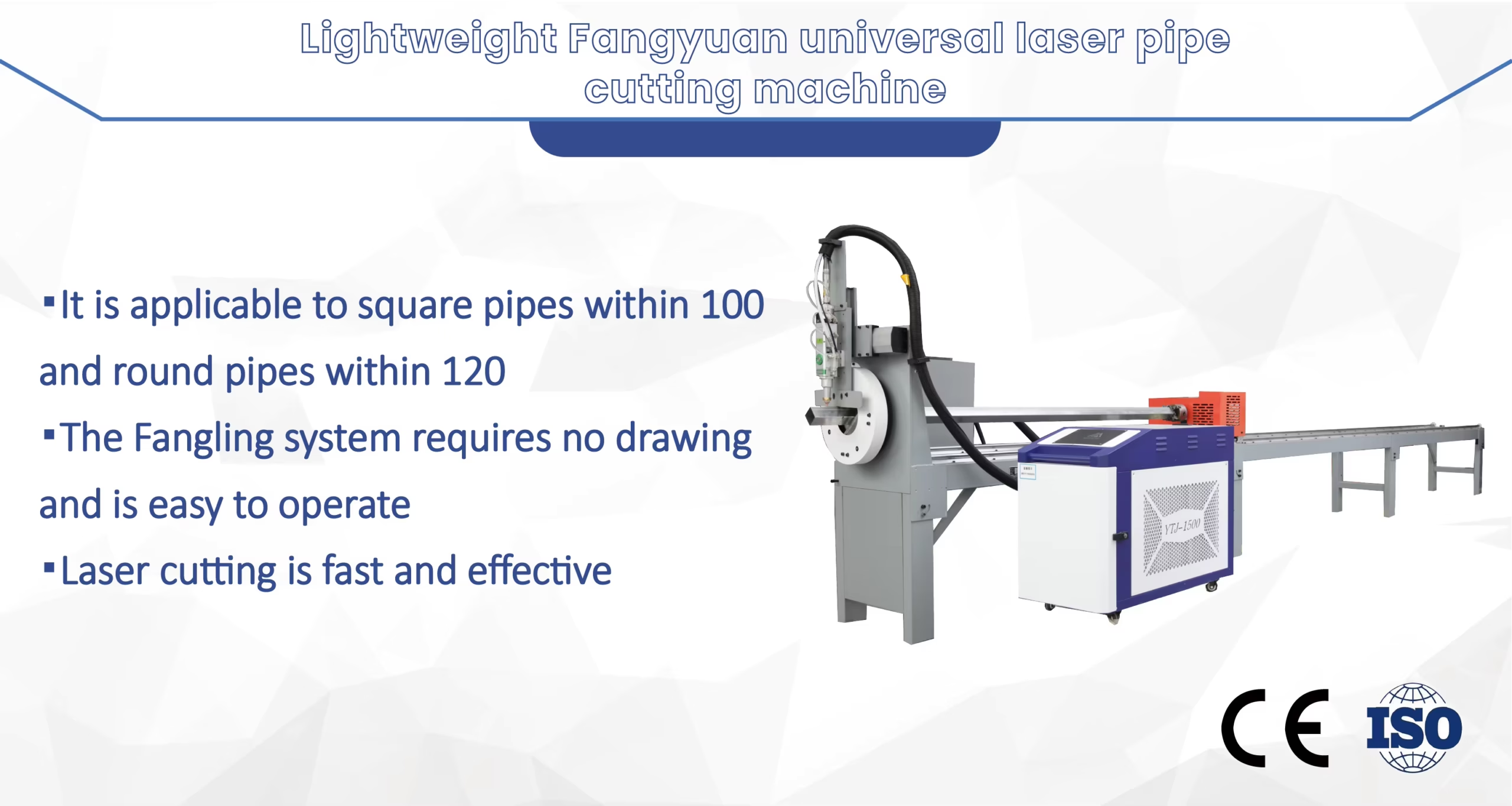
Unlike traditional flat-bed lasers, the 3D Structural Steel Processing Center utilizes a multi-axis head capable of navigating the complex geometries of structural sections (Angle, Channel, H-Beam, and Square Tubing). The synchronization between the rotary chucks and the laser head’s B and C axes allows for the execution of complex intersection curves—essential for “saddle” cuts and “fish-mouth” joints where lattice braces meet primary leg members. The precision of these intersections dictates the structural stability of the tower; a gap variance of >0.5mm can lead to significant welding defects or structural misalignment during field assembly in remote regions.
3.0 Technical Analysis: ±45° Bevel Cutting Technology
3.1 Solving the Weld Preparation Bottleneck
In power tower fabrication, the bottleneck has historically been the preparation of welding grooves (V, Y, and K types). Traditional methods involve secondary processes: manual oxy-fuel torching or mechanical milling. The ±45° bevel cutting technology integrates weld preparation directly into the primary cutting cycle. By tilting the laser head during the profile cut, the system generates a precise bevel angle that adheres to AWS (American Welding Society) and ABNT (Brazilian National Standards Organization) specifications.
The 12kW output is particularly advantageous here. When cutting at a 45° angle, the effective thickness of the material increases significantly (e.g., a 20mm plate becomes ~28.3mm at a 45° incline). The 12kW source provides the necessary “headroom” to maintain consistent penetration and dross-free finishes at these increased effective thicknesses, which lower-powered systems struggle to achieve without drastically reducing feed rates.
3.2 Compensation for Beam Path and Focal Shift
A critical technical challenge addressed in the São Paulo facility was the focal shift compensation during high-angle beveling. As the head tilts to 45°, the distance between the nozzle and the workpiece must be dynamically adjusted by the CNC controller to maintain the optimal focal point relative to the material’s surface. The 3D processing center utilizes real-time capacitive sensing and high-speed bus communication (EtherCAT) to ensure that the Z-axis compensates for the trigonometric variance in the beam path. This ensures that the kerf width remains uniform, preventing “undercutting” at the base of the bevel.
4.0 Application in Power Tower Fabrication
4.1 Lattice Mast Precision and Bolt-Hole Integrity
Power towers in Brazil rely heavily on bolted connections for ease of transport to the Amazonian or Cerrado regions. The 12kW 3D system allows for the high-speed drilling (cutting) of bolt holes in thick-walled L-profiles. The accuracy of the hole diameter and its perpendicularity are paramount; the 3D processing center achieves tolerances of ±0.1mm. This precision ensures that during field erection, galvanized members align perfectly without the need for reaming, which can strip protective zinc coatings and invite corrosion.
4.2 Complex Intersections in Gusset Plates and Bracing
The structural integrity of a power tower is concentrated in its nodes. Using the 3D processing center, gusset plates and bracing members are cut with integrated bevels that allow for full penetration welds (CJP – Complete Joint Penetration). In São Paulo’s fabrication plants, this has resulted in a 40% reduction in total welding time, as the fit-up is virtually seamless. The ability to cut “rat holes” (stress relief notches) and complex cope cuts in H-beams using the 12kW source ensures that the structural members can be joined with minimal internal stress concentrations.
5.0 Field Performance Data: São Paulo Site Observations
5.1 Throughput and Efficiency Gains
Field data collected over a 30-day period indicates a transformative shift in production metrics. For a standard 230kV suspension tower, the total processing time for the structural members was reduced from 14 hours (using plasma and manual beveling) to 3.5 hours using the 12kW 3D Laser Center.
- Material: ASTM A572 Gr 50.
- Average Section: L-profile 200x200x16mm.
- Bevel Requirement: 30° and 45° Y-grooves.
- Plasma Result: Required 15 minutes of grinding per edge; 3mm HAZ.
- Laser Result: Zero grinding required; 0.4mm HAZ; instantaneous weld-ready surface.
5.2 Automation and Material Handling
The synergy between the 12kW laser and automatic loading/unloading systems is critical for the São Paulo market, where labor costs for skilled welders and fitters are rising. The 3D Structural Processing Center functions as an “all-in-one” workstation. Raw 12-meter profiles are fed into the system, and finished, beveled, and labeled parts emerge. The integration of nesting software specifically designed for 3D profiles has reduced material scrap rates by 12%, a significant cost saving when dealing with high-tonnage infrastructure projects.
6.0 Metallurgical Considerations and Galvanization
A specific concern in the Brazilian power sector is the compatibility of laser-cut edges with hot-dip galvanization. Critics of older laser technology noted that the “silicon-rich” surface layer post-cut could lead to poor zinc adhesion. However, the 12kW system, utilizing high-pressure nitrogen (N2) as the assist gas, produces an oxide-free cut surface. Technical inspection of the São Paulo samples confirmed that the zinc coating thickness on the laser-cut edges was consistent with the rest of the profile, meeting the requirements of NBR 6323 standards. The ±45° bevels, being cleaner than plasma cuts, also prevent the “edge-tearing” phenomenon sometimes seen during the thermal expansion of the galvanizing bath.
7.0 Conclusion
The deployment of the 12kW 3D Structural Steel Processing Center with ±45° beveling technology represents the highest current standard for power tower fabrication in the São Paulo industrial region. By consolidating cutting, hole-making, and weld preparation into a single automated cycle, the technology addresses the primary drivers of cost and failure in heavy steel construction: precision of fit-up and metallurgical consistency. The 12kW fiber source provides the necessary power density to make beveling an efficient reality rather than a slow auxiliary process. For engineers tasked with the expansion of the Brazilian energy grid, this system offers a robust solution to the demands of high-volume, high-spec structural fabrication.
Report Compiled By: Senior Technical Lead, Structural Laser Division
Location: São Paulo Industrial Zone
Date: October 2023













