The Dawn of High-Power Laser Processing in Riyadh’s Industrial Landscape
Riyadh is currently the epicenter of a global construction boom. From the sprawling developments of the King Salman Park to the logistical hubs supporting NEOM and the Red Sea Project, the demand for structural steel is at an all-time high. However, the traditional methods of fabrication—mechanical punching, plasma cutting, and manual layout—are no longer sufficient to meet the aggressive deadlines and stringent quality standards of modern modular construction.
The introduction of the 12kW 3D Fiber Laser Structural Steel Processing Center represents a leap in technology. At 12,000 watts, the laser source provides the energy density required to vaporize thick-walled structural members instantly. This power level is the “sweet spot” for structural engineering; it is powerful enough to maintain high feed rates on 20mm-30mm steel plates and flanges while remaining energy-efficient compared to older CO2 or plasma technologies. In the context of Riyadh’s industrial zones, where efficiency and heat management are paramount, the fiber laser’s localized heat zone minimizes material distortion, a critical factor for modular frames that must be perfectly square.
The 3D Advantage: Mastering Complex Geometry and Beveling
Structural steel is rarely about straight lines. Modular construction relies on complex joinery, interlocking notches, and precision bolt holes. Traditional 2D lasers are confined to flat planes, but a 3D processing center utilizes a sophisticated five-axis (or six-axis) cutting head. This allows the laser to rotate and tilt, performing “V,” “X,” “K,” and “Y” bevel cuts directly on the edges of beams and tubes.
For a fabricator in Riyadh, this means that a heavy H-beam can be loaded into the machine, and within minutes, it emerges with all bolt holes drilled, coping cuts finished, and weld prep bevels completed. The 3D capability allows for the creation of “bird-mouth” joints and complex saddle cuts for tubular trusses, which are increasingly popular in the aesthetic modular designs of Riyadh’s new commercial districts. This eliminates the need for secondary grinding or manual beveling, which are labor-intensive and prone to human error.
Power and Precision: The 12kW Fiber Resonator
The heart of this system is the 12kW fiber resonator. As an expert in the field, it is important to highlight why 12kW is a game-changer over the previously standard 6kW or 8kW systems. In structural steel, flange thickness is the primary challenge. A 12kW source allows for high-speed “flying piercing,” where the laser penetrates the material in a fraction of a second without leaving the large, messy entry holes associated with lower-power units.
Furthermore, the beam quality (M2 factor) of a 12kW fiber laser is optimized for thick-section cutting. It creates a narrow kerf (cut width), which reduces the amount of molten dross at the bottom of the cut. In the dry, often dusty environment of a Riyadh workshop, the stability of a 12kW fiber delivery system—protected by nitrogen or oxygen assist gases—ensures that the machine can run for 24 hours a day with minimal maintenance, a necessity for meeting the “just-in-time” delivery requirements of modular construction sites.
Automatic Unloading: Solving the Logistical Bottleneck
A machine that cuts at 12kW is only as fast as its ability to be loaded and unloaded. In many facilities, the laser finishes a beam in three minutes, but the operators take ten minutes to rig chains and move the finished part with a crane. This is where the Automatic Unloading system becomes indispensable.
In a dedicated structural steel center, the automatic unloading system uses a series of heavy-duty conveyors and hydraulic lifters. Once the 3D head finishes the final cut, the system automatically detects the part length and triggers a lateral discharge mechanism. The finished beam is moved to a collection rack while the next raw member is simultaneously fed into the cutting zone.
In Riyadh’s climate, reducing manual handling is also a safety and ergonomics priority. By automating the movement of 500kg+ steel beams, the risk of workplace injuries is significantly lowered. Moreover, the synchronization between the laser’s software and the unloading hardware ensures that parts are sorted by project ID or assembly sequence, which is vital for modular builders who need to receive “Kit A” and “Kit B” in a specific order for site assembly.
Enabling Modular Construction and Vision 2030
Modular construction is the “Lego-ization” of the building world. Units are built in a controlled factory environment and then transported to the site for final assembly. For this to work, the tolerances must be incredibly tight—often within +/- 0.5mm over a 12-meter beam. Traditional fabrication cannot consistently achieve this.
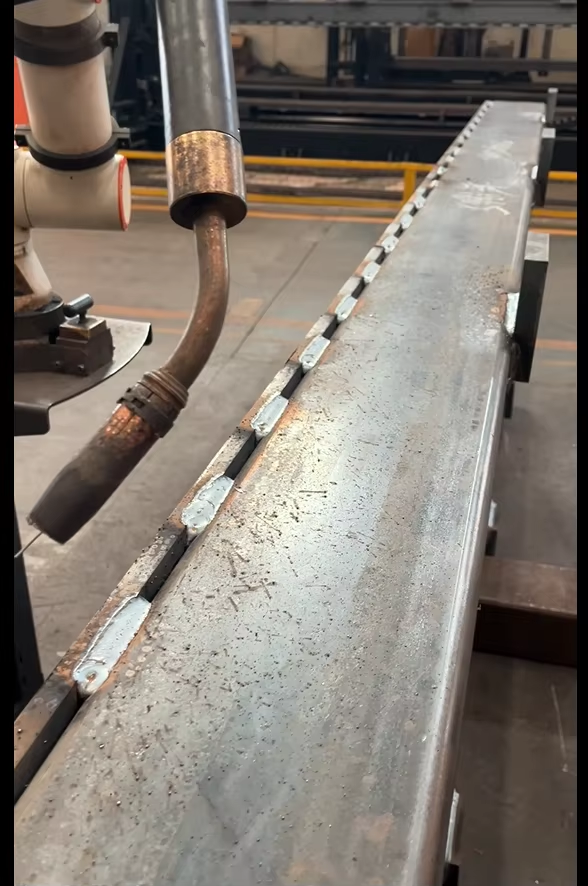
The 12kW 3D laser ensures that every bolt hole aligns perfectly across hundreds of modules. When these modules are stacked in a high-rise development in Riyadh’s Financial District, there is no need for on-site “burning and turning” (field corrections). The 3D laser’s ability to cut precise interlocking features allows for “tab-and-slot” assembly, where the steel members literally snap into place, holding themselves square while they are tacked and welded. This level of precision is the cornerstone of the Saudi government’s push for high-tech manufacturing and rapid housing deployment.
Overcoming Regional Challenges: Heat, Dust, and Power
Operating a high-power laser in Riyadh presents unique environmental challenges. The ambient temperature can exceed 50°C in the summer, which is detrimental to laser resonators and sensitive optics. A world-class 12kW system designed for this region must include:
1. **High-Capacity Dual-Circuit Chillers:** These systems must be oversized to maintain the laser source and the cutting head at a constant 20-25°C, even when the factory floor is much hotter.
2. **Positive Pressure Enclosures:** To prevent the fine desert sand and industrial dust from contaminating the optics, the entire machine cabinet and the optical path must be kept under positive pressure with filtered air.
3. **Voltage Stabilization:** With the massive industrial growth in Riyadh, power grid fluctuations can occur. A 12kW laser requires a stable power supply to prevent “clipping” the beam, necessitating integrated voltage regulators and UPS systems for the control PC.
Software Integration: The Digital Twin of Fabrication
A 12kW 3D laser is a “dumb” tool without the right “brains.” Modern structural steel centers utilize Tekla or Revit integration. The structural engineer’s BIM (Building Information Modeling) file is exported directly to the laser’s nesting software. The software then calculates the most efficient way to cut the parts from standard 12-meter stock lengths to minimize waste.
For Riyadh’s modular factories, this creates a “Digital Twin” workflow. Before a single piece of steel is cut, the software simulates the 3D cutting path to ensure there are no collisions between the 5-axis head and the workholding chucks. This integration allows for real-time tracking of production—management can see exactly how many tons of steel were processed during a shift from a dashboard in their office, providing the data-driven oversight required for multi-billion dollar infrastructure projects.
Conclusion: The Future of Riyadh’s Skyline
The 12kW 3D Structural Steel Processing Center with Automatic Unloading is more than just a machine; it is a critical infrastructure asset for the future of Saudi Arabia. By combining the raw power of 12kW fiber technology with the surgical precision of 5-axis 3D motion and the efficiency of automated logistics, Riyadh-based fabricators can outcompete international firms in both speed and quality.
As modular construction becomes the standard for the Kingdom’s residential, commercial, and industrial sectors, the reliance on high-accuracy laser processing will only grow. The investment in such technology ensures that the buildings of Vision 2030 are not only built quickly but are built to a standard of structural integrity and architectural complexity that was previously unthinkable. For the fiber laser expert, the verdict is clear: the future of structural steel is light-based, automated, and three-dimensional.