The Strategic Shift to 12kW Fiber Laser Power in Hamburg
Hamburg has long been a focal point for European heavy industry, serving as a gateway for global trade and a center for high-end engineering. In the realm of crane manufacturing—where equipment must withstand immense dynamic loads and harsh North Sea environments—the transition from traditional plasma or mechanical processing to fiber laser technology is a strategic necessity.
The 12kW power rating is the “sweet spot” for structural steel. While lower power lasers struggle with the thickness of H-beams and heavy-walled tubes, 12,000 watts provides the thermal density required to melt through 20mm to 30mm steel with unprecedented speed. For a crane manufacturer, this means the ability to process S355 and S690 high-strength steels without the significant heat-affected zones (HAZ) associated with plasma cutting. By minimizing the HAZ, the structural integrity of the steel is preserved, which is paramount when fabricating the main chords of a crane’s boom or the heavy plate reinforcements of a mobile crane chassis.
Unlocking Geometric Freedom: The Power of 3D Processing
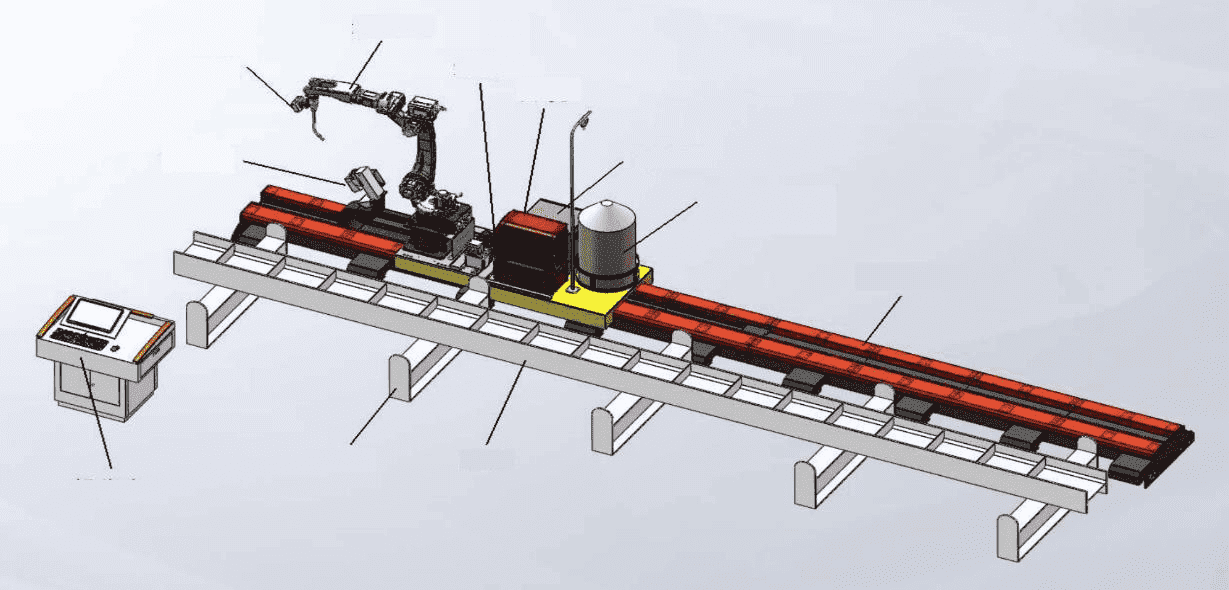
Traditional structural steel processing often involves a disjointed workflow: sawing to length, drilling holes on a separate station, and manual oxy-fuel cutting for complex notches or bevels. The 12kW 3D Structural Steel Processing Center consolidates these operations into a single, continuous process.
The “3D” aspect refers to the machine’s ability to manipulate either the laser head or the workpiece across five or more axes. This allows for complex beveling, which is essential for weld preparation. In crane manufacturing, nearly every joint requires a specific V, Y, or K-shaped bevel to ensure deep weld penetration. The 3D laser head can execute these transitions with sub-millimeter accuracy in a single pass. Furthermore, the system can process “open” profiles like I-beams, H-beams, and C-channels, as well as “closed” profiles like square and rectangular hollow sections. This versatility ensures that every component of a crane—from the massive support outriggers to the intricate lattice bracing—is produced on the same platform.
The Logistics of Efficiency: Automatic Unloading Systems
One of the primary bottlenecks in heavy-duty laser cutting is material handling. A 12-meter I-beam is inherently difficult to maneuver manually or even with standard overhead cranes. The integration of an automatic unloading system in the Hamburg facility solves this logistical challenge.
As the 12kW laser completes the final cut, the automatic unloading system employs a series of synchronized conveyors and hydraulic lift arms to transition the finished part from the cutting zone to a dedicated sorting area. This system is not merely about moving weight; it is about intelligent sorting. The software tracks each component, ensuring that parts are grouped by project or subsequent assembly stage. For crane manufacturers, this means that the dozens of diagonal struts required for a boom section are delivered in the exact order needed for fit-up and welding. This reduction in “search and sort” time significantly compresses the overall manufacturing cycle.
Precision Engineering for High-Strength Steels
Cranes are increasingly built from high-tensile steels to reduce self-weight while maintaining lifting capacity. These materials are sensitive to heat. The 12kW fiber laser utilizes a high-brightness beam that concentrates energy into a very small spot size. This results in a narrow kerf (cut width) and extremely fast travel speeds.
In the Hamburg installation, the laser’s motion system is designed for high dynamic accuracy. Even when processing a heavy beam, the machine maintains precision in hole circularity and notch positioning. This is critical because crane components are often modular; sections must bolt together perfectly after being transported to a construction site or port. If a bolt hole in a 10-meter section is off by even two millimeters, the entire assembly process grinds to a halt. The fiber laser’s CNC-controlled precision eliminates these costly misalignments, ensuring a “Lego-like” fit every time.
Integration with Industry 4.0 and CAD/CAM Workflows
The 12kW Processing Center in Hamburg does not operate in a vacuum. It is the physical manifestation of a digital twin. Engineers design crane components in sophisticated 3D CAD environments. This data is fed directly into the laser’s CAM software, which optimizes the nesting of parts on the beam to minimize material waste—a crucial factor given the rising cost of high-grade steel.
The system also provides real-time feedback. Sensors within the 12kW cutting head monitor the health of the protective windows, the temperature of the optics, and the consistency of the gas pressure. In a high-output environment like Hamburg, predictive maintenance ensures that the machine avoids unplanned downtime. Furthermore, the automatic unloading system logs each part’s completion, providing management with accurate data on throughput and efficiency, which is essential for quoting large-scale infrastructure projects.
Safety and Environmental Considerations in an Urban Industrial Hub
Operating a 12kW laser requires stringent safety protocols, especially in a dense industrial region like Hamburg. The processing center is fully enclosed, preventing any stray laser radiation from escaping the work zone. High-capacity dust extraction and filtration systems are integrated into the machine to capture the fine metallic particulates generated during the vaporization of steel.
From an environmental perspective, the fiber laser is significantly more efficient than CO2 lasers or plasma systems. It converts electricity into light with high wall-plug efficiency, and because it cuts so much faster, the energy consumed per meter of cut is remarkably low. For Hamburg-based manufacturers looking to meet strict European carbon footprint regulations, the 12kW fiber laser represents a “green” transition in heavy manufacturing.
Transforming the Workforce: From Manual Labor to Systems Management
The introduction of such an advanced system changes the labor dynamic within the factory. The role of the worker shifts from heavy lifting and manual grinding to systems operation and quality oversight. The automatic unloading system reduces the physical strain on employees and significantly lowers the risk of workplace injuries associated with handling heavy structural steel.
In the Hamburg facility, operators are trained in advanced CNC programming and laser optics maintenance. This upskilling of the local workforce ensures that the city remains competitive in an increasingly automated global market. The synergy between human expertise and machine precision is what allows the crane manufacturer to produce world-class lifting equipment that meets the rigorous standards of the DNV or Lloyd’s Register.
Conclusion: The Future of Structural Steel in Hamburg
The 12kW 3D Structural Steel Processing Center with automatic unloading is more than just a piece of machinery; it is a critical infrastructure investment for the future of crane manufacturing in Hamburg. By combining the raw power of a 12kW fiber source with the agility of 3D processing and the efficiency of automated logistics, manufacturers can produce lighter, stronger, and more complex cranes than ever before.
As the demands for larger wind turbines and deeper port facilities grow, the cranes required to build them must also evolve. This technology provides the foundation for that evolution, ensuring that the structural steel components leaving Hamburg are of the highest possible quality, produced with maximum efficiency, and ready to support the heavy loads of tomorrow’s global economy. The precision of the laser, the intelligence of the automation, and the strategic location in Hamburg create a powerhouse of industrial capability that sets a new benchmark for the structural steel industry.