Shop-Floor Economics of Automated Tube Laser Integration for Material Handling Frame Fabrication
Material handling frames — pallet racking uprights, AGV chassis rails, conveyor support trusses, and forklift attachment cages — share a common metallurgical profile: they are almost always built from structural tube in S355JR, SUS304, or occasionally Al6061-T6, with wall thicknesses between 2.0 mm and 8.0 mm and cut lengths from 400 mm to 6,200 mm. Historically these parts were processed on bandsaws, cold saws, and plasma tables, then moved to a drill press or a manual mill for hole patterns and notching. That routing works, but it bleeds labor. A single 6-meter S355JR 100×100×4 mm square tube with 14 bolt holes, two 45° miter cuts, and a coped end can consume 22–35 minutes of touch time across three stations. Multiply that by a weekly batch of 400 frames and the hidden cost becomes the dominant cost. This is precisely the gap that a cost efficient automated tube laser for material material handling frames closes, and the numbers below show how fast the amortization curve bends.
Baseline Process Physics: Why Legacy Cutting Bleeds Margin
Before evaluating any laser, quantify the incumbent process. Plasma cutting on 4 mm S355JR runs a kerf of roughly 1.8–2.5 mm with a heat-affected zone (HAZ) of 0.8–1.5 mm. That HAZ requires post-grinding before welding, and the taper on a 4 mm wall can reach 4–6° on the cut face. Mechanical sawing produces a clean face but zero geometry — every hole, slot, and cope is a secondary op. Both routes share a hard constraint: they cannot produce a 3D intersecting contour in a single setup.
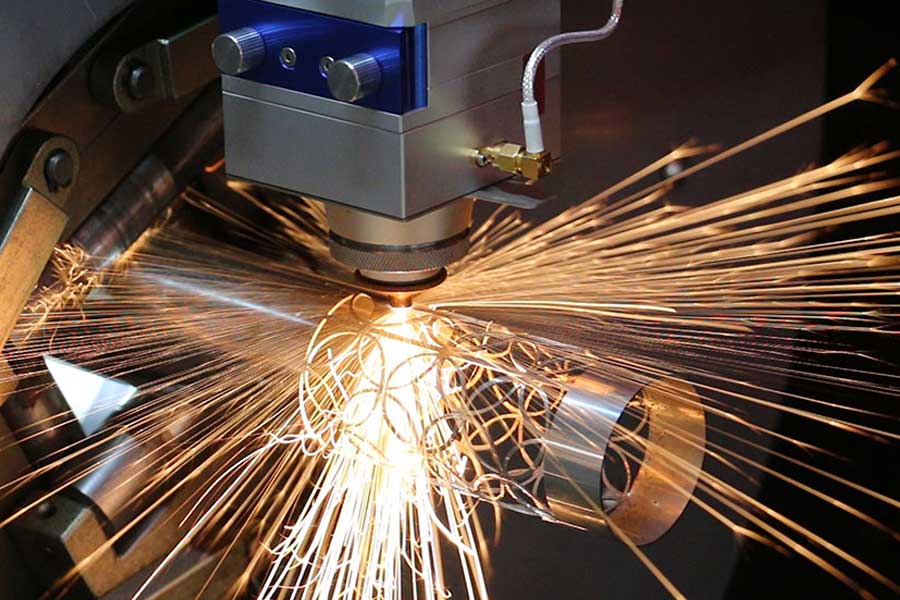
Tube laser cutting inverts this. A 3 kW or 4 kW fiber source with a 1.2–1.5 MPa nitrogen assist (for stainless and aluminum) or 0.8–1.2 MPa oxygen assist (for carbon steel) delivers a kerf of 0.15–0.30 mm, an HAZ under 0.1 mm, and full 3D contour capability — holes, slots, miters, copes, and weld-prep bevels — in one fixturing cycle. The physics is straightforward: 1070 nm wavelength, beam parameter product (BPP) of 0.6–1.1 mm·mrad, and a duty cycle that holds 85–95% on a 4 mm wall at 3.5–5.5 m/min feed.
Comparative Technical Data: Legacy vs. Automated Tube Laser
| Parameter | Plasma + Drill Press | Mechanical Saw + Mill | Automated Tube Laser (3–4 kW) |
|---|---|---|---|
| Kerf width (4 mm S355JR) | 1.8–2.5 mm | 2.0–3.0 mm (blade) | 0.15–0.30 mm |
| HAZ depth | 0.8–1.5 mm | Negligible (cold cut) | < 0.10 mm |
| Setup count per part | 3–4 | 3–5 | 1 |
| Touch time, 6 m tube w/ 14 holes + cope | 22–35 min | 28–40 min | 3.5–6 min |
| Assist gas consumption | Compressed air / O2, high volume | None (coolant only) | N2 @ 1.2–1.5 MPa, 18–28 L/min |
| Chuck / clamping pressure | Manual vise, 0.4–0.6 MPa | Manual vise, 0.4–0.6 MPa | Pneumatic chuck, 0.6–0.9 MPa |
| Dimensional repeatability | ±0.5–1.0 mm | ±0.3–0.5 mm | ±0.05–0.10 mm |
| Post-op grinding required | Yes (HAZ + dross) | Deburr only | Minimal / none |
| Labor content per part | High (3 operators) | High (2–3 operators) | Low (0.5 operator, load/unload) |
Gas Consumption Metrics: The Real Cost Driver
Nitrogen is the single largest consumable line item on a tube laser running SUS304 or Al6061. At a delivery pressure of 1.2–1.5 MPa and a nozzle standoff of 0.8–1.2 mm, a 2.0 mm nozzle on 4 mm SUS304 consumes 20–26 L/min at 3.0–4.0 m/min feed. On a 6-hour productive shift, that is roughly 7,200–9,360 liters — about 1.5–2.0 standard 40L cylinders, or 8–11 kWh-equivalent if generated on-site via PSA. For S355JR, switching to oxygen assist at 0.8–1.2 MPa drops consumption to 6–10 L/min and cuts gas cost by 60–70%, at the price of a slightly oxidized cut face that is acceptable for most welded frame joints.
Pneumatic chuck pressure matters more than most buyers realize. Running the chuck at 0.6 MPa instead of 0.9 MPa on thin-wall SUS304 (2.0 mm) reduces tube deformation at the clamping zone, but increases the risk of slip during high-speed rotary indexing. The practical sweet spot for material handling frame stock is 0.7–0.8 MPa with a rotary axis acceleration capped at 1.2 rad/s². Above that, thin-wall distortion shows up as ovality exceeding 0.3 mm, which then fails weld-fixture alignment.
Cost-Benefit Analysis and ROI Projection
Assume a mid-size fabricator running 400 material handling frames per week, average 3.2 m of tube per frame, mixed S355JR and SUS304. Legacy routing: 3 operators at $28/hr fully burdened, 28 minutes touch time per frame, plus 12% scrap/rework from HAZ grinding and hole misalignment. Annual labor: 400 × 52 × (28/60) × 3 × $28 ≈ $815,360. Scrap and rework add roughly $48,000.
Automated tube laser routing: 0.5 operator at $28/hr, 5 minutes touch time per frame, scrap under 2%. Annual labor: 400 × 52 × (5/60) × 0.5 × $28 ≈ $24,266. Scrap drops to $8,000. Gas, nozzle, and lens consumables run $22,000–$30,000 annually at 1.5 MPa N2 on stainless. Net annual saving: approximately $800,000 before machine cost.
A 4 kW automated tube laser with 6 m loading, 3D head, and automatic bundle loader lands in the $280,000–$420,000 range depending on chuck configuration and software. At a conservative $780,000 net annual saving, straight-line amortization hits breakeven in 5–7 months. Even at 40% utilization — a realistic first-year ramp — payback stays under 18 months. That is the amortization argument that survives a CFO review.
Amortization Structure and Residual Value
For capital planning, treat the tube laser as a 7-year MACRS asset. With a $350,000 installed cost, Section 179 or bonus depreciation can front-load 60–80% of the deduction in year one, effectively reducing the after-tax cost to $210,000–$245,000. Residual value at year 5 for a well-maintained 4 kW fiber tube laser with under 18,000 beam-on hours typically holds 45–55% of original cost, which further compresses the true amortization window. The machine is not a depreciating liability — it is a labor-arbitrage asset with a measurable internal rate of return above 40% in most material handling frame shops.
Integration Notes for Frame Fabrication Cells
- Match chuck jaw profile to the dominant tube section (square 100×100, rectangular 120×60, or round Ø76) to avoid jaw changeover eating cycle time.
- Set rotary axis acceleration below 1.2 rad/s² on 2.0 mm SUS304 to hold ovality under 0.3 mm.
- Use oxygen assist on S355JR weld-joint cuts to cut gas cost 60–70%; reserve nitrogen for SUS304 and Al6061.
- Program a 0.8 mm nozzle standoff and 1.2–1.5 MPa N2 for stainless; drop to 0.8–1.2 MPa O2 for carbon steel.
- Integrate a bundle loader to convert the laser from a 6-hour shift asset to a 14-hour lights-out asset.
What is the realistic payback period for an automated tube laser in a material handling frame shop?
For a shop running 400 frames per week with 3.2 m of tube per frame, net annual savings after labor, gas, and scrap typically reach $750,000–$820,000. Against a $280,000–$420,000 installed cost, breakeven lands in 5–7 months at full utilization and under 18 months at 40% first-year utilization.
Which assist gas is most cost-efficient for S355JR material handling frames?
Oxygen at 0.8–1.2 MPa is the cost-efficient choice for S355JR. It cuts gas consumption to 6–10 L/min versus 18–28 L/min for nitrogen, reducing gas cost 60–70%. The trade-off is a lightly oxidized cut face, which is acceptable for welded frame joints but requires nitrogen for SUS304 and Al6061 to prevent oxidation.
How does chuck pneumatic pressure affect cut quality on thin-wall tube?
On 2.0 mm SUS304, chuck pressure above 0.9 MPa causes clamping-zone deformation and ovality exceeding 0.3 mm, which fails weld-fixture alignment. The practical range is 0.7–0.8 MPa with rotary acceleration capped at 1.2 rad/s². Below 0.6 MPa, slip risk rises during high-speed indexing on 6 m tubes.













