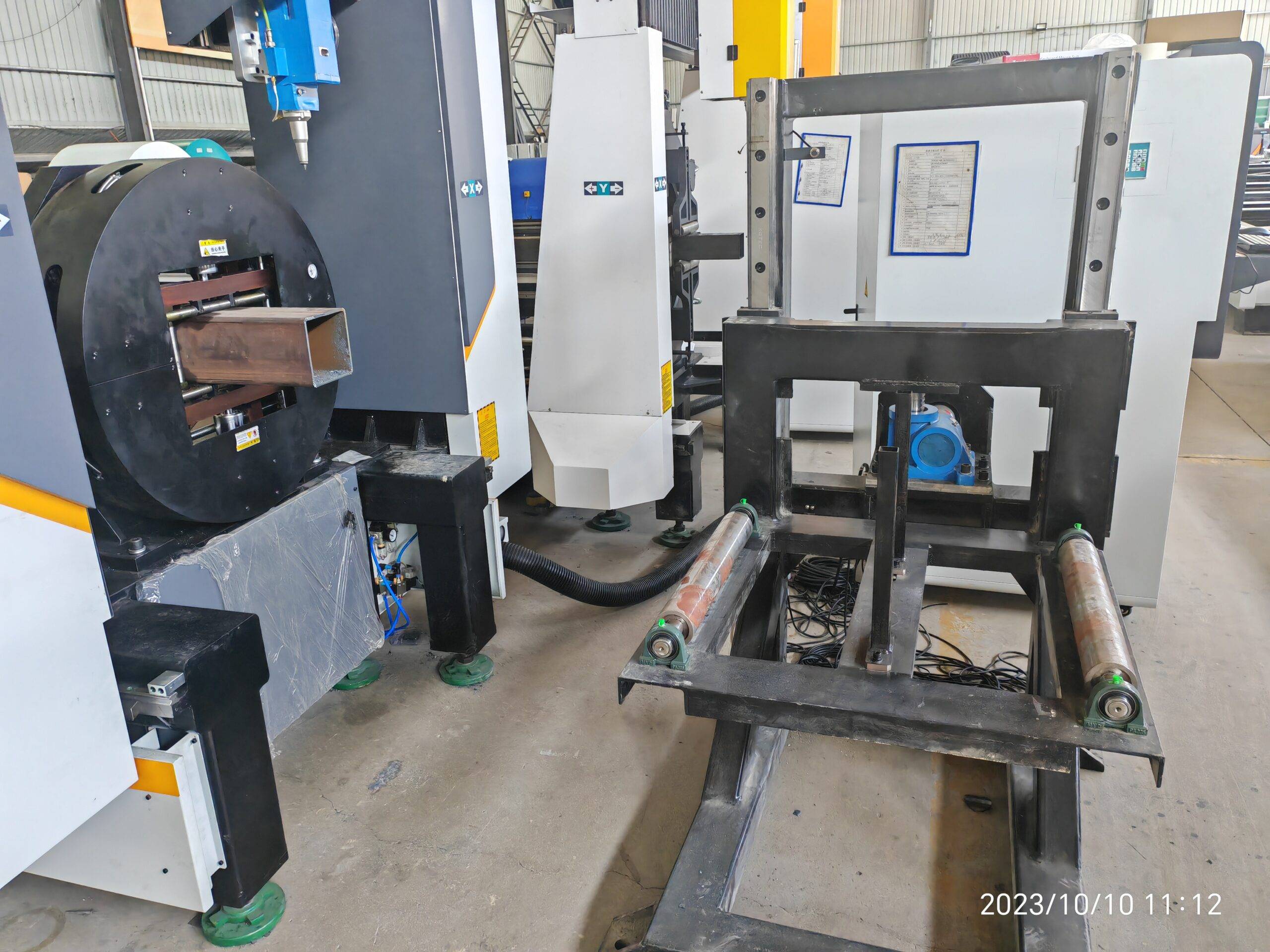
Shop-Floor Reality: Laser Cutting Zinc-Coated Conveyor Tube at Production Scale
The integration of a conveyor pipe zinc coated tube laser processing supplier into an existing structural fabrication line is not a plug-and-play upgrade. It is a full re-engineering of material handling, optical delivery, and post-cut corrosion management. Zinc-coated tube—typically S355JR or DX51D+Z with a 20–275 g/m² hot-dip galvanized layer—behaves fundamentally differently under a 1 µm to 1.07 µm fiber laser beam than bare carbon steel. The zinc vaporization temperature sits at 907°C, while the underlying steel melts near 1,500°C. That 600°C gap creates a violent outgassing event at the kerf that will destroy a poorly tuned cutting head within a single shift.
Material Tolerance Windows and Absorption Physics
Zinc coating thickness directly modulates absorptivity. At 1,070 nm wavelength, bare S355JR reflects roughly 68% of incident energy. A 100 g/m² zinc layer drops that reflectivity to approximately 52% at the surface, but introduces a secondary problem: the molten zinc pool has a vapor pressure of 0.1 MPa at 907°C, rising to 1.0 MPa at 1,100°C. If the assist gas cannot evacuate this vapor faster than it forms, the melt pool destabilizes, producing dross on the bottom edge and micro-cracking along the heat-affected zone.
Practical parameter windows observed on 3 kW to 6 kW single-mode fiber sources for 2.0 mm to 4.0 mm galvanized tube:
- Cutting speed: 4.2 to 6.8 m/min for 2 mm wall, dropping to 1.8 to 2.4 m/min at 4 mm
- Laser power duty cycle: 85–92% with 1 kHz modulation to prevent zinc pooling
- Focal position: −0.5 mm to −1.2 mm below surface (negative focus widens kerf, aiding vapor escape)
- Nitrogen assist pressure: 1.2 to 1.5 MPa at the nozzle, 0.8 to 1.0 MPa at the kerf entrance
- Nozzle standoff: 0.8 mm for 1.5 mm orifice diameter; 1.2 mm for 2.0 mm orifice
Oxygen cutting is viable only for thicknesses above 5 mm where edge quality is secondary. For conveyor tube used in food-grade or outdoor logistics systems, nitrogen at 99.999% purity is non-negotiable to prevent zinc oxide formation on the cut face.
Chucking, Rotation, and Pneumatic Clamping Dynamics
Zinc-coated tube presents a lower coefficient of friction (approximately 0.15 static against hardened steel jaws) compared to bare carbon steel (0.35–0.40). A three-jaw pneumatic chuck running at 0.6 to 0.8 MPa clamping pressure will slip on a 4 mm wall galvanized tube during high-speed rotation above 80 rpm. The fix is not simply higher pressure—that deforms thin-wall tube. Instead, use serrated carbide jaws with 0.3 mm tooth pitch and maintain 0.75 MPa on the primary clamp with a secondary 0.4 MPa stabilizing collet 300 mm downstream.
Rotational acceleration must be limited to 1.2 rad/s² to prevent inertial slip. For a 6-meter tube at 12 kg/m, that translates to a maximum angular velocity of 45 rpm during contour cutting and 120 rpm during simple through-cuts.
Comparative Process Analysis: Legacy vs. Fiber Laser
| Parameter | Plasma Cutting | Mechanical Sawing | Fiber Laser (Zinc-Coated) |
|---|---|---|---|
| Cut edge roughness (Ra) | 12–25 µm | 6–15 µm | 1.6–3.2 µm |
| Heat-affected zone | 0.8–2.5 mm | 0.1–0.3 mm (mechanical) | 0.05–0.15 mm |
| Zinc coating degradation at edge | 3–6 mm burn-back | None, but burr formation | 0.2–0.5 mm burn-back |
| Dimensional tolerance | ±0.8 mm | ±0.3 mm | ±0.05 mm |
| Cycle time (2 mm wall, 1 m cut) | 45–70 s | 90–140 s | 12–18 s |
| Post-processing requirement | Grinding, re-galvanizing | Deburring, re-galvanizing | None for most conveyor applications |
| Consumable cost per meter | $0.85–$1.40 | $0.30–$0.60 (blade wear) | $0.12–$0.22 (N₂ + nozzle) |
Workflow Integration and Throughput Math
A typical conveyor tube fabrication cell processing 2,000 pieces per week at 3.5 m average length requires a minimum of two 6 kW laser tube cutters with automatic bundle loading. The bottleneck is rarely the laser itself—it is the zinc fume extraction. A 2,000 m³/h extraction system at the cutting head is mandatory. Without it, zinc oxide particulate accumulates on the protective window within 4 to 6 hours, causing focal shift and catastrophic lens failure.
Duty cycle planning: run 18 minutes cutting, 2 minutes for window inspection and wipe-down. This 90% duty cycle aligns with the thermal limits of most 6 kW source modules and keeps the extraction filter from saturating prematurely.
Procurement FAQ
What minimum laser power is required for cutting 4 mm zinc-coated conveyor tube at production speed?
A 4 kW single-mode fiber source will cut 4 mm galvanized tube at 1.8 to 2.2 m/min with nitrogen assist at 1.4 MPa. For speeds above 3 m/min on the same thickness, step up to 6 kW. Below 4 kW, zinc vapor evacuation becomes unreliable and dross formation increases by 40–60%.
How does zinc coating thickness affect the cutting nozzle and lens consumable life?
Coating above 200 g/m² produces roughly 2.5 times the zinc oxide particulate of a 100 g/m² coating. Expect protective window replacement every 40–60 hours instead of 120–150 hours. Nozzle life drops from 800 hours to 350–450 hours. Budget accordingly for consumables at $18–$35 per window and $45–$90 per nozzle.
Can a single laser tube cutter handle both bare S355JR and galvanized DX51D+Z without parameter changes?
No. The absorptivity difference between bare and zinc-coated surfaces is 16 percentage points at 1,070 nm. Switching materials requires a minimum of three parameter changes: focal position shifts by −0.4 mm, cutting speed drops 15–25%, and assist gas pressure increases by 0.2 MPa. Store these as separate recipes in the CNC controller to avoid scrap.













