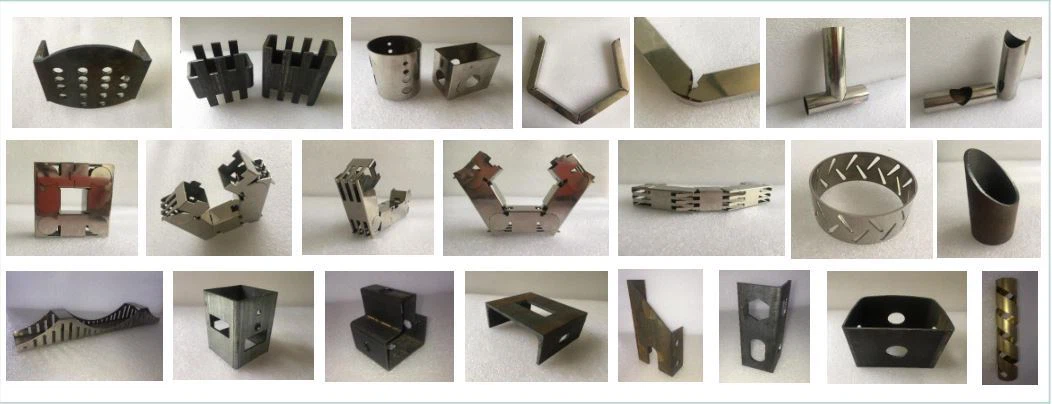
Heavy Profile Laser Processing for Agricultural Machinery Frames: Energy Efficiency, Electro-Optical Conversion, and Compressed Air Cost Optimization
Agricultural machinery frames operate under brutal fatigue cycles — combine harvester chassis, seeder main beams, and plough hitches routinely absorb 3–5 G shock loads on S355JR structural steel with wall thicknesses between 8 mm and 25 mm. When a fabrication shop migrates from plasma or band-saw cutting to heavy profile laser processing for agricultural machinery frames, the engineering conversation shifts from “can it cut?” to “what does each kilowatt-hour and each cubic meter of compressed air actually buy us on the floor?” This paper dissects the real cost architecture behind fiber laser tube and profile cutting in the 6–12 kW class, with hard numbers pulled from production cells running S355JR, SUS304, and Al6061 stock.
Electro-Optical Conversion: Where the Wall-Plug Power Actually Goes
Modern fiber laser sources in the 6–12 kW range advertise wall-plug efficiency (WPE) of 35–42%. That figure is honest but incomplete. The resonator converts roughly 40% of electrical input into usable 1070 nm beam energy; the remainder becomes thermal load on the diode stacks and is dumped through the chiller circuit. On a 12 kW source, expect approximately 7.2 kW of rejected heat, which translates to a chiller draw of 3.5–4.5 kW electrical on top of the resonator’s own consumption.
Optical delivery losses matter more than most procurement engineers assume. A dirty protective window, a misaligned collimator, or a contaminated QBH connector can each steal 2–4% of delivered power. Across a 12 kW chain — source, fiber patch, collimator, focusing optics — a realistic delivered-to-workpiece figure is 88–92%. On a 20 mm S355JR cut at 1.8 m/min, that 8–12% loss is the difference between a clean dross-free kerf and a scrapped beam.
Duty Cycle and the Real Energy per Part
Agricultural frame cutting is rarely a continuous duty operation. Piercing 16 mm S355JR with oxygen assist consumes 4–7 seconds at full power; contour cutting then drops to 60–80% modulation. A realistic duty cycle across an 8-hour shift sits at 55–70%. The idle-state consumption of a 12 kW fiber source is roughly 0.6–1.0 kW, and the chiller, dust extraction, and CNC axes add another 2.5–4 kW. A shop running 300 parts per shift on 12 mm plate should model 42–48 kWh per shift for the laser cell alone — not the 96 kWh a naive “12 kW × 8 h” calculation would suggest.
High-Pressure Air and Assist Gas: The Hidden Cost Center
Assist gas selection drives both cut quality and operating cost more than any other single variable in heavy profile processing.
- Oxygen (O₂) at 0.8–1.2 MPa: Used for carbon steel S355JR above 6 mm. Exothermic reaction adds roughly 30–40% effective cutting energy, allowing lower laser power. Consumption on a 2.0 mm nozzle at 1.0 MPa runs 25–35 Nm³/h. Bulk liquid oxygen at €0.18–0.25/Nm³ is economical, but the cut edge oxidizes and requires post-processing for weld-critical joints.
- Nitrogen (N₂) at 1.2–1.5 MPa: Required for SUS304 and Al6061 to prevent oxidation. High-pressure N₂ on 12 mm stainless consumes 45–60 Nm³/h. Bulk supply at €0.35–0.55/Nm³ makes this the dominant consumable cost — often exceeding electricity cost per part.
- Compressed shop air at 1.2–1.5 MPa: The pragmatic middle ground for S355JR up to 10 mm. A dedicated high-pressure screw compressor delivering 2.5 m³/min at 1.5 MPa draws 22–30 kW. At €0.12/kWh, that is €2.64–3.60 per hour of cutting — versus €12–20/h for bottled or bulk nitrogen on the same duty.
The compressor itself becomes a thermal management problem. Air at 1.5 MPa exits the aftercooler at 35–45°C and must be dried to a pressure dew point below −40°C before entering the cutting head, or condensation will pit the protective lens within 200 operating hours. Refrigerated dryers alone are insufficient; desiccant or membrane drying is mandatory.
Comparative Technical Data: Legacy Methods vs. Heavy Profile Laser
| Parameter | Plasma Cutting (Manual/CNC) | Mechanical Band Saw | Fiber Laser 12 kW (Heavy Profile) |
|---|---|---|---|
| Typical material | S355JR, 10–25 mm | S355JR, SUS304, Al6061 | S355JR, SUS304, Al6061 |
| Cut speed on 12 mm S355JR | 1.2–1.8 m/min | 0.15–0.35 m/min | 2.4–3.2 m/min (O₂ assist) |
| Kerf width | 2.5–4.0 mm | 3.0–5.0 mm (blade set) | 0.8–1.4 mm |
| Heat affected zone | 1.5–3.0 mm | None | 0.15–0.4 mm |
| Edge squareness | ±1.5° typical | ±0.2° | ±0.3° |
| Energy per meter of cut | 0.35–0.55 kWh/m | 0.20–0.30 kWh/m | 0.09–0.14 kWh/m |
| Assist gas cost per meter | €0.04–0.08 (air/plasma gas) | Coolant + blade €0.10–0.20 | €0.03–0.06 (HP air) / €0.12–0.22 (N₂) |
| Post-cut machining required | Frequent (dross, taper) | Deburring only | Minimal to none |
| Chuck/fixture pressure | N/A | Hydraulic 8–12 MPa | Pneumatic 0.6–1.0 MPa |
The energy-per-meter column is the decisive figure for green manufacturing audits. Fiber laser cutting consumes roughly 70–75% less electrical energy per linear meter than plasma on equivalent thickness, primarily because the beam is delivered only where it is needed and the kerf is a fraction of the width. On a 12 mm S355JR frame component with 4.5 m of cut length, that is a saving of approximately 1.2–1.8 kWh per part.
Chuck and Fixture Dynamics on Heavy Tube Profiles
Agricultural frames often use rectangular hollow sections (RHS) up to 250 × 150 × 12 mm. Pneumatic chuck clamping pressure must be tuned carefully: below 0.6 MPa, the tube slips during high-speed rotation and the kerf wanders; above 1.0 MPa, thin-wall SUS304 sections ovalize by 0.3–0.5 mm. The sweet spot for most heavy RHS work sits at 0.7–0.85 MPa with serrated jaws and a 3-point contact pattern. For Al6061, reduce to 0.5–0.6 MPa and increase jaw contact area to prevent galling.
Rotational acceleration on a 200 kg tube assembly is the second constraint. Servo-driven chucks with a 0.8 s 0–90° index consume 15–25% of cycle energy. Reducing index speed by 20% typically cuts that figure by a third with negligible throughput loss on heavy profiles, because the cut itself dominates the cycle.
Green Manufacturing Accounting: What to Measure
Shops pursuing ISO 50001 or customer-driven carbon reporting should instrument the following points on a heavy profile laser cell:
- Resonator input power (kWh meter at the source breaker)
- Chiller circuit power (separate meter)
- Assist gas flow (mass flow meter on the N₂/air line)
- Compressor specific power (kW per Nm³ delivered at 1.5 MPa)
- Extraction fan power and filter differential pressure
A properly instrumented 12 kW cell cutting S355JR with high-pressure air assist typically reports 0.11–0.15 kWh per meter of cut and 0.9–1.4 kg CO₂e per meter on a European grid mix. Switching from nitrogen to filtered compressed air on carbon steel alone can reduce the gas-related carbon footprint by 60–70% without compromising weld-ready edge quality on thicknesses below 10 mm.
Frequently Asked Procurement Questions
What laser power is required to cut 20 mm S355JR agricultural frame steel cleanly?
A 10–12 kW fiber source with oxygen assist at 0.9–1.2 MPa and a 2.0–2.5 mm nozzle delivers a dross-free cut on 20 mm S355JR at 1.6–2.0 m/min. Below 8 kW, edge quality degrades and taper exceeds 0.5 mm, requiring post-machining.
Is high-pressure compressed air a viable substitute for nitrogen on stainless agricultural components?
For SUS304 above 6 mm, compressed air produces an oxidized edge that fails most weld and corrosion specifications. Air assist is viable on carbon steel S355JR up to 10 mm and on some Al6061 non-cosmetic parts, but stainless frames should remain on nitrogen at 1.2–1.5 MPa.
How much can a shop realistically reduce energy cost per part by switching from plasma to fiber laser?
On 12 mm S355JR frame components, the electrical energy per linear meter drops from 0.35–0.55 kWh (plasma) to 0.09–0.14 kWh (fiber laser). Including assist gas, total operating cost per meter typically falls 45–60%, with additional savings from eliminated dross grinding and reduced rework.













