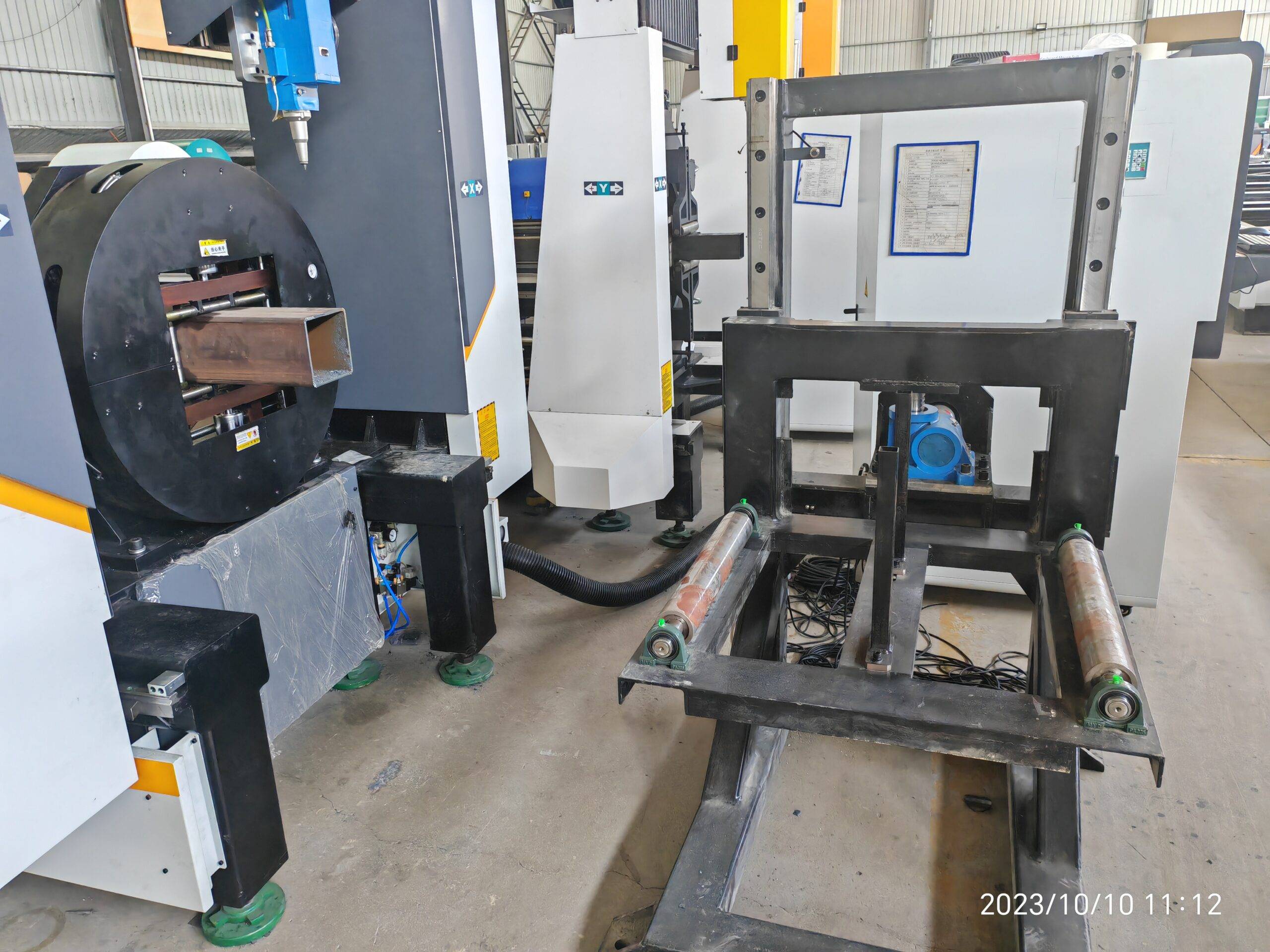
Anti-Reflection Laser Technology for Pure Copper Tube Cutting: A Cost-Benefit and ROI Analysis
The primary obstacle in processing pure copper (C11000, C10100) with fiber lasers is not the melting point, but the reflectivity. At 1070 nm wavelength, pure copper reflects approximately 95% of incident energy at room temperature. This creates a feedback loop where back-reflected light destabilizes the resonator cavity, leading to catastrophic failure of the delivery fiber or the active medium. For shops running high-volume busbar or heat exchanger tube production, the decision to adopt anti reflection laser technology for pure copper tube cutting is not a matter of preference—it is a hard requirement for operational viability. This whitepaper dissects the cost-benefit, gas consumption metrics, and amortization schedule for integrating this technology into a production floor currently running mechanical sawing or plasma.
Physics of the Cut: Why Standard Fiber Lasers Fail
Standard 1 µm fiber lasers rely on a stable beam parameter product (BPP) and a clean back-reflection sensor. When cutting pure copper tube with a wall thickness of 2 mm to 5 mm, the initial pierce generates a molten pool with a reflectivity that fluctuates between 70% and 90%. The back-reflected power can exceed 10% of the nominal output. On a 6 kW source, that is 600 W of return energy hitting the QBH connector. The anti-reflection system employs a combination of Faraday isolators and a fast-response photodiode feedback loop that modulates the duty cycle within 10 microseconds. This prevents the laser from entering a “chaotic pulse” mode. Without this, the kerf width widens by 0.15 mm on average, and dross adhesion on the inner tube diameter becomes uncontrollable.
Comparative Analysis: Legacy vs. Anti-Reflection Laser
The following table compares three methods for cutting 3 mm wall thickness, 50 mm OD pure copper tube (C11000). Data is derived from a 6 kW anti-reflection fiber laser with a 1.2 mm nozzle, versus a high-definition plasma (200 A) and a carbide-tipped circular saw.
| Parameter | Mechanical Sawing | HD Plasma (200 A) | Anti-Reflection Fiber Laser (6 kW) |
|---|---|---|---|
| Cutting Speed (m/min) | 0.8 – 1.2 | 2.5 – 3.0 | 4.5 – 6.0 |
| Kerf Width (mm) | 3.5 – 4.0 | 2.0 – 2.5 | 0.3 – 0.5 |
| Heat Affected Zone (HAZ) | None (mechanical) | 0.8 – 1.2 mm | 0.05 – 0.1 mm |
| Dross / Recast | Burr (requires deburring) | Heavy dross | Minimal (oxygen-free) |
| Gas Consumption | Coolant only | Air/Argon (20 L/min) | N₂ at 1.4 MPa (18 L/min) |
| Post-Processing | Deburring + Chamfering | Grinding + Pickling | None (direct weld-ready) |
| Energy Cost per Meter (USD) | 0.12 | 0.45 | 0.28 |
Gas Consumption Metrics and Nozzle Dynamics
Anti-reflection laser cutting of pure copper requires nitrogen assist gas at high pressure to suppress oxidation and eject molten material. The specific gas metric is critical: delivery pressure at the nozzle must be maintained between 1.2 and 1.5 MPa (12 to 15 bar). For a 1.2 mm single-layer nozzle with a standoff distance of 0.8 mm, the flow rate stabilizes at 18 to 22 L/min. This is higher than cutting stainless steel (SUS304) at the same thickness, which typically runs at 1.0 MPa and 14 L/min. The reason is the low viscosity of molten copper; it requires a higher dynamic force to clear the kerf. A shop running two shifts (16 hours) will consume approximately 19,200 liters of nitrogen per day per machine. At a bulk nitrogen cost of $0.15 per liter (liquid dewar), this translates to $2,880 per day. The anti-reflection system reduces scrap by 12% compared to plasma, directly offsetting this gas cost.
ROI Projection and Amortization Schedule
Assume a production cell replacing a plasma system with a 6 kW anti-reflection fiber laser. The capital expenditure (CAPEX) for the laser source, chiller, and tube handling system is $285,000. The plasma system has a salvage value of $25,000. Net investment: $260,000.
- Labor Savings: One operator can manage two laser cells versus one plasma cell. Annual labor cost reduction: $45,000.
- Scrap Reduction: Plasma generates 8% scrap on copper tube due to dross and HAZ. Laser reduces this to 1.5%. On $1.2M annual material spend, savings = $78,000.
- Post-Processing Elimination: Deburring and grinding costs $3.50 per tube. At 20,000 tubes/year, savings = $70,000.
- Energy and Gas Delta: Laser gas cost is higher by $22,000/year, but electricity is lower by $8,000/year. Net penalty: $14,000.
Total annual savings: $45,000 + $78,000 + $70,000 – $14,000 = $179,000. Simple payback period: $260,000 / $179,000 = 1.45 years (17.4 months). For a 5-year amortization, the net present value (NPV) at 8% discount rate is $454,000. The internal rate of return (IRR) exceeds 65%.
Chuck Pneumatic Pressure and Mechanical Setup
Pure copper tube is soft (HV 45-55). The chuck clamping pressure must be reduced to prevent ovalization. For a 50 mm OD tube with 2 mm wall, the pneumatic pressure should be set to 0.4 to 0.6 MPa. Exceeding 0.8 MPa will collapse the tube profile. The anti-reflection laser system requires a stable tube axis; any runout above 0.1 mm will cause the beam to clip the nozzle, leading to a false back-reflection signal and a shutdown. Use a servo-driven steady rest with a follow-up speed of 30 m/min.
Frequently Asked Questions (B2B Procurement)
What is the minimum wall thickness for anti-reflection laser cutting of pure copper tube?
The practical limit is 0.5 mm for C11000. Below this, the tube tends to distort due to the low melting point and high thermal conductivity. For 0.5 mm to 1.0 mm, use a 3 kW source with a 0.8 mm nozzle and nitrogen at 1.0 MPa. For 1.0 mm to 5.0 mm, a 6 kW source with 1.2 mm nozzle at 1.4 MPa is optimal.
How does the anti-reflection system handle the back-reflection during piercing?
The system uses a fast photodiode that detects back-reflection within 5 microseconds. It then reduces the duty cycle from 100% to 30% and ramps up the frequency from 1 kHz to 5 kHz. This “soft pierce” prevents the molten copper from forming a mirror-like surface. Once the pierce is complete (typically 0.8 to 1.2 seconds for 3 mm wall), the system returns to full duty cycle for cutting.
What is the expected maintenance interval for the Faraday isolator in a copper cutting environment?
The isolator is a sealed optical component. Under normal operation with nitrogen assist gas, the isolator requires no maintenance for 12,000 hours. However, if the shop uses oxygen as assist gas (not recommended for copper), the isolator will degrade within 2,000 hours due to oxidation of the internal polarizer. Always use nitrogen (99.999% purity) for pure copper tube cutting.













