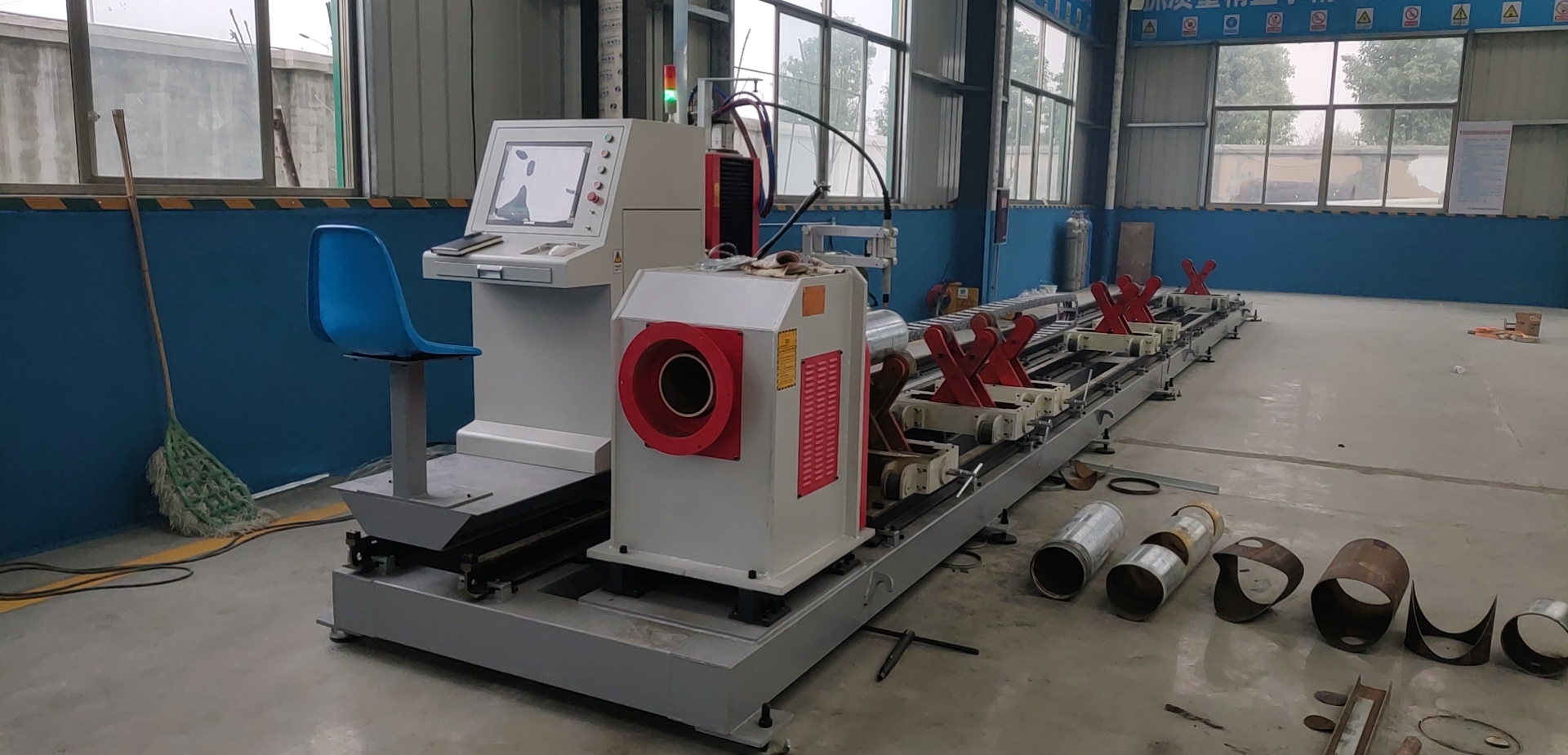
Operational Economics of Tube Laser Processing: Energy, Electro-Optics, and Gas Dynamics
Determining the true cost per cut analysis for steel furniture tube laser cutting requires more than dividing the machine’s hourly rate by the number of parts produced. On the shop floor, the real cost driver is the interaction between electro-optical conversion efficiency, assist gas consumption, and the specific metallurgical behavior of the tube being processed. A 3 kW fiber resonator cutting S355JR structural tube at 1.5 mm wall thickness behaves entirely differently from the same resonator cutting SUS304 at 2.0 mm, and the delta in cost per cut is rarely linear. This whitepaper breaks down the physics and the financials.
Electro-Optical Conversion: Where the Kilowatts Actually Go
Modern fiber laser sources advertise wall-plug efficiencies between 30% and 40%. That figure is measured at the resonator output, not at the cutting head. Between the QBH connector and the workpiece, the optical chain introduces losses that directly inflate cost per cut.
- Fiber delivery losses: 2% to 4% depending on bend radius and fiber length.
- Collimation and focusing optics: 3% to 6% depending on lens contamination and coating degradation.
- Protective window and nozzle geometry: 1% to 3%, with rapid degradation when spatter adhesion occurs.
On a 6 kW source running a 60% duty cycle across an eight-hour shift, a 5% total optical loss translates to roughly 144 kJ of wasted energy per shift. At industrial electricity rates of $0.12/kWh, that is a recoverable cost of approximately $0.35 per shift per machine — small on its own, but across a 20-machine furniture tube cell running 300 days per year, the figure exceeds $2,100 annually. The dominant cost is not the electricity itself; it is the reduced cutting speed that forces the machine to dwell longer on each cut, consuming more assist gas and chuck cycle time.
Resonator Choice and Duty Cycle Reality
Single-mode 3 kW sources are optimal for thin-wall furniture tube (0.8 mm to 1.5 mm) in SUS304 and Al6061, delivering high beam quality (M² < 1.1) and enabling nitrogen cutting at 1.2 to 1.5 MPa with clean edges. Multi-mode 6 kW sources are required for S355JR at 3.0 mm and above, but their beam parameter product (BPP) of 2.5 to 4.0 mm·mrad produces a wider kerf, increasing gas consumption per unit length. The cost per cut scales with kerf width squared in terms of gas volume displaced.
High-Pressure Assist Gas: The Silent Cost Multiplier
Nitrogen cutting of stainless and aluminum furniture tube is the single largest consumable cost after labor. A typical 2.0 mm SUS304 cut at 4.5 m/min with a 1.5 mm nozzle at 1.4 MPa consumes approximately 28 to 32 Nm³/h of N₂. At bulk liquid nitrogen pricing of $0.35/Nm³ (delivered, vaporized, and regulated), that is $9.80 to $11.20 per hour of arc-on time.
Oxygen cutting of S355JR at 1.0 to 1.2 MPa consumes far less gas — typically 4 to 6 Nm³/h — but introduces oxide formation on the cut face, requiring post-processing for furniture applications where weld quality and paint adhesion are critical. The trade-off is rarely about gas price alone; it is about downstream labor.
Nozzle Standoff and Chuck Pneumatics
Chuck pneumatic pressure for tube clamping on a 3-jaw rotary chuck typically runs 0.6 to 0.8 MPa. Insufficient pressure causes tube slip during high-speed contour cuts, producing scrapped parts. Excessive pressure deforms thin-wall Al6061 tube (1.0 mm wall) beyond tolerance. The cost per cut includes not just the compressed air, but the scrap rate induced by improper clamping. A 2% scrap rate on a $4.20 tube blank adds $0.084 per part — often exceeding the entire assist gas cost per cut.
Comparative Technical Data: Legacy vs. Fiber Laser
| Parameter | Plasma Cutting (Legacy) | Mechanical Sawing (Legacy) | Fiber Laser (Current) |
|---|---|---|---|
| Typical material | S355JR, 3–6 mm | S355JR, SUS304, any wall | S355JR, SUS304, Al6061, 0.8–6 mm |
| Cut edge quality (Ra) | 12–25 µm, dross present | 25–50 µm, burr present | 1.6–6.3 µm, dross-free |
| Kerf width | 1.5–2.5 mm | 2.0–3.0 mm (blade) | 0.15–0.40 mm |
| Assist gas | Compressed air / O₂, 0.5 MPa | None (coolant only) | N₂ at 1.2–1.5 MPa or O₂ at 1.0–1.2 MPa |
| Energy draw | 25–40 kW | 3–7 kW | 9–18 kW (wall-plug) |
| Post-processing required | Grinding, deburring | Deburring, facing | Minimal to none |
| Cost per cut (2 mm SUS304, 100 mm length) | $0.42–$0.58 | $0.31–$0.44 | $0.11–$0.19 |
| Duty cycle achievable | 55–70% | 40–60% | 85–95% |
The table above assumes a 100 mm circumferential cut on a 50 mm OD tube. The fiber laser advantage is not merely speed; it is the elimination of secondary operations. A plasma-cut S355JR furniture frame requires an average of 1.8 minutes of grinding per joint. At a fully burdened labor rate of $38/hour, that is $1.14 per joint — more than the entire laser cut cost for the same feature.
Green Manufacturing: Quantifying the Efficiency Gain
Sustainability in tube processing is not a marketing position; it is a measurable reduction in kWh per finished part. A fiber laser cutting SUS304 at 2.0 mm consumes approximately 0.045 kWh per 100 mm cut at the wall plug. The equivalent plasma operation consumes 0.18 kWh per 100 mm cut, plus the energy embedded in grinding consumables and compressed air for deburring. The electro-optical conversion efficiency of a modern fiber source (35%) versus a CO₂ source (8–10%) explains most of this delta.
High-pressure nitrogen generation on-site via PSA systems reduces the delivered cost of N₂ from $0.35/Nm³ to approximately $0.09/Nm³, but at the cost of 0.12 kWh per Nm³ of compression energy. The break-even point against bulk liquid delivery occurs at approximately 40 Nm³/h average consumption. Below that threshold, bulk delivery remains cheaper; above it, on-site generation dominates. Furniture tube fabricators running two shifts on multiple machines typically cross this threshold.
Procurement FAQ
What is the realistic cost per cut for 2 mm SUS304 furniture tube on a 3 kW fiber laser?
Assuming a 100 mm circumferential cut, 1.4 MPa nitrogen assist gas, and a machine burden rate of $22/hour, the cost per cut ranges from $0.11 to $0.19. This includes electricity, gas, nozzle wear amortization, and chuck cycle time, but excludes labor and facility overhead.
Can oxygen cutting replace nitrogen for steel furniture tube to reduce gas cost?
For S355JR and similar carbon steels, oxygen cutting at 1.0 to 1.2 MPa reduces gas cost by 70–80% but produces an oxidized edge that requires acid pickling or mechanical removal before powder coating. For painted furniture where the cut edge is visible, nitrogen remains the only viable option.
How does chuck pneumatic pressure affect scrap rate and cost per cut?
Chuck pressure below 0.6 MPa on a 3-jaw rotary chuck causes tube slip during high-speed contouring, producing dimensional scrap. Pressure above 0.8 MPa deforms thin-wall Al6061 and SUS304 tube below 1.2 mm wall thickness. Maintaining 0.65 to 0.75 MPa with pressure monitoring reduces scrap rate from a typical 2.5% to below 0.8%, saving $0.05 to $0.12 per part.













