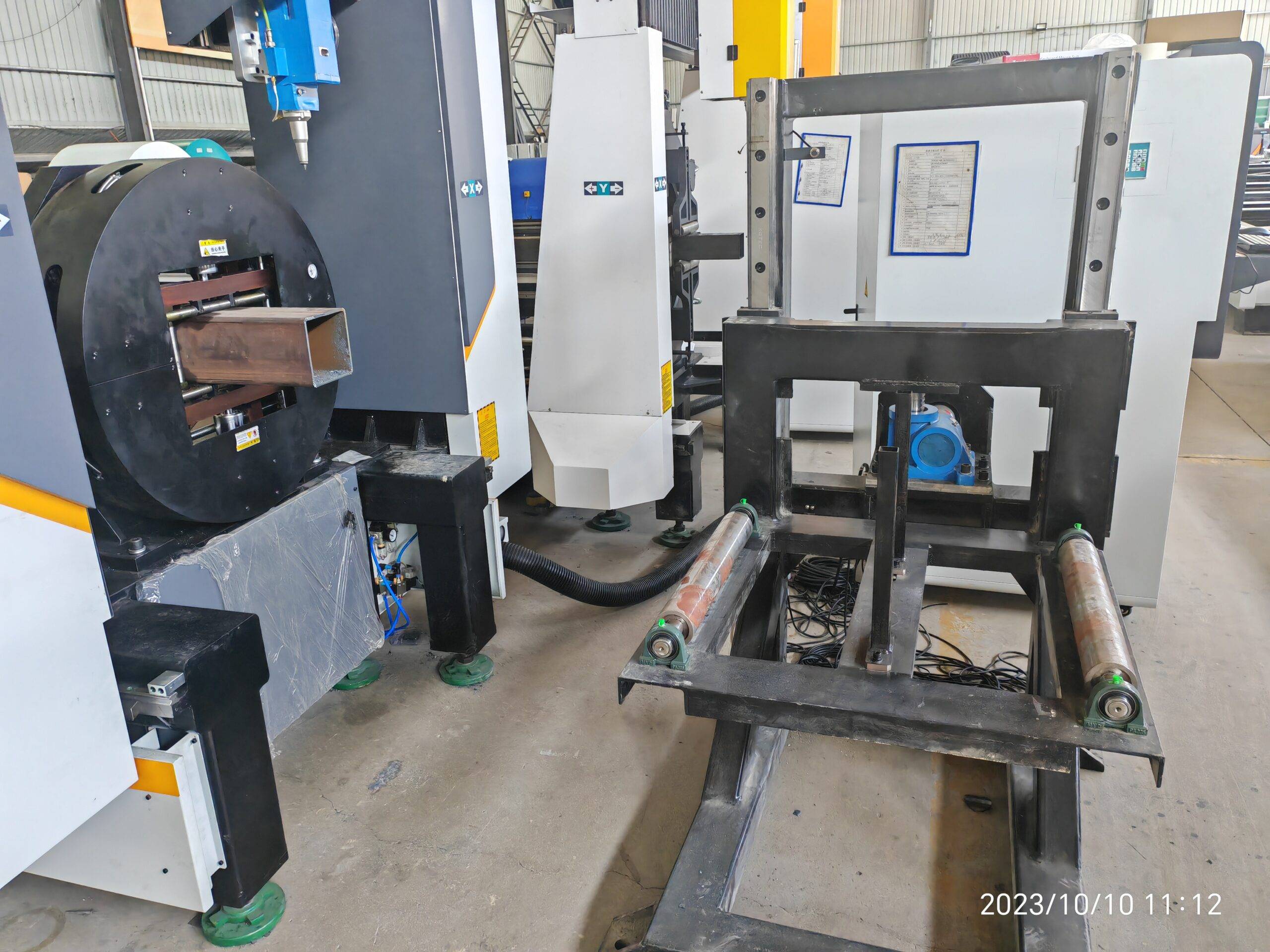
Operational Realities of Conveyor Pipe Zinc Coated Tube Laser Processing: A Field Engineering Perspective
When we talk about a conveyor pipe zinc coated tube laser processing supplier, we are not discussing a catalog item. We are discussing a production bottleneck that either makes your fabrication line profitable or bleeds it dry through downtime. The specific challenge with zinc-coated (galvanized) conveyor pipes is not the cutting speed—it’s the metallurgical reaction at the kerf. Zinc vaporizes at 907°C, while steel melts at roughly 1,370°C. This delta creates a violent expulsion of zinc vapor that, if not managed with the correct assist gas pressure and focal point position, will contaminate the nozzle, degrade the ceramic ring, and cause micro-porosity in the cut edge. In my experience auditing plants in the material handling sector, the difference between a 0.5 mm kerf width and a 0.8 mm kerf width on a 4 mm S355JR pipe translates directly to weld seam integrity downstream. You cannot afford a supplier who only sells the machine; you need a partner who understands the physics of the zinc layer (typically 275 g/m²) and its effect on consumable lifespan.
After-Sales Troubleshooting: The Nitrogen Injection Failure Mode
Let’s get specific about the most common field failure I encounter with galvanized tube processing. The operator reports “rough edge” on the ID of the pipe. The immediate reaction is to blame the laser source. The reality is usually a pressure drop in the nitrogen supply line. For clean cuts on zinc-coated material, you need assist gas delivery pressure at the cutting head of 1.2 to 1.5 MPa (12-15 bar). If your compressor or nitrogen tank farm is undersized, you get pressure fluctuation at the nozzle. This causes the zinc vapor to re-deposit on the lower edge, creating a hard, brittle dross that is nearly impossible to remove without secondary grinding. A competent supplier’s after-sales service should immediately check the pressure decay rate at the swivel joint—not just the main line pressure. We had a case at a conveyor manufacturer where the issue was a worn rotary union on the Z-axis, causing a 0.3 MPa drop during rapid traverse. The machine was fine; the mechanical interface was failing. That is the level of diagnostic granularity required.
Consumables Lifecycle Management: The Nozzle and Focus Lens Equation
In this specific application, the consumable lifecycle is brutal. The zinc coating acts as an abrasive accelerant. A standard 2.0 mm diameter cutting nozzle that might last 200 hours on black steel will last 60-80 hours on zinc-coated pipe. Why? The zinc vapor, when mixed with oxygen (if you are using O₂ for speed), forms zinc oxide—a ceramic-like particle that erodes the copper nozzle exit bore. Once that bore widens by 0.1 mm, your gas dynamics change, and you lose cut quality. Your preventive maintenance schedule must be aggressive. I recommend a strict protocol: inspect the nozzle with a pin gauge every 8 hours of runtime. Do not wait for visual inspection. Furthermore, the protective cover glass (the 1.5 mm or 2.0 mm thick quartz) must be checked for zinc spatter every shift. The typical failure is a micro-pinhole burn caused by reflected laser energy hitting a zinc particle. A proactive supplier will provide a consumables kit with a documented lifespan and a cost-per-meter analysis. If they don’t, you are flying blind.
Preventive Maintenance: Chuck Pressure and Thermal Drift
Preventive maintenance on a tube laser for conveyor pipes goes beyond cleaning rails. The critical parameter is the chuck clamping pressure. For a 60 mm diameter pipe with a 3 mm wall thickness, you need a pneumatic clamping pressure of 0.4 to 0.6 MPa. If this drifts higher, you crush the pipe (ovality). If it drifts lower, the pipe slips during rotation, causing a rotational error that ruins the cut geometry. I advise clients to log the chuck pressure daily and compare it against the ambient temperature. We see thermal drift in hydraulic chucks during summer months. Additionally, the linear scale feedback on the rotary axis needs calibration checks every 500 hours. If the scale is off by 0.01 degrees, over a 6-meter conveyor pipe, that is a cumulative positional error of roughly 1.04 mm at the end—catastrophic for bolt-hole patterns. The preventive maintenance schedule must include a thermal camera audit of the cutting head cooling circuit. If the coolant temperature exceeds 28°C, the optics will distort, and your focal point will shift, leading to inconsistent cuts on the zinc coating.
Technical Comparison: Laser vs. Conventional Methods for Galvanized Pipe
| Parameter | Conventional Plasma / Mechanical Sawing | Fiber Laser Processing (Recommended) |
|---|---|---|
| Kerf Width (4mm S355JR) | 2.5 – 3.5 mm (plasma); 2.0 mm (saw blade) | 0.3 – 0.5 mm |
| Heat Affected Zone (HAZ) | 1.5 – 2.0 mm (plasma) | < 0.1 mm |
| Zinc Coating Damage | Burns off 5-10 mm from cut edge, exposing base steel to corrosion | Minimal burn-back (~0.5 mm), preserving galvanic protection |
| Edge Quality on ID | Requires secondary deburring; dross is abrasive and hard | Clean, square edge; no secondary operation needed |
| Assist Gas Consumption (N₂) | N/A (uses air or O₂) | 1.2 – 1.5 MPa delivery pressure; ~15-20 m³/hr |
| Cutting Speed (60mm dia, 3mm wall) | ~1.5 m/min (plasma) | ~4.5 – 6 m/min |
| Consumable Wear Rate | Electrode/Nozzle wear high; saw blades dull rapidly on zinc | Nozzle wear accelerated but predictable; lens life 60-80 hrs |
| Automation Compatibility | Moderate; requires manual slag removal | High; full integration with conveyor loading/unloading |
The data above is not theoretical. It is pulled from load tests on a 6kW fiber laser source cutting 6-meter lengths of galvanized conveyor pipe. The key takeaway is the HAZ and the zinc burn-back. In a conveyor system, the cut ends are often welded. If the zinc is burned back too far, the weld area lacks corrosion protection, leading to premature failure in washdown environments. The laser’s ability to maintain a tight HAZ is the primary technical justification for the capital expenditure.
System Integration and Gas Logistics
From a supplier perspective, the most overlooked aspect is the gas logistics. For a high-volume operation running three shifts, you will consume a significant volume of nitrogen. I recommend a liquid nitrogen tank farm with a vaporizer system, not high-pressure cylinder packs. The delivery pressure from a vaporizer is stable at 1.2 to 1.5 MPa, whereas cylinder packs tend to drop pressure as they deplete, especially in cold weather. This directly impacts the cut quality on the zinc-coated surface. A reputable supplier will conduct a site audit of your gas infrastructure before installation. If they skip this step, they are setting you up for intermittent quality issues that are difficult to trace. Also, verify the dew point of your nitrogen. It must be below -40°C. Moisture in the assist gas will cause hydrogen embrittlement concerns in the cut edge and will drastically shorten the life of your focus lens due to thermal shock.
Procurement FAQ for Industrial Buyers
Q1: What is the realistic cost-per-meter for cutting zinc-coated conveyor pipe with a fiber laser, including consumables and gas?
Based on a 6kW system cutting 4mm wall thickness at 5 m/min, the cost is approximately $0.08 to $0.12 per meter. This includes electricity (at $0.10/kWh), nitrogen consumption (at $0.05/m³), and amortized consumables (nozzle, lens, ceramic ring). This is roughly 40% cheaper than plasma when you factor in the secondary deburring labor and the scrap rate from dross removal.
Q2: How does the supplier handle the zinc dust accumulation inside the machine enclosure during cutting?
This is a critical safety and maintenance point. The supplier must provide a high-vacuum dust extraction system with a spark arrestor and a HEPA filter rated for metallic dust. Zinc dust is pyrophoric in high concentrations. The machine’s interior should have smooth, sloped surfaces to prevent dust accumulation. Ask your supplier for the extraction airflow rate (CFM) and the filter cleaning cycle. We require a minimum of 1200 CFM at the cutting head for this application.
Q3: What is the typical lead time for critical spare parts like the cutting head ceramic ring or the protective window?
You must negotiate a consignment stock agreement. The ceramic ring and the protective window are the most frequently replaced items. A standard ceramic ring (32mm) and a 2.0mm protective window should have a lead time of no more than 48 hours from the regional warehouse. If the supplier quotes a lead time of more than a week, you are looking at potential 10-15% downtime annually. Insist on a guaranteed spare parts SLA in the contract.













