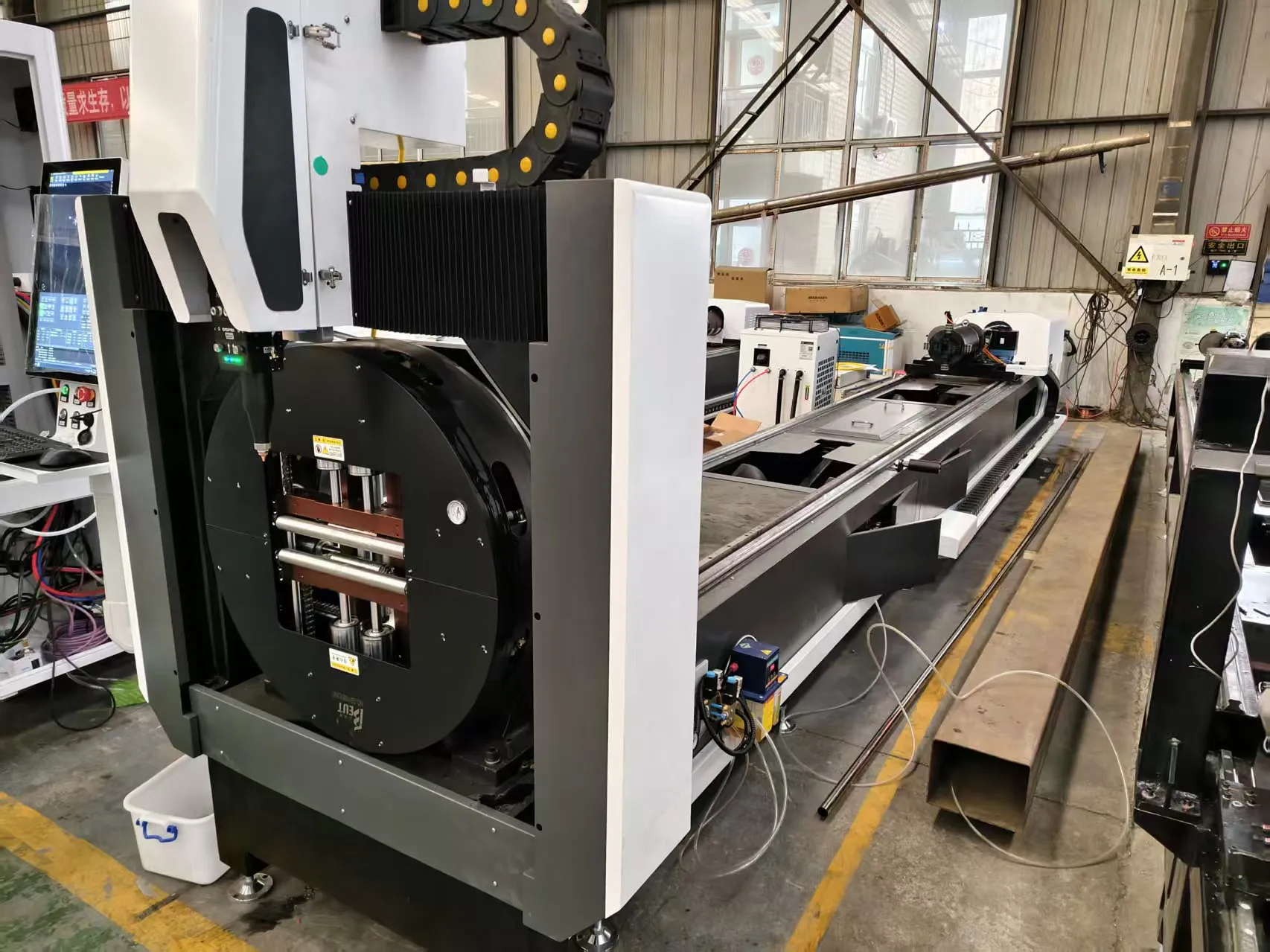
Heavy Profile Laser Processing for Agricultural Machinery Frames: A Cost-Benefit and ROI Analysis
When I walk a fabrication floor dedicated to agricultural machinery, the first thing I check is the miter saws and plasma tables. For years, that was the standard for heavy profiles—S355JR or S355J2H rectangular hollow sections (RHS) with wall thicknesses pushing 12.5 mm to 20 mm. But the tolerances required for modern planter frames, sprayer booms, and tractor cabs are no longer forgiving. We are seeing a definitive shift toward heavy profile laser processing for agricultural machinery frames as the primary fabrication method, not just for speed, but for the dramatic reduction in downstream machining. This analysis is not about marketing fluff; it is about the hard numbers regarding gas consumption, chuck pressure dynamics, and the amortization schedule of a 6 kW to 12 kW fiber laser system versus your existing sawing and plasma infrastructure.
The Physics of the Cut: Why Fiber Wins on Heavy Wall
Let’s get the technical baseline straight. For agricultural frames, we are predominantly dealing with structural steel grades like S355JR and occasionally wear-resistant grades like Hardox 450 for specific wear plates. The challenge with heavy profiles (thickness >10 mm) is the kerf width and heat-affected zone (HAZ). A plasma arc at 200 amps will give you a kerf of roughly 4.5 mm to 6 mm, with a HAZ of 1.5 mm to 2 mm. That HAZ requires secondary grinding before welding to prevent porosity. A 10 kW fiber laser, operating at a frequency of 10 kHz to 15 kHz with a 150-micron fiber, will produce a kerf of 0.8 mm to 1.2 mm. The HAZ is negligible—under 0.3 mm—which means you can weld directly after cutting without edge prep. This alone eliminates an entire work cell dedicated to deburring and grinding.
However, the physics of laser cutting on heavy profiles demands strict control of the assist gas. For clean, dross-free cuts on 15 mm S355JR, you are looking at Nitrogen delivery pressures of 1.2 to 1.5 MPa (12 to 15 bar). The nozzle diameter must be increased to 3.0 mm to 4.0 mm to handle the gas flow rate, which will spike to nearly 40 to 60 cubic meters per hour. If you switch to Oxygen for faster cutting speeds on thicker sections (which I do not recommend for structural frames due to oxide layer formation), you drop the pressure to 0.6 MPa but increase the risk of nitriding on the cut edge, which complicates welding. The decision between N2 and O2 is the single largest variable in your operational expenditure (OPEX).
Comparative Analysis: Sawing/Plasma vs. Fiber Laser
To make a sound capital expenditure (CAPEX) decision, you must compare the total cost of ownership. Below is a technical breakdown based on a typical production run of 500 frames per month, with an average of 40 cuts per frame on 12 mm S355JR RHS.
| Parameter | Conventional (Band Saw + Plasma) | Fiber Laser (8 kW – 10 kW) |
|---|---|---|
| Kerf Width (12 mm wall) | Plasma: 5.0 mm / Saw: 3.0 mm | 1.0 mm |
| Cutting Speed (12 mm) | Plasma: 1.2 m/min / Saw: 0.4 m/min | 2.8 m/min (N2 assist) |
| Edge Squareness Tolerance | ± 1.5° (requires machining) | ± 0.2° (weld ready) |
| Secondary Operations | Grinding, deburring, straightening | None (direct to weld) |
| Assist Gas Cost (per meter) | Plasma: Compressed air (low cost) | N2 at 1.4 MPa: $0.35/m (high volume) |
| Consumables (per hour) | Electrodes, nozzles, saw blades ($18/hr) | Laser optics, nozzles ($6/hr) |
| Material Waste (per frame) | ~1.5 kg (scrap + grinding dust) | ~0.4 kg (recyclable clean scrap) |
| Labor Utilization | 2 operators (cut + prep) | 1 operator (supervises 2 machines) |
The gas consumption metric is the one that scares most plant managers. Yes, Nitrogen at 1.2 MPa is expensive. But look at the labor and consumables. A band saw blade for a 300 mm RHS costs roughly $400 and lasts for 8 hours of cutting before needing replacement. Plasma electrodes are a consumable nightmare, requiring replacement every 2 hours of arc time. The laser eliminates these variable costs entirely. The real ROI driver, however, is the elimination of the “fit-up” time in the welding jig. When plasma cuts are tapered, the welder spends 10 minutes per joint shimming and adjusting. With laser-cut square edges, the joint gap is consistent at 0.5 mm, allowing for automated MIG welding at higher travel speeds.
ROI Projection and Amortization Schedule
Let’s run the numbers for a mid-sized agricultural equipment manufacturer. Assume an investment of $850,000 for a 10 kW fiber laser tube cutting system with a 12-meter loading magazine and a 3-chuck (chuck pneumatic pressure at 2.0 MPa for clamping stability) configuration.
- Current Costs (Plasma/Saw): $12.50 per frame (labor, consumables, scrap).
- Proposed Costs (Laser): $7.80 per frame (higher gas cost offset by lower labor and zero secondary prep).
- Direct Savings: $4.70 per frame x 500 frames/month = $2,350/month.
- Indirect Savings (Weld Rework): Reduction in rework from 8% to 1% saves an additional $3,000/month.
- Throughput Increase: The laser cuts 40% faster than plasma on the profile ends, allowing the same shift to produce 650 frames instead of 500. This additional 150 frames at a $50 margin adds $7,500/month in potential revenue.
The total monthly value generation is approximately $12,850. The payback period is calculated at $850,000 / $12,850 = 66 months (5.5 years). However, this is a conservative estimate. If you are running two shifts, the labor savings double, and the payback drops to under 3.5 years. The critical factor is gas management. You must install a bulk Nitrogen tank with a vaporizer, not rely on cylinder packs. Buying liquid nitrogen at $0.10/liter versus cylinder gas at $0.30/liter is the difference between a profitable cell and a money pit. Furthermore, the ability to cut S355JR with a 1.0 mm kerf means you can nest parts tighter, reducing material waste by 3% to 5% annually—a figure that often covers the maintenance contract cost.
Operational Parameters for the Floor
Do not let the software engineers fool you; the cutting head setup is where the skill lies. For a 12 mm wall, I set the focal position at -6 mm (inside the material) to ensure the beam stays collimated through the thickness. The nozzle standoff is critical at 0.8 mm. If you increase the standoff to 1.2 mm, the gas dynamics change, and you will get dross on the bottom edge. The chuck pressure must be monitored. For a 200 mm x 100 mm profile, you need a clamping force of at least 15 kN to prevent the material from twisting during the piercing cycle. The piercing itself should be done with a 1 ms pulse at 50% power, followed by a 0.5-second ramp-up to full power to avoid creating a “bullet hole” that damages the rear wall of the profile.
The maintenance schedule is also different. You are not replacing saw blades, but you must check the protective window on the cutting head daily. A single spatter particle can cause the lens to heat up and fail, costing you $200 in optics and 2 hours of downtime. I advise my clients to implement a strict air-quality protocol for the cutting area. The laser resonator needs a stable ambient temperature of 20°C to 25°C; otherwise, the beam quality degrades, and you lose cutting speed.
FAQ: Procurement Considerations for Heavy Profile Lasers
1. What is the minimum laser power required to cut 20 mm thick S355JR agricultural frames efficiently?
For production efficiency, you need at least 8 kW. A 6 kW laser will cut 20 mm, but at a speed of 0.8 m/min, which is slower than plasma. An 8 kW to 10 kW system gives you the headroom to cut 20 mm at 1.5 m/min with Nitrogen, ensuring a clean, weldable edge. Anything less, and you are compromising cycle time for capital cost.
2. How does the gas consumption for Nitrogen compare to Oxygen when cutting structural steel for frames?
Nitrogen consumption is significantly higher—roughly 3 to 4 times the volume of Oxygen due to the higher pressure (1.2 MPa vs 0.6 MPa). However, Nitrogen leaves a bright, oxide-free edge that is ready for welding. Oxygen leaves a brittle oxide scale that must be removed. For agricultural frames where weld integrity is paramount, the higher gas cost of Nitrogen is justified by the labor savings in post-cut cleaning.
3. Can a fiber laser tube cutting machine handle tapered profiles or variable wall thicknesses common in boom construction?
Yes, but you need a machine with a B-axis (tilting head) capability. Standard 2D cutting heads cannot adjust the angle of incidence. For tapered profiles, the laser head must tilt to maintain perpendicularity. Additionally, the CNC control must have adaptive focal position control to adjust for the varying wall thickness in real-time, otherwise, you will get inconsistent cut quality along the taper.













