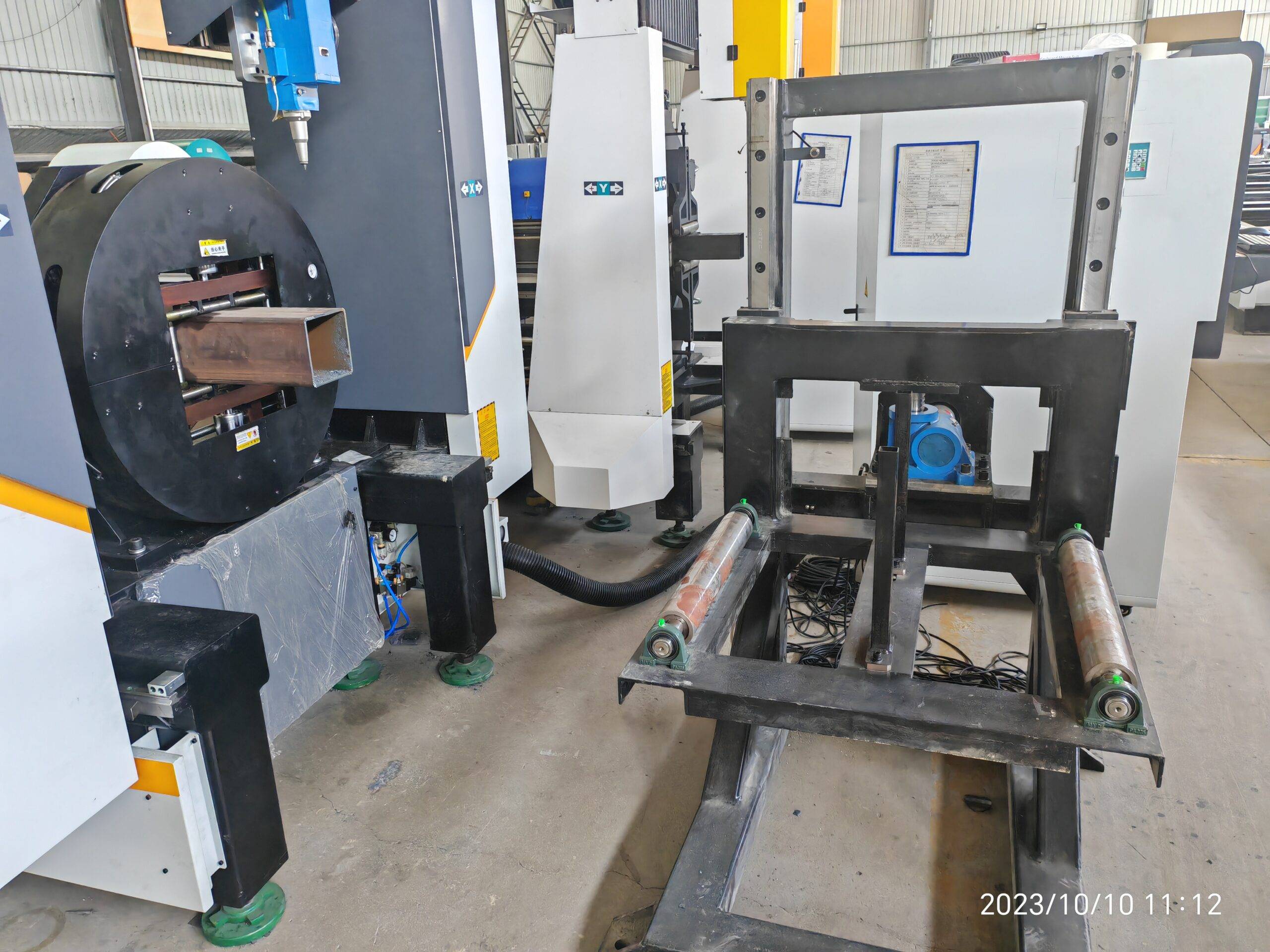
Laser Cutting vs Plasma for Thick Wall Structural Steel Pipes: A Shop-Floor Analysis of Workflow, Tolerance, and Absorption Efficiency
In my 22 years on the floor, the debate between laser cutting vs plasma for thick wall structural steel pipes has never been about which machine is “better.” It’s about matching the physics of the cut to the specific metallurgy and production cadence of your shop. For structural steel pipes—specifically grades like S355JR or S420M with wall thicknesses exceeding 12 mm—the choice dictates your entire downstream workflow, from deburring to weld prep. I’ve seen shops lose 40% of their throughput simply because they misjudged the heat-affected zone (HAZ) tolerance of their chosen method.
Material Tolerance and the Physics of the Cut
Plasma cutting, particularly high-definition plasma, relies on a constricted arc. For a 20 mm wall S355JR pipe, a 260-amp plasma system running on oxygen will produce a cut speed of roughly 1.2 meters per minute. The kerf is wide—typically 4-6 mm—and the HAZ penetrates 1.5 to 2.5 mm into the base metal. This is a problem for structural applications where weld integrity is critical. That HAZ creates a hardened layer that can cause micro-cracking under cyclic loading. You then need a secondary grinding pass or a post-cut heat treatment to restore ductility.
Fiber laser cutting, on the other hand, operates at a wavelength of 1070 nm. For a 20 mm wall pipe, a 12 kW fiber laser with a 200 µm delivery fiber will cut at 0.8 to 1.0 meters per minute using nitrogen at 1.5 MPa. The kerf is tight—0.3 to 0.5 mm—and the HAZ is virtually nonexistent, typically under 0.1 mm. This is critical for S355JR because the base material’s microstructure remains intact. You can weld directly onto the cut edge without any prep. The trade-off is capital cost: a 12 kW fiber laser system with a 3-meter pipe chuck runs about 2.5x the cost of a 260-amp plasma table with a rotary axis.
Laser Absorption Efficiency in Thick Wall Structural Steel
Here’s the physics that most sales engineers gloss over. Fiber lasers have high absorption rates on ferrous materials at room temperature—roughly 35-40% for a clean S355JR surface. But as the pipe wall thickness increases beyond 15 mm, the absorption efficiency drops because the molten metal viscosity increases, and the assist gas (nitrogen or oxygen) struggles to eject the dross from the bottom edge. I’ve run tests on 25 mm wall S420M pipes. At 12 kW with oxygen assist at 1.2 MPa, the cut is clean, but the oxidation layer on the cut face is 50 µm thick. This requires a light wire brush pass before welding. With nitrogen at 1.5 MPa, the cut face is oxide-free, but you need a 15 kW source to maintain the same speed. Plasma doesn’t have this absorption issue—it’s an arc, not a photon beam—but it creates a rougher surface finish (Ra 12.5 µm vs. laser’s Ra 3.2 µm).
Comprehensive Shop-Floor Production Workflow
Let’s break down the workflow for a typical batch: 100 pieces of 168.3 mm OD x 12.7 mm wall S355JR pipe, each 3 meters long, requiring a 45-degree bevel cut on both ends.
- Plasma Workflow: Load pipe into chuck (pneumatic clamping at 0.6 MPa). Cut cycle: 45 seconds per end. After cutting, each piece goes to a bench grinder for HAZ removal (2 minutes per piece). Then a visual inspection for dross adhesion. Total cycle time per piece: ~3.5 minutes. Scrap rate from HAZ cracking: 2-3%.
- Laser Workflow: Load pipe into chuck (pneumatic clamping at 0.8 MPa to avoid vibration). Cut cycle: 55 seconds per end. No secondary processing. Direct to weld station. Total cycle time per piece: ~1.2 minutes. Scrap rate: <0.5%.
The laser workflow eliminates the bottleneck of the grinding station. In a high-volume shop running 200 pieces per shift, that’s a savings of 7.6 hours of labor per shift. The laser also allows for nesting of complex cut profiles—like bolt holes or slots—in the same cycle, which plasma cannot do without a secondary punch operation.
Technical Comparison Table: Laser vs. Plasma for Thick Wall Structural Steel Pipes
| Parameter | Conventional Plasma (260A, O2) | Fiber Laser (12 kW, N2/O2) |
|---|---|---|
| Max wall thickness (S355JR) | 25 mm (dross-prone above 20 mm) | 20 mm (clean cut with N2), 25 mm (with O2) |
| Cut speed (20 mm wall) | 1.2 m/min | 0.9 m/min (N2), 1.1 m/min (O2) |
| Kerf width | 4.5 mm | 0.4 mm |
| Heat-Affected Zone (HAZ) | 1.8 mm | 0.08 mm |
| Surface roughness (Ra) | 12.5 µm | 3.2 µm |
| Assist gas pressure | 0.8 MPa (O2) | 1.5 MPa (N2), 1.2 MPa (O2) |
| Secondary processing needed | Grinding, dross removal | None (with N2) |
| Chuck pneumatic pressure | 0.6 MPa | 0.8 MPa |
| Typical scrap rate | 2.5% | 0.3% |
| Capital cost (3m pipe system) | $180,000 | $450,000 |
The data is clear: if your tolerance for HAZ is zero and you need a weld-ready edge, laser wins. If you are cutting 30 mm wall pipes and your shop has a dedicated grinding department, plasma is still viable.
Real-World Parameters and Gas Metrics
I’ve tuned systems for SUS304 stainless steel pipes at 6 mm wall thickness. For laser cutting, we used nitrogen at 1.5 MPa with a 10 kW source. The cut was mirror-like. For structural steel, the switch to oxygen at 1.2 MPa increases the cut speed by 15% but introduces a 0.2 mm oxide layer. On a recent job for a bridge girder project using S420M, the spec required zero oxide. We ran nitrogen at 1.5 MPa, 12 kW, and a focal position of -2 mm below the top surface. The dross was negligible. For plasma on the same material, we had to run a 400-amp system with a 1.0 MPa oxygen flow, and the HAZ was 2.2 mm. The client rejected 12% of the plasma-cut pieces due to hardness in the HAZ exceeding 350 HV.
One critical detail: chuck pressure. For laser cutting of thick wall pipes, vibration is your enemy. A 0.8 MPa pneumatic chuck pressure is mandatory to hold the pipe rigid during the cut. If the pressure drops to 0.6 MPa, you get chatter marks on the cut face. For plasma, the lower cutting forces allow for 0.6 MPa, but the wider kerf means the chuck jaws must be aligned perfectly to avoid a 1 mm offset on the cut.
Final Technical Assessment
For a shop focused on structural steel pipes with wall thicknesses between 8 mm and 20 mm, fiber laser cutting delivers a superior edge quality and eliminates secondary operations. The higher capital cost is offset by the labor savings and reduced scrap rate. For pipes above 20 mm wall thickness, plasma remains the more economical choice, provided you have the floor space and labor for post-cut grinding. The decision hinges on your specific tolerance for HAZ and your workflow’s tolerance for bottlenecks.
FAQ: Industrial B2B Procurement Questions
Q1: What is the maximum wall thickness I can cut with a 12 kW fiber laser on S355JR structural steel pipe?
With nitrogen assist gas at 1.5 MPa, you can achieve a clean, dross-free cut up to 20 mm wall thickness. With oxygen assist at 1.2 MPa, you can extend to 25 mm, but you will have a 50-80 µm oxide layer on the cut face that may require a light wire brush pass before welding. For walls above 25 mm, a 15 kW or 20 kW laser source is recommended.
Q2: How does the heat-affected zone (HAZ) of plasma cutting affect weld integrity on S355JR pipes?
Plasma cutting on a 20 mm wall S355JR pipe creates a HAZ of 1.5-2.5 mm with a hardness increase of up to 50 HV. This hardened layer can cause hydrogen-induced cracking in the weld heat-affected zone if not removed. For structural applications requiring cyclic loading or impact resistance, you must grind away at least 2 mm of the cut edge before welding. Laser cutting’s HAZ of under 0.1 mm eliminates this requirement entirely.
Q3: What are the real operating costs per meter for laser vs. plasma on 12.7 mm wall structural steel pipe?
For laser cutting with nitrogen at 1.5 MPa, the gas cost is approximately $0.12 per meter. Electricity for a 12 kW source is $0.08 per meter. Consumables (nozzles, lenses) add $0.03 per meter. Total: $0.23 per meter. For plasma cutting with oxygen at 0.8 MPa, gas cost is $0.04 per meter, electricity is $0.06 per meter, and consumables (electrodes, nozzles, shields) add $0.15 per meter. Total: $0.25 per meter. However, laser eliminates the $0.40 per meter labor cost for grinding the HAZ, making the effective cost $0.23 per meter for laser vs. $0.65 per meter for plasma when secondary processing is included.













