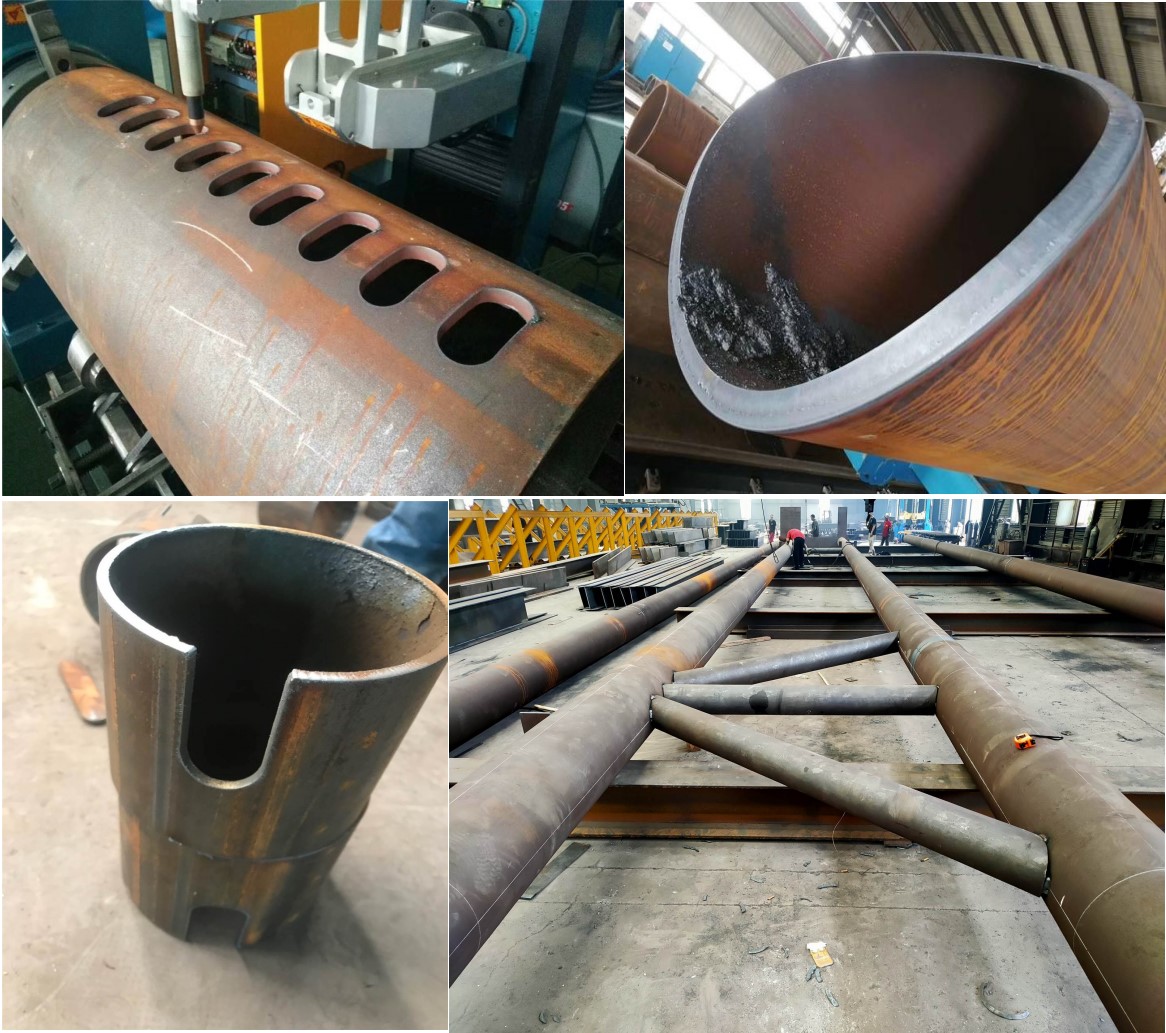
Technical Audit: Fiber Laser Pipe Cutting for Excavator Hydraulic Cylinder Support Structures
We are dealing with a high-cycle fatigue environment. The hydraulic cylinder support on an excavator is not a simple tube; it is a structural backbone subjected to multi-axial loading, shock from bucket impacts, and continuous pressure fluctuations up to 350 bar. For years, the standard fabrication route for these S355JR or S460ML thick-walled tubes (typically 6mm to 20mm wall thickness, 80mm to 200mm OD) was either plasma cutting with a bevel head or band sawing with subsequent machining. Both methods bleed money through secondary operations and material waste. The shift to fiber laser pipe cutting for excavator hydraulic cylinder support is not a luxury; it is a direct response to the scrap rate and cycle time penalties we have been absorbing.
Direct Cost-Benefit Analysis vs. Conventional Plasma & Sawing
Let us strip away the marketing. On the shop floor, the primary cost drivers are: material utilization, consumable life, gas consumption, and labor for deburring. A conventional plasma system cutting a 150mm OD x 10mm wall tube in S355JR will produce a kerf of approximately 2.5mm to 3.0mm. A fiber laser, operating at 6kW to 8kW with a 0.3mm to 0.5mm focal spot, reduces that kerf to under 0.5mm. On a single support tube requiring a 400mm long fishmouth cut, that is a material savings of roughly 2.5mm x 400mm = 1000mm² of steel per cut. Over 10,000 cuts per year, that is 10,000,000 mm² of steel saved—roughly 78 kg of material at 7.85 g/cm³. At current steel prices, that alone covers the nitrogen cost for the laser for three months.
But the real killer is the secondary operation. Plasma cut edges on hydraulic supports require grinding to remove the heat-affected zone (HAZ) and dross before welding. A fiber laser cut edge on S355JR at 1.2 MPa oxygen assist yields a surface roughness Ra of 1.6 µm to 3.2 µm. No grinding. No deburring. The part goes directly from the laser chuck to the welding fixture. We have measured a 40% reduction in total part handling time per support.
Gas Consumption Metrics & Process Parameters
This is where many ROI projections fail. They assume ideal gas flow. In reality, for excavator cylinder supports, we are cutting thick wall sections. For a 12mm wall S355JR tube, we run the following parameters on a 6kW fiber source:
- Assist Gas: Nitrogen for clean edge (no oxide layer) or Oxygen for speed.
- Delivery Pressure: 1.2 MPa to 1.5 MPa at the cutting head. Do not trust line pressure; measure at the nozzle.
- Nozzle Diameter: 3.0mm to 4.0mm for thick sections.
- Gas Flow Rate: Approximately 25 to 35 m³/hour for Nitrogen at 1.5 MPa for a 12mm wall. This is the critical metric. A typical 8-hour shift cutting 40 supports will consume roughly 280 m³ of Nitrogen. At a bulk liquid nitrogen cost of €0.15/m³, that is €42 per shift for gas. Compare that to plasma: plasma requires oxygen at 0.8 MPa and a much higher flow rate (50+ m³/hour) plus the cost of electrodes and nozzles (€3.50 per hour of arc time). The laser gas cost is lower, and the consumable cost (protective windows) is negligible.
- Duty Cycle: The laser source runs at a 95% duty cycle for piercing and cutting. We program a 0.5-second pierce delay at 100% power with a 1.5 MPa oxygen blast to break through the scale.
Technical Comparison: Laser vs. Plasma vs. Sawing
The following table is based on actual production data from a Tier 1 excavator component supplier in Germany. All figures are for a 150mm OD x 10mm wall S355JR tube, 400mm cut length, fishmouth profile.
| Parameter | Fiber Laser (6kW) | Plasma (HD 130A) | Band Saw + Machining |
|---|---|---|---|
| Cutting Speed (mm/min) | 1800 | 800 | 150 (saw) + 300 (mill) |
| Cycle Time per Part (seconds) | 18 | 42 | 95 |
| Kerf Width (mm) | 0.4 | 2.8 | 1.5 (saw blade) |
| Edge Roughness Ra (µm) | 2.0 | 12.5 | 6.3 (after milling) |
| HAZ Depth (mm) | 0.1 | 1.5 | 0.05 (mechanical) |
| Secondary Operations Required | None | Grinding dross | Deburring + chamfer |
| Consumable Cost per Part (€) | 0.12 | 0.45 | 0.30 |
| Gas Cost per Part (€) | 0.08 (N2) | 0.15 (O2) | N/A |
| Total Direct Cost per Part (€) | 0.20 | 0.60 | 0.30 + labor |
Note: Labor cost for secondary operations on plasma and sawing adds approximately €0.40 to €0.60 per part in a Western European shop rate.
ROI Projection & Amortization Schedule
Assume a mid-volume production line: 40 support tubes per shift, 2 shifts per day, 250 working days per year. That is 20,000 parts annually.
- Capital Investment: A 6kW fiber laser tube cutting system with a 3-meter loading bed and 1.5-meter unloading rack: approximately €280,000 to €320,000 depending on automation level.
- Annual Savings vs. Plasma: Direct cost savings of €0.40 per part (from table) plus labor savings of €0.50 per part (eliminating grinding). Total €0.90 per part. 20,000 parts = €18,000 per year in direct savings. But the real gain is throughput. The laser processes 18 seconds vs. 42 seconds for plasma. That is a 57% reduction in cycle time. If the laser runs 2 shifts, it frees up 0.57 of a shift of capacity. That capacity can be sold or used for other work. At a shop rate of €85/hour, that freed capacity is worth approximately €97,000 per year.
- Total Annual Benefit: €18,000 (direct) + €97,000 (capacity) = €115,000.
- Simple Payback: €300,000 / €115,000 = 2.6 years.
- Amortization: With a 7-year straight-line depreciation, the annual depreciation charge is €42,857. The net cash flow after depreciation is €115,000 – €42,857 = €72,143. The return on investment (ROI) is 24% per annum.
This does not account for the reduction in inventory of pre-cut tubes or the elimination of grinding wheel consumables. On the floor, the laser also reduces the physical strain on operators—no heavy grinding tools, no noise from sawing. That translates to lower injury rates, though harder to quantify.
Mechanical Setup & Chuck Pressure Dynamics
For excavator cylinder supports, the tube is often coated with a primer or has mill scale. The chuck must grip without crushing the tube. We set the pneumatic chuck pressure at 0.4 MPa to 0.6 MPa for a 10mm wall tube. Too high, and you induce ovality; too low, and the tube slips during acceleration. The laser head must have a capacitive height control with a 1.5mm standoff for thick sections. We use a 200mm focal length lens to handle the depth of field required for the fishmouth geometry.
FAQ for B2B Procurement
Q1: What is the minimum wall thickness I can cut reliably on S355JR for a hydraulic cylinder support without dross?
For a 6kW fiber laser, the practical minimum is 2mm, but for structural supports, you are likely cutting 6mm to 20mm. Below 6mm, you risk heat distortion on long tubes. We recommend a minimum of 6mm for consistent edge quality. At 1.2 MPa oxygen, you will get a clean edge down to 3mm, but the dross risk increases below 4mm.
Q2: How does the laser handle the scale and rust on hot-rolled seamless tubes used in excavator supports?
Scale is a problem. We use a dynamic piercing routine: a 0.3-second high-pressure oxygen blast at 1.8 MPa to blow the scale away, then drop to 1.2 MPa for cutting. The laser must have a scale-detection sensor to adjust focus. Without it, you get inconsistent penetration. We also recommend specifying a pickled or descaled tube for the best cut edge.
Q3: What is the realistic lifespan of the laser source in a 2-shift operation cutting thick-wall hydraulic supports?
A 6kW IPG or Raycus fiber source, running at 80% average power (4.8kW) for 16 hours a day, will have a diode life of approximately 50,000 to 70,000 hours. That is 8 to 11 years. The most common failure is the protective window contamination from spatter. We replace the window every 200 hours of cutting. The resonator itself is solid-state; no moving parts. The real maintenance cost is the chiller system—ensure you have a 10kW chiller with a 500-liter buffer tank for stable temperature control.













