Diagnosing the Production Floor Bottleneck
Walk into a desk manufacturing plant running traditional cut‑to‑length saws and you will see the real bottleneck: the manual hand-off between bundled raw tube and the infeed of the saw. Forklift operators drop palletised 6‑metre bundles of cold‑rolled ERW square tube. An operator wrestles individual lengths onto a roller table, measures, clamps, cuts. Deburr. Stack. Repeat. On a typical line producing frames for 800 height‑adjustable desks per shift, saw‑cycle time, plus operator fatigue and inevitable measurement drift, yields no more than 220 viable frame kits in an 8‑hour window. Secondary processing—drilling cross‑holes for cable‑management slots and punching assembly tabs—doubles the part‑touch count. When desk OEMs chase 40‑second takt times at final assembly, they discover that the blanking cell has been running at 65‑second intervals all along. The arithmetic is unforgiving.
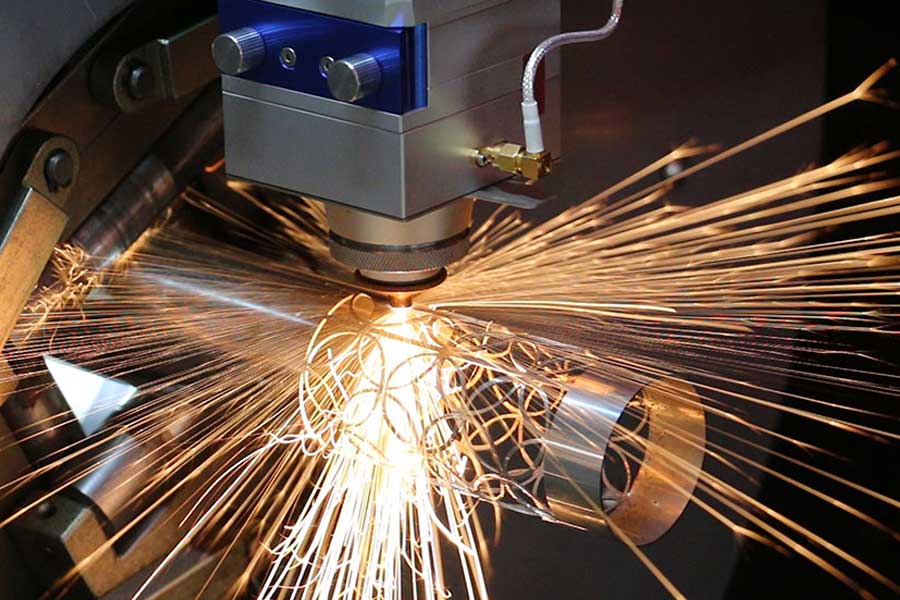
The shift to a fully integrated CNC laser tube cutter with automatic bundling and loading for desks surgically removes those non‑productive touches. A single machine performs profile severing, high‑tolerance contouring, and drilling in one clamping, while an automatic bundle‑loading magazine feeds raw stock without human intervention. The floor‑level consequence is a leap from 220 kits per shift to over 700, using half the floor space and a single operator supervising the cell. Understanding how that leap translates into hard financial metrics requires a component‑by‑component dissection of cost drivers, assist‑gas behaviour, and capital recovery.
Hardware Architecture: Bundling Magazine, Loading Manipulator, and Fiber Laser Head
The machine is a gantry‑style 3D laser cutting centre engineered specifically for tubular profiles: square, rectangular, round, D‑shape, and oval sections from 20 mm to 150 mm diameter, wall thicknesses 1–4 mm in mild steel, and optionally stainless and aluminium. The loading side consists of a multi‑lane bundle magazine with a capacity of 4 tonnes, accepting raw lengths up to 6.5 metres. Pairs of pneumatic separators isolate a single tube, which a magnetic or gripper‑based loading manipulator picks and transfers to a self‑centring chuck. After the chuck closes and confirms diameter via non‑contact sensors, a 3 kW fibre laser head, driven by brushless servos and a proprietary CNC controller with collision‑avoidance algorithms, cuts at traverse speeds up to 120 m/min. The process includes auto‑focus adjustment for varying material thickness and gas pressure ramps for piercing versus high‑speed cutting.
The outfeed side typically integrates a sorting table or an automatic bundler that stacks finished parts by job, ready for the welding cell. No saw blade changes, no daily recalibration of mechanical stops, and no re‑clamping for secondary operations. For desk production, where a single frame can involve eleven distinct profile cuts, three obround slots, and two tapped clean‑outs, the cycle time from bundle to completed part kit drops from over 18 minutes per frame (across multi‑station manual processing) to under 90 seconds on the laser.
Detailed Cost‑Benefit Analysis: Direct Labour, Indirect Operations, and Yield
We isolate the annualised cost delta by comparing a manual band‑saw + drilling line against the automatic tube laser. The baseline manual cell requires three operators per shift: one on raw‑stock handling and saw infeed, one on deburr and measurement, one on drill‑press setup. Fully burdened labour cost is taken at $28/hour in a mid‑cost‑region factory. One 8‑hour shift, 250 working days equates to 6,000 labour hours; total labour $168,000/year.
With the laser system, one operator manages the entire cell—loading raw bundles via forklift, monitoring the interface, and collecting sorted kits. At the same $28/hour, labour cost falls to $56,000/year, yielding a direct saving of $112,000. The laser eliminates perishable tooling: carbide‑tipped saw blades ($4,800 annually) and drill bits/punches ($3,200), for another $8,000. Additionally, nesting the parts along the 6‑metre stock reduces material loss. Our field data across desk‑frame runs shows a 2.7% yield improvement. For a plant consuming 480 tonnes of ERW tube per year at an average landed cost of $1,450/tonne, the raw material saving is $18,792. All told, annual hard savings amount to $138,792.
Intangible benefits add further credibility: a 70% reduction in work‑in‑progress inventory because the laser finishes a frame kit in 90 seconds instead of staging saw‑cut blanks for days; superior dimensional consistency (Cpk ≥ 1.33) that cuts robotic welding rework by a measured 4.2%; and the ability to switch from job to job in under three minutes, enabling smaller batch sizes without economic penalty.
ROI Projection: From Purchase Order to Net‑Cash Break‑Even
We cost the turnkey installation at $295,000, covering a 3 kW fibre laser tube machine with automatic 4‑tonne bundle loader, chiller, fume extraction, laser‑safe enclosure, and on‑site commissioning over five days. We add $25,000 for a dedicated 22 kW screw compressor and refrigerated dryer to supply clean, dry assist air. Total capital outlay: $320,000.
Annual ownership costs include maintenance contract at $11,500 (covers laser source, optics, linear guides); electricity for laser, chiller, drives, and compressor, estimated at $8,500/year (local rate $0.09/kWh); and a contingency of $3,000 for lens replacement. Total annual operational cost = $23,000. Subtracting that from the hard savings above ($138,792 – $23,000) leaves net operational gain of $115,792. Simple payback: $320,000 / $115,792 ≈ 2.76 years. Factoring depreciation via MACRS 7‑year property class and a 21% corporate tax rate, the after‑tax IRR over a five‑year horizon exceeds 28%, making the capital request robust against a 20% downside in forecast labour savings.
Gas Consumption Metrics: Deconstructing the Variable Overhead
Assist gas is often a black box in supplier quotes. We benchmarked gas consumption when cutting desk‑typical 2 mm wall ERW square tube (25 × 25 mm, zinc‑plated) with three different configurations using the same 3 kW fibre laser.
Compressed air (shop air, dried to ISO 8573‑1 Class 1.4.1): Flow rate during cutting 13.2 Nm³/h at 8 bar. With a 22 kW compressor delivering 3.0 Nm³/min at full load, the electrical consumption per hour of active cutting is 15.4 kWh, costing $1.39 per cutting hour at $0.09/kWh—yielding an hour‑cost of $1.39. At a cutting speed of 11.2 m/min, cost per metre = $0.0021. Air is usable only on mild steel up to 3 mm when edge oxidation is acceptable for post‑weld processes.
Oxygen (99.5% purity, bottle manifold): Used when a cleaner kerf is required for visible desk joints. Flow 3.6 Nm³/h at 3 bar. Bottled oxygen runs $0.42/Nm³ in bulk volumes, so gas cost per hour = $1.51. Cutting speed drops to 9.8 m/min on 2 mm, raising cost per metre to $0.0026. For a plant processing 4.2 million metres of cut length per year (matching desk output), the delta between air and oxygen represents an annual $2,100 difference—small enough that quality requirements, rather than cost, dictate the choice.
Nitrogen (99.9%, liquid tank): Demanded for stainless‑steel desk accents. Flow 36 Nm³/h at 18 bar when cutting 2 mm 304 SS. Liquid nitrogen at $0.18/Nm³ high‑volume delivers a staggering $6.48 per cutting hour, or $0.0096 per metre—four times the cost of air. A nitrogen generator with a 90% purity recirculation loop recovers in 18 months under a mixed‑materials desk product line.
Amortization: Mapping Machine Depreciation to Per‑Part Cost
Straight‑line depreciation over seven years (reflecting the expected life of the laser source and mechanics before major overhaul) yields an annual depreciable charge of $45,714. On a volume of 175,000 desk frame kits per year (single shift), the depreciation cost per kit is $0.261. Adding the hourly operational cost ($23,000/2,000 available cutting hours = $11.50/hr) and gas expense (worst‑case oxygen at $1.51/hr) assigns $13.01 to each operating hour. The laser completes one full desk frame kit in 1.5 minutes (0.025 hours), so the full allocated machine cost per kit stands at ($0.261 + $13.01×0.025) = $0.59.
Contrast this with the manual saw‑drill cell whose per‑kit cost we calculated by summing labour ($168,000/175,000 kits = $0.96), tooling ($8,000/175,000 = $0.046), and scrap loss ($18,792/175,000 = $0.107) for a total of $1.11. The laser, even after full depreciation and gas, delivers a $0.52 margin improvement on every desk frame. Multiply across annual volume and the cumulative cash‑flow advantage eclipses the machine’s book value by month 20.
The automatic bundling feature amplifies amortization efficiency by compressing job‑change downtime. Old‑style manual loading incurred 12‑15 minutes of dead time between batch sizes. The magazine‑fed unit swaps bundles in under one minute, preserving approximately 60 production hours per year that otherwise disappear. Those reclaimed hours decrease the effective hourly burden rate by 3%, directly feeding the bottom line.
FAQ: Industrial Procurement of CNC Laser Tube Cutters with Automatic Bundling and Loading for Desks
What is the expected payback period when integrating a tube laser with automatic loading into desk frame production?
Payback typically falls between 24 and 33 months for a single‑shift operation producing 700+ desk frame kits per day. The dominant variable is local labour rate; in regions with $28‑$35/hour fully‑burdened manufacturing wages, direct labour reduction alone returns the capital within three years. Factoring yield improvement and tooling elimination accelerates break‑even to as little as 21 months for high‑mix, small‑batch desk OEMs that previously suffered from excessive changeover time.
How do assist gas consumption metrics influence the total operating cost per metre of cut?
Gas can contribute 8‑15% of the hourly operating cost if bottled nitrogen is used continuously. On mild steel desk components, compressed air delivers the lowest cost ($0.0021/m at 2 mm) with acceptable edge quality for most welded joints. Oxygen adds about 24% to the per‑metre cost relative to air. Nitrogen is substantially more expensive and should be reserved for stainless trim or aesthetic exposed edges. A well‑designed cell includes a gas‑selection panel that automatically switches between air and oxygen based on the part’s cosmetic specification.
Does the automatic bundling system support mixed batches of raw tube dimensions, or does it require single‑size loading?
Modern multi‑lane magazines handle up to five different cross‑section sizes simultaneously, each with individual separator and loading parameters stored in the CNC. The controller recognises the profile by lane and adjusts chuck pressure, laser focus, and gas settings automatically. When a job calls for mixed gauges within the same batch, the operator loads the correct dimensions into designated lanes; the machine picks the required profile without stopping the process flow. Full‑bundle changeover with lane‑reset takes under 90 seconds.













