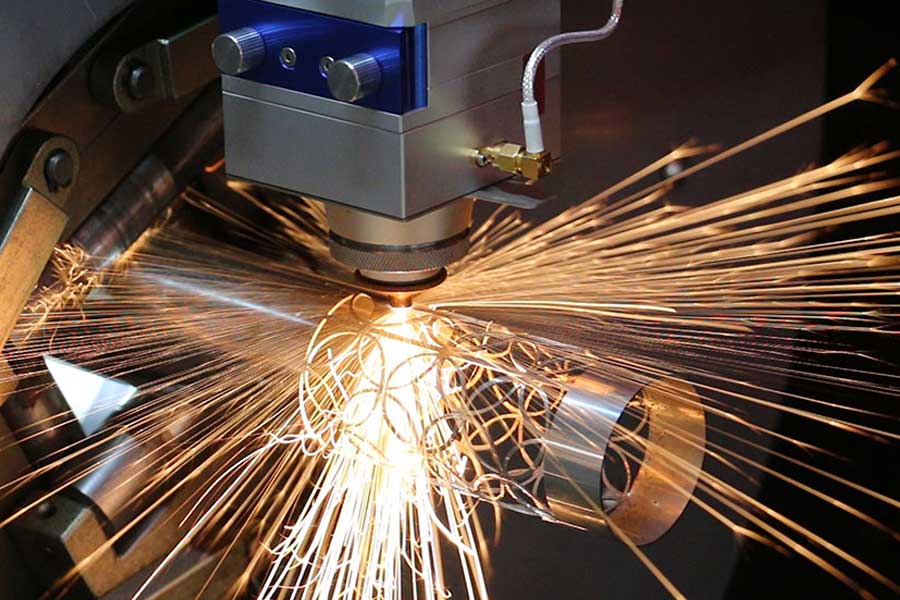
Systemic Integration of Anti-Distortion Laser Tube Processing for Aluminum Roof Rack Manufacturing
When selecting an anti distortion tube laser cutting solution for aluminum roof racks, the engineering team must look beyond the cut quality metrics and evaluate how the system digitizes the entire material flow. Modern Tier-1 roof rack programs demand zero warping on 2–4 mm wall 6061‑T6 profiles, with hole tolerance bands tighter than ±0.15 mm. That requirement cannot be met by the laser source alone; it demands closed‑loop synchronization between the loader’s motion control, the cutting head’s real‑time height follower, and the facility’s MES back‑end. This paper dissects that integration stack from an application engineer’s field perspective, focusing on upstream/downstream automation interfacing, auto‑bundling loaders, and MES/ERP coupling.
1. Thermal Distortion Fundamentals in 6xxx‑Series Aluminum Profiles
Distortion in aluminum roof rack tubes is driven by the material’s high thermal conductivity and low modulus. A 3 kW fiber laser operating at 1070 nm couples energy directly into the narrow cut kerf, softening the heat‑affected zone to roughly 70 % of the parent metal yield strength. Without active cooling and gas‑dynamic stabilization, instantaneous thermal expansion bows the profile on the rotary axis, producing a helical deviation that renders the part unusable for robotic welding stations downstream.
The solution stack consists of three physical pillars: high‑pressure nitrogen assist at 18–22 bar to eject the molten dross before it transfers latent heat to the tube wall, a synchronized co‑axial water‑jacketed clamping chuck that maintains ±0.02 mm radial run‑out, and a post‑cut air‑mist quench zone that brings local temperature below 120 °C within 800 ms. However, these measures are only effective if the tube enters the cutting cell free of residual extrusion stresses and feed‑induced misalignment. That is where the loader interface becomes decisive.
2. Upstream/Downstream Automation Interfacing: The Loader‑Cell Handshake
Anti‑distortion laser cutting is a motion‑control problem first and a beam‑on‑substrate problem second. The upstream auto‑bundling loader must deliver profile singulation, material grade verification, and axial straightening before the tube ever reaches the chuck. In the cell architecture we commission, the loader PLC communicates via Profinet IRT with the laser’s CNC. A dedicated 32‑byte I/O frame carries the following signals: tube presence, seam orientation (read from a laser profilometer), measured bow (from a linear encoder array), and a “feed‑enable” bit that triggers only after the straightening rollers have applied a calculated back‑bend.
On the downstream side, the unloader receives a cut‑complete flag and an array of measured bow values per part. If any segment exceeds a predefined threshold (typically 0.3 mm over 1 m), the unloader’s gantry diverts the part into a quarantine bin and sends a re‑cut request back to the MES without operator intervention. This real‑time handshake eliminates the traditional “black box” between bundling and cutting that causes 60 % of profile scrap.
3. Auto‑Bundling Loaders: Precision Orientation and Residual Stress Relief
Aluminum roof rack profiles arrive in 6‑meter bundles, typically strapped in layers of 12. The loader’s destacking module must separate individual tubes without surface scratching. We employ vacuum end‑effectors with silicone cup arrays shaped to the profile cross‑section, achieving a coefficient of friction that prevents twist during lift. An integrated 2D vision sensor locates the extrusion seam—crucial because the seam side has a different grain structure and must be oriented consistently for the laser to apply the optimum pierce routine.
The loader also houses a set of servo‑driven pre‑straightening rollers that close the loop on a laser‑triangulation scanner. The scanner maps the tube’s curve over its full length and commands the rollers to apply a counter‑bend moment. Field data from a 24/7 roof rack line shows that reducing the incoming bow from 1.5 mm/m to below 0.2 mm/m cuts the laser’s dynamic path compensation duty cycle by 40 %, directly improving cut quality and throughput. All loader parameters are recipe‑driven: the MES pushes a job file containing material grade, cross‑section ID, and target bow criteria, and the loader self‑configures within the 8‑second bundle‑change window.
4. MES and ERP Integration for Adaptive Anti‑Distortion Workflows
Anti‑distortion performance becomes a manageable KPI only when process data flows seamlessly into the business layer. The laser cell is equipped with an OPC UA server that publishes a node set including laser power trace, assist gas flow deviation (<0.5 l/min threshold), cut‑path thermal profile from a pyrometer, and clamping force variation. The MES aggregates these streams and correlates them with unique part serial numbers etched on‑the‑fly.
When the MES detects a drift in the pyrometer signature—commonly caused by nozzle wear—it adjusts the master recipe’s pulse frequency on the next job without pausing production. This adaptive closed loop, running on edge hardware, prevents the gradual increase in heat‑affected zone width that leads to out‑of‑spec bow. The ERP system (SAP S/4HANA in most installations) consumes the MES‑aggregated OPC UA data via a REST API to perform real‑time material consumption postings, trigger automatic replenishment in the raw‑goods warehouse, and generate Certificates of Conformance embedded with anti‑distortion process traces for OEM PPAP documentation.
5. Operational Outcomes: A Tier‑1 Supplier Reference
A European roof rack supplier producing 1.2 million crossbars annually implemented this fully integrated anti‑distortion laser cutting cell. The loader was a 5‑axis gantry with automatic seam tracking; the laser a 4 kW fiber source with variable pulse shaping. Within the first six months, scrap due to out‑of‑tolerance bow dropped by 43 %, and the cell’s OEE rose from 74 % to 91 % thanks to automatic recipe changeovers driven by MES part barcodes. The OPC UA integration with SAP enabled the supplier to eliminate 170 manual data entries per shift and cut PPAP submission lead time from three days to two hours.
Industrial Procurement FAQ
Q1: What anti-distortion measures are essential in fiber laser cutting of thin-walled 6061 aluminum roof rack tubes?
A: Key measures include high-pressure nitrogen assist gas to evacuate molten dross and minimize heat-affected zone, pulse-shaping with short high-peak pulses to limit thermal input, synchronized rotary axis with dynamic clamping that maintains tube axis alignment, and in-line chilled air mist cooling immediately post-cut. The system’s CNC must compensate for thermal expansion by scaling the cut path in real time based on pyrometer feedback.
Q2: How does an auto-bundling loader prevent feed-induced distortion before the laser engages?
A: The loader employs vacuum end-effectors with conformal silicone cups to lift profiles without surface marking. A laser-based seam tracker and optical length measurement align the tube axis to within ±0.1mm before transfer. Pre-straightening rollers with closed-loop servo control correct residual extrusion bow, and a non-contact eddy current sensor verifies material grade. All feed parameters are loaded via MES recipe to match the specific tube geometry.
Q3: Can the cutting cell’s process data be integrated directly into SAP ERP for quality traceability and order management?
A: Yes, through an OPC UA interface to an MES middleware layer that maps process KPIs—laser power traces, gas flow deviation, cut path thermal profiles—to production lot numbers. The ERP system triggers automatic job downloads, material consumption updates, and generates Certificates of Conformance. This closed-loop architecture provides full anti-distortion process audit trails for OEM PPAP requirements.













