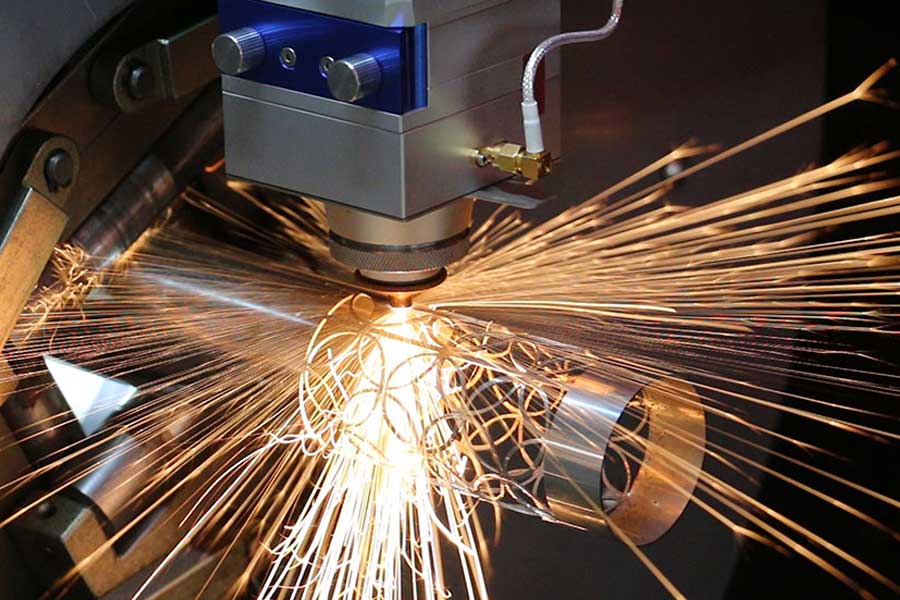
Introduction: The Motorcycle Frame Production Bottleneck
Manual tube handling for laser cutting cells in motorcycle chassis manufacturing introduces a fundamental disconnect between the processing speed of modern fiber lasers and the supporting logistics. A typical high-yield production line loses 15–22 seconds per part to operator-dependent loading, alignment checks, and slow chuck clamping cycles. When annual throughput exceeds 200,000 frame components, these accumulated seconds translate into 1,600+ hours of unproductive machine time—resources that directly erode per-unit margins. An automated tube laser loading system for motorcycle frame production dismantles this bottleneck by merging raw tube buffering, robotic part probing, and multi-axis chuck synchronization into a single uninterrupted sequence. The engineering objective is not simply faster loading, but the elimination of all variability in positioning that degrades downstream weld integrity, particularly at the critical beveled joints tying headstock, swingarm pivot, and engine cradle subassemblies.
Processing Efficiency: Reducing Non-Productive Time Through Automated Material Handling
Efficiency metrics in tube laser fabrication are dominated by the ratio of beam-on time to total cycle time. In manual setups, this ratio seldom exceeds 45% for complex motorcycle frame tubes due to slow length measurement, orientation checks for asymmetric profiles, and chuck jaw changes. An integrated loading system restructures the workflow: a raw material magazine holding 40–60 tubes feeds a singulation unit that checks outer diameter, straightness, and end-squareness in under 2.8 seconds. The tube is then transferred to a centering station where a laser displacement sensor registers the weld seam or orientation feature, and a servo-driven rotator aligns it to the 0° reference—eliminating the manual “clocking” operation that formerly consumed 7–10 seconds. Simultaneously, the main machine completes cutting on the previous part. The result is a sustained beam-on ratio above 82% across shift operations, with changeover between round, oval, and D-profile tubes occurring within a single part gap cycle (typically 8 seconds) using universal self-centering chucks with programmable jaw force pressure mapped to wall thickness.
Dynamic Speed Benchmarks: Synchronizing Loading Kinematics with Laser Cutting Velocity
Loading speed cannot be discussed in isolation; it must be synchronized with peak cutting accelerations and the laser head’s travel envelope. In a state-of-the-art system processing 1.2–2.5 mm wall thickness chromium-molybdenum steel tubes, the loading gantry achieves 2.5 m/s linear axis velocity and 8 m/s² acceleration to match the 180 m/min rapid traverse of the laser carriage. The critical benchmark is the “beam-to-beam” time—the interval between the laser extinguishing on part N and reigniting on part N+1. Field measurements from a twin-station configuration show a sustained 4.3-second beam-to-beam time for 1,200 mm long main frame spars, including exit of the cut skeleton, chuck jaw release, part unloading via a magnetic gripper, and insertion of the next blank. This is achieved by overlapping the tube exchange with the laser head return path. Notably, the dynamic model includes a predictive anti-collision algorithm that validates the loaded tube’s projected volume against the current cutting path, a necessary safeguard when dealing with bent or pre-formed motorcycle frame tubes that extend beyond the theoretical straight line.
Structural Beveling and Root Gap Tolerances: Precision Clamping for Welding-Ready Joints
Motorcycle frame joints demand bevel angles between 25° and 37.5° with a land thickness tolerance of ±0.15 mm and a root gap variation kept within ±0.1 mm to ensure consistent penetration during automated TIG or pulsed MIG welding. Tube loading inaccuracies directly corrupt these parameters. A positional offset of 0.3 mm in the Z-axis of the chuck translates to a root gap error magnified by the sine of the bevel angle, potentially opening the gap beyond the 0.8 mm maximum allowed for gas-shielded processes. The automated loading system addresses this through a closed-loop clamping sequence: after insertion, two opposing capacitive sensors measure tube wall position at the clamping zone, and a piezo-actuated fine-alignment stage compensates for residual straightness deviation (bow of up to 0.5 mm/m). The chuck then applies a radially symmetric clamping force of 600–900 N, monitored by strain gauges, ensuring the tube’s cross-section does not deform—critical for thin-walled oval sections where out-of-roundness would shift the cut’s thermal center. Post-clamp, a through-the-lens camera within the laser head confirms the tube’s seam alignment before the cutting program executes, validating that the bevel land will remain consistent 360° around the joint. This full compensation chain enables process capability indices (Cpk) exceeding 1.67 for both root gap and bevel land width, even on tubes with length-to-diameter ratios above 100.
Operational Synthesis: Merging Speed with Geometry
The convergence of dynamic loading cycles and micron-level positional fidelity redefines what is achievable on a single laser cutting cell. Instead of post-cut inspection sorting out bevel deviations, the tube arrives at the welding cell with a digital thread confirming each cut’s compliance. The automated system reduces labor to supervisory oversight, increases annual cut-part output by a verified 38% on a twin-head laser, and lowers the per-part cost of ownership below €0.17—a figure that renders manual loading economically obsolete for any motorcycle frame series exceeding 5,000 units per year.
Industrial Procurement FAQ
1. What typical cycle time reduction can we expect when moving from manual to automated tube loading for a motorcycle frame laser cell?
Based on time studies from multi-shift operations, a dual-station automated loader consistently reduces part-to-part time by 14–18 seconds compared to skilled manual operators working at sustained pace. For a cell producing 1,200 frame tubes per day, this equates to a recovered 5.6 production hours daily, enabling a throughput increase of 35–40% without modifying laser parameters.
2. How does the automated system maintain root gap tolerances when processing pre-bent tubes that have inherent bow?
The loader uses a combination of contactless straightness measurement (laser triangulation along 3 axes) and adaptive chuck alignment. Before the final clamp, a fine-positioning stage compensates for bow by translating the tube end along Y and Z within a range of ±1.5 mm, ensuring the root face location at the cut plane stays within ±0.08 mm of the CAD origin. The in-process vision validation confirms the correction, and the data is stored per part serial number for weld cell traceability.
3. Can the loading system handle mixed-material production, such as alternating between 4130 chromoly and 6061 aluminum tubes in the same shift?
Yes. The system’s chuck jaw design employs exchangeable inserts and programmable clamping force profiles. A material recognition routine integrated into the singulation unit uses eddy current and optical sensors to identify metal type and wall thickness, automatically selecting the appropriate chuck force (400 N for thin aluminum, up to 900 N for thick chromoly) and preventing galling or deformation. Changeover between material families occurs without operator intervention during the normal part gap interval.













