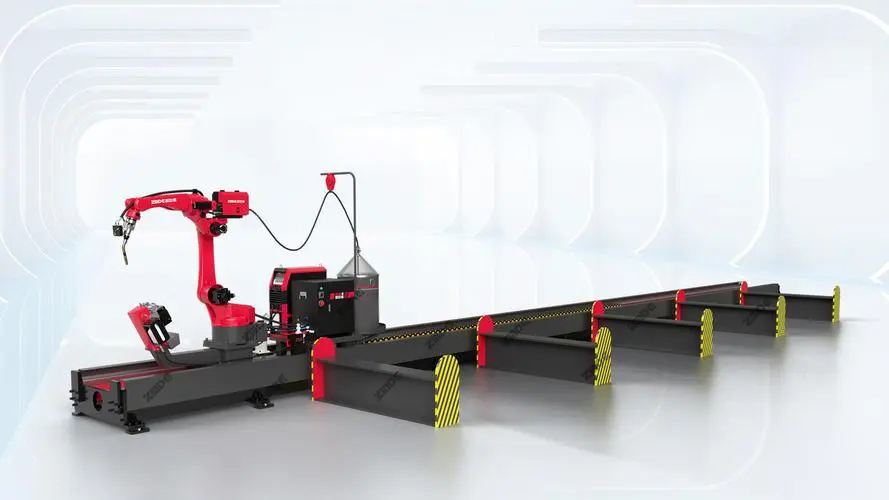
Modern structural steel fabrication, heavy machinery chassis assembly, and long-span architectural truss manufacturing require advanced adaptive joining systems. The deployment of our autonomous teachless robotic welding machine with a 12-meter linear horizontal travel track marks a crucial shift away from traditional manual trajectory teaching. Integrated with CAD-to-Path intelligent software and high-speed blue-laser sensors, this premium industrial cell adapts dynamically to large complex parts on global production lines, delivering certified multi-pass weld quality without human pendant bottlenecks.
Teachless Laser Vision Dynamic Tracking Technology
The core technological advantage of this setup is the elimination of manual torch teaching. Traditional robotic cells often face lengthy downtime when reconfiguring for non-standard parts, stifling efficiency in low-volume, high-mix structural steel and heavy equipment sectors. This work cell, specialized in vision-guided automated joining cells and large-component multi-pass processing, employs an advanced laser vision sensor mounted adjacent to the torch head cluster.
This sensor scans the joint topography in real-time, instantly identifying groove type, fit-up displacement, and localized thermal distortion parameters. Autonomous control software converts this volumetric data into precise multi-axis kinematics and synchronized linear rail positioning, generating optimal, clean thermal joining paths without human pendant input.
Integrated 12-Meter Linear Travel Track Infrastructure
For operations targeting massive structural components—such as crane girders, ship sections, and long multi-section industrial boilers—the robotic cell is integrated onto a heavy-duty 12-meter linear horizontal travel track. This horizontal travel rail extends the robotic work envelope significantly, allowing continuous fusion across long-span segments without pausing for work-piece repositioning. The track uses high-grade linear guideways and ground rack-and-pinion drives synchronized perfectly within the main multi-axis controller.
This extended linear axis layout operates seamlessly alongside associated factory automation. Global fabrication facilities can deploy this work cell to leverage unified communication protocols matching high-tier robot de soudure networks or complex multi-station soudure robotisée and machine de soudage robotisée environments.
Technical Specification Matrix: Autonomous Work Cell Parameters
Review the standard hardware configurations engineered directly into our factory configuration plans to ensure seamless facility integration:
Deployment Integrity and Factory Workflow Alignment
Achieving absolute fabrication continuity with an autonomous cell requires a balanced plant floor infrastructure. Sourcing equipment directly from the original production plant ensures long-term software update support and authentic mechanical components across international supply chains.
