The Industrial Evolution of Rayong’s Maritime Sector
Rayong has long served as the heartbeat of Thailand’s Eastern Economic Corridor (EEC). As the global demand for more efficient, lighter, and more durable vessels increases, the region’s shipyards have faced a critical choice: modernize or be left behind. The introduction of the 20kW Universal Profile Steel Laser System represents the pinnacle of this modernization.
In the high-stakes environment of shipbuilding, where tolerances are measured against the unforgiving nature of the sea, the precision of a fiber laser is transformative. Traditional methods like plasma cutting, while effective for thickness, often introduce significant Heat Affected Zones (HAZ), which can compromise the structural integrity of marine-grade steel. The 20kW fiber laser minimizes this thermal footprint, ensuring that the metallurgical properties of the steel remain intact, a factor that is non-negotiable for hulls navigating international waters.
Unpacking the Power: Why 20kW Matters
For an expert in laser physics, the jump to 20kW is not merely about “more power”; it is about “power density” and “processing stability.” At 20kW, the laser beam possesses enough energy to maintain a stable vapor capillary (keyhole) even in thick, rusted, or primed shipbuilding steel.
In a Rayong shipyard, this translates to cutting speeds that are 300% to 500% faster than traditional methods for 20mm to 30mm plates. Furthermore, the 20kW source provides the “reserve power” necessary to maintain a vertical kerf and a dross-free finish. When dealing with AH36 or DH36 high-tensile steels used in ship construction, the 20kW system allows for nitrogen cutting on medium thicknesses, which produces a bright, oxide-free edge. This is critical because it allows for immediate painting or welding without the need for mechanical grinding, saving thousands of man-hours across a single vessel project.
The Universal Profile Capability: Beyond Flat Plates
Shipbuilding is not just about flat sheets; it is a complex puzzle of structural members. The “Universal Profile” designation of this system means it is equipped to handle H-beams, I-beams, L-angles, C-channels, and bulb flats—the skeletal structure of any ship.
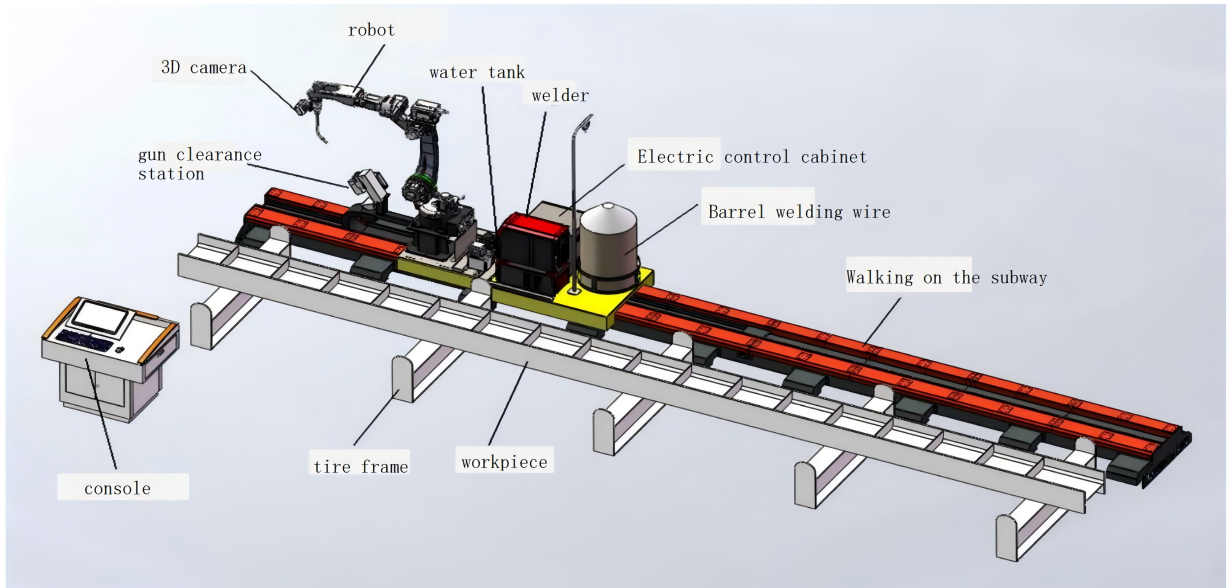
Historically, processing these profiles required multiple machines: a saw for length, a drill for holes, and manual torches for notches and cope cuts. The 20kW Universal system integrates all these functions into a single robotic or gantry-based workstation. By using advanced 3D sensing technology, the laser can compensate for the slight twists and deviations common in long structural profiles, ensuring that every bolt hole and interlocking notch is perfectly aligned. This “one-stop” processing is the cornerstone of the modern “smart shipyard” philosophy.
The Infinite Rotation 3D Head: Engineering Without Limits
The most technically impressive component of this system is the Infinite Rotation 3D Head. Traditional 5-axis laser heads are often hindered by “cable wrap,” where the internal gas hoses and electrical lines limit the rotation to perhaps 360 or 720 degrees before the head must “unwind.” In a complex shipbuilding environment—where the laser may need to follow a winding path around a curved bulkhead or a circular pipe—this unwinding causes downtime and creates “start-stop” marks on the metal.
The infinite rotation head utilizes advanced slip-ring technology and specialized fiber optical joints to rotate indefinitely. This allows for continuous bevel cutting at angles up to ±45 degrees. For weld preparation, this is a game-changer. The system can execute a “variable bevel,” where the angle of the cut changes fluidly along the contour of the part. This ensures that when two massive hull sections are brought together, the fit-up is airtight, requiring less filler wire and resulting in a much stronger weld seam.
Precision Weld Preparation and Reduced Fit-Up Time
In the traditional shipbuilding workflow, “fit-up” (the process of aligning parts for welding) can take up to 40% of the total assembly time. Much of this is due to the inaccuracies of manual or plasma cutting, which require “trimming to fit” on the shop floor.
With the 20kW laser and 3D head, the “Ready-to-Weld” concept becomes a reality. The laser produces a precision that plasma cannot match, especially on complex bevels like the K-cut or the X-cut. Because the parts are cut to a tolerance of +/- 0.1mm, they slot together like Lego blocks. In Rayong’s competitive labor market, reducing the reliance on highly skilled manual fitters and grinders allows shipyards to scale their output without a proportional increase in headcount.
Integration with Rayong’s Digital Ecosystem
The deployment of such a system in Rayong aligns perfectly with Thailand 4.0 initiatives. These laser systems are typically integrated with advanced PLM (Product Lifecycle Management) and NESTING software. For a shipyard, this means that a CAD design from an architect in Bangkok or Singapore can be sent directly to the machine in Rayong.
The software optimizes the nesting of parts on the steel sheet to minimize waste—a vital feature given the rising costs of raw materials. Furthermore, the 20kW system provides real-time data feedback. Managers can monitor gas consumption, cutting time, and energy usage from a smartphone, allowing for “Just-in-Time” manufacturing that was previously impossible in heavy industry.
Environmental Impact and Operational Efficiency
The shift to 20kW fiber lasers also brings a significant environmental benefit to the Rayong industrial zone. Compared to CO2 lasers, fiber lasers are roughly 3 to 4 times more energy-efficient. Compared to plasma cutting, they produce significantly less dust and hazardous fumes, as the high-speed laser process coupled with sophisticated dust extraction systems keeps the shipyard air cleaner.
Moreover, the longevity of the fiber laser source—often rated for 100,000 hours—means less electronic waste and lower maintenance costs over a 10-year cycle. For Thai shipbuilders looking at the Total Cost of Ownership (TCO), the initial investment in a 20kW system is offset by the drastic reduction in secondary processing, lower power bills, and the elimination of consumables like plasma electrodes and nozzles.
The Future: Autonomy in the Shipyard
As we look toward the next decade, the 20kW Universal Profile Steel Laser System is just the beginning. The “Infinite Rotation” capability paves the way for fully autonomous robotic cells where AI-driven vision systems identify the steel profile as it arrives on a conveyor, and the laser head automatically adjusts its path to compensate for material grade and thickness.
For the shipyards in Rayong, this technology represents more than just a faster way to cut steel; it represents a seat at the table of the global maritime elite. By producing vessels that are lighter (due to precision thinning of structural members) and stronger (due to superior weld prep), Thai shipbuilders can compete with the giants of South Korea and China.
In conclusion, the 20kW Universal Profile Steel Laser System with Infinite Rotation 3D Head is the definitive tool for the modern maritime era. It bridges the gap between heavy-duty structural fabrication and high-precision engineering, ensuring that Rayong remains a formidable force in the global shipbuilding landscape. For the expert, it is a masterpiece of photonics and mechanics; for the shipyard owner, it is the engine of future growth.