The New Era of Maritime Fabrication in Dubai
Dubai has long served as the pulse of the Middle East’s maritime industry. From the bustling activities at DP World to the specialized engineering within Dubai Maritime City and Drydocks World, the demand for rapid, high-precision structural steel fabrication has never been higher. Shipbuilding and offshore platform construction require the processing of massive quantities of H-beams, I-beams, and channels. Historically, this has been a labor-intensive process involving band saws, plasma cutters, and manual grinding for weld preparation.
The introduction of the 20kW H-Beam laser cutting Machine with ±45° beveling changes the equation entirely. In an industry where “time is money” is a literal calculation of dockage fees and contract penalties, the ability to cut a complex H-beam profile in minutes—rather than hours—is revolutionary. This machine serves as the centerpiece of a modern shipyard, bridging the gap between digital design and physical assembly.
The Significance of 20kW Fiber Laser Power
In the realm of fiber lasers, power equates to more than just “more heat.” A 20kW resonance provides a power density that allows for the vaporization of thick structural steel with incredible speed. For H-beams, which often feature thick flanges and webs, 20kW ensures that the laser can penetrate and slice through varying thicknesses without the dross or heat-affected zone (HAZ) issues common with lower-power sources or plasma alternatives.
At 20kW, the cutting speed on 12mm to 25mm steel—the bread and butter of ship frames—is exponentially faster than 6kW or 10kW systems. Furthermore, the high power allows for the use of compressed air or nitrogen as an assist gas on thicker sections than previously possible, significantly reducing the cost per cut compared to oxygen-assisted cutting. In Dubai’s competitive market, reducing the cost of consumables while increasing throughput is the primary driver for ROI.
Mastering the Geometry: 3D H-Beam Processing
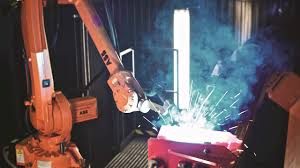
Unlike flat-sheet cutting, H-beam processing is a three-dimensional challenge. The beam must be rotated or the laser head must travel around the profile to reach the web and both flanges. A 20kW H-beam laser machine utilizes a sophisticated 5-axis or 6-axis robotic arm or a specialized bridge structure that allows the cutting head to orbit the workpiece.
This capability allows for the cutting of bolt holes, cope notches, and complex cut-outs in a single programmed sequence. In shipbuilding, where beams must often interlock or pass through bulkheads at specific angles, the precision of a laser is unmatched. The machine’s software takes the 3D model (often from TEKLA or similar CAD platforms) and translates it into a cutting path that accounts for the beam’s structural deviations, ensuring a perfect fit during the assembly stage at the drydock.
The Game Changer: ±45° Bevel Cutting for Weld Prep
In shipbuilding, a cut is rarely just a cut. To ensure structural integrity, most joints require a specific bevel—V, Y, or K-shaped grooves—to allow for full-penetration welding. Traditionally, a shipyard worker would cut the beam to length and then spend hours with a handheld grinder or a portable beveling machine to create the necessary edge angle.
The ±45° beveling head on a 20kW laser machine eliminates this secondary process entirely. As the laser cuts the profile of the H-beam, it simultaneously tilts to the required angle, creating a weld-ready edge in real-time. The precision of a ±45° laser bevel is significantly higher than manual or plasma-cut bevels, leading to:
1. **Reduced Weld Volume:** Precise bevels mean tighter tolerances, requiring less filler wire and fewer welding passes.
2. **Increased Structural Strength:** Consistent bevel angles ensure uniform heat distribution during welding, critical for vessels subjected to the high-pressure environments of the open sea.
3. **Automation of Complex Intersections:** When two beams meet at an oblique angle, the bevel required is not constant. The laser’s CNC controller can vary the bevel angle dynamically as it moves, a task that is nearly impossible to do accurately by hand.
Operational Resilience in the Dubai Climate
Operating high-power fiber lasers in Dubai presents unique environmental challenges. The extreme ambient temperatures, which can exceed 45°C in the summer, combined with high humidity and fine desert dust, require a machine built for “industrial survival.”
A 20kW laser for a Dubai shipyard must be equipped with an oversized, high-efficiency chilling system to maintain the stability of the laser source and the cutting head optics. Furthermore, the machine’s internal components must be housed in pressurized, air-conditioned cabinets to prevent the ingress of dust and moisture. For a fiber laser expert, the “Dubai spec” means ensuring that the beam delivery path is entirely sealed and that the optics are protected by multi-stage filtration. The reliability of the machine in these conditions is what separates a world-class shipyard from its competitors.
Integrating Industry 4.0 into the Shipyard Workflow
The 20kW H-beam laser is a data-driven machine. In the context of Dubai’s “Smart City” initiatives and the move toward industrial automation, these machines are integrated into the shipyard’s PLM (Product Lifecycle Management) systems.
Shipbuilders can track the progress of every beam in real-time. Because the laser marks the steel with part numbers, QR codes, and assembly instructions during the cutting process, the logistics of moving thousands of tons of steel through a shipyard become manageable. This traceability is vital for maritime certification (such as Lloyd’s Register or ABS), as it provides a digital paper trail from the raw material to the finished hull section.
Economic Impact and Return on Investment
While the capital expenditure for a 20kW H-beam laser with beveling capabilities is significant, the ROI for a high-volume Dubai shipyard is typically realized within 18 to 24 months. The savings are found in four key areas:
* **Labor Reduction:** One laser operator can replace a team of five or six workers involved in sawing, drilling, and grinding.
* **Material Utilization:** Advanced nesting software for H-beams minimizes “drops” or scrap, which is essential given the high cost of marine-grade steel.
* **Floor Space:** By consolidating multiple processes (cutting, drilling, beveling) into one machine footprint, the shipyard frees up valuable real estate for assembly and painting.
* **Assembly Speed:** Because the parts are cut with sub-millimeter precision, they “snap together” on the shop floor. This reduces the need for “forced fits” and re-work, which are the primary causes of project delays in shipbuilding.
Conclusion: The Future of the Horizon
As the maritime industry shifts toward greener fuels and more complex vessel designs, the demand for precision-engineered structural steel will only grow. For Dubai shipyards, staying competitive on a global scale requires the adoption of the most advanced fabrication technologies available.
The 20kW H-Beam Laser Cutting Machine with ±45° Bevel Cutting is more than a tool; it is a statement of intent. It signals that a shipyard is capable of handling the most demanding offshore and marine projects with speed, accuracy, and efficiency. By harnessing the power of the fiber laser, Dubai’s maritime sector is not just building ships; it is carving out the future of global infrastructure, one perfectly beveled beam at a time. Through the lens of a fiber laser expert, the transition to 20kW technology is the single most important step a modern shipyard can take to ensure its dominance in the 21st-century blue economy.