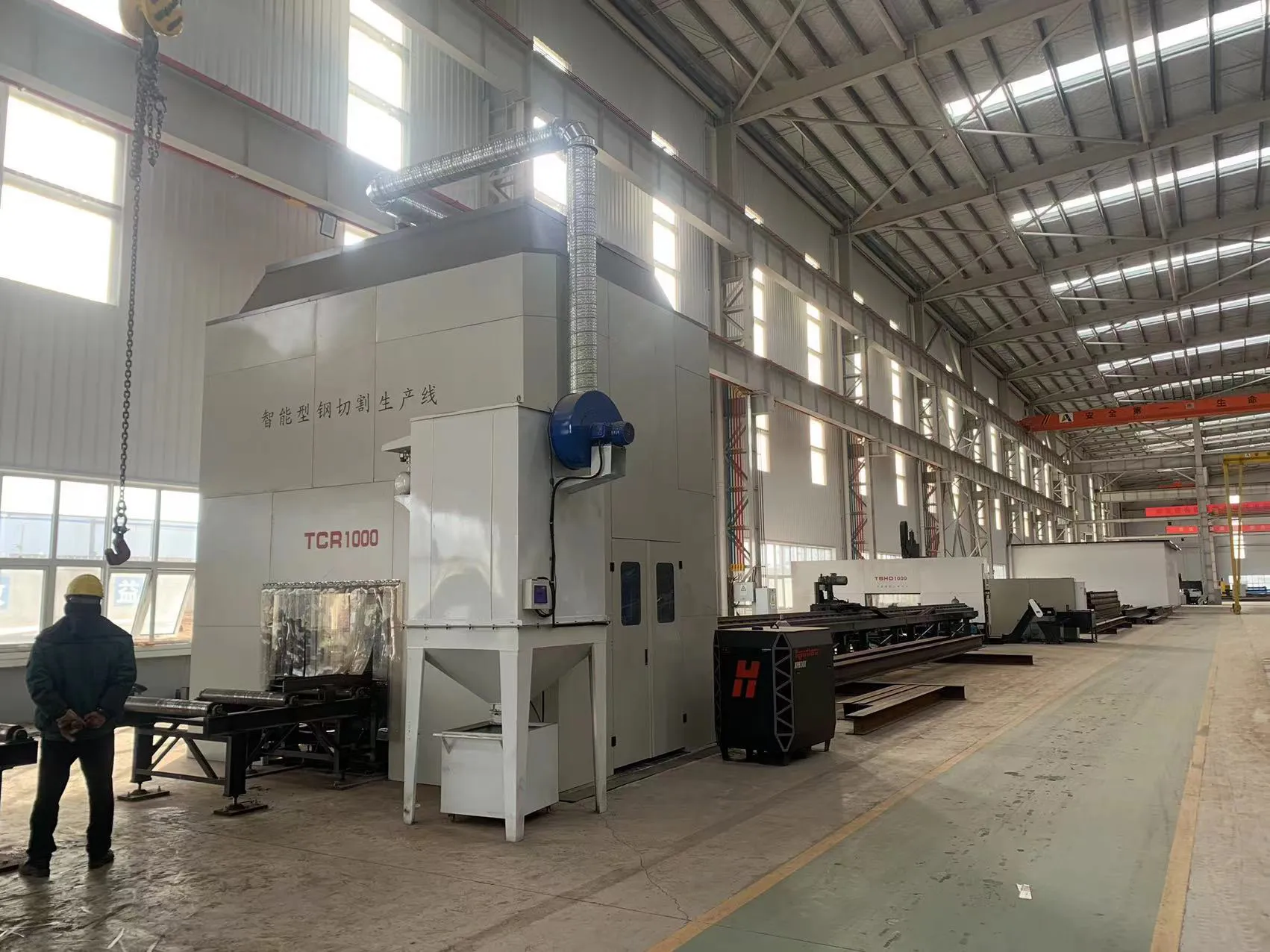
The Dawn of High-Power Structural laser cutting in Haiphong
Haiphong has long been the industrial heartbeat of Northern Vietnam. As a port city and a focal point for the “China + 1” manufacturing strategy, its demand for sophisticated logistics and warehousing solutions has skyrocketed. Storage racking—the skeletal framework of every modern warehouse—requires immense structural integrity and precision. Traditionally, these H-beams and heavy channels were processed using plasma cutting, sawing, or manual drilling. However, the introduction of the 6000W fiber laser has rendered these traditional methods obsolete.
The 6000W fiber laser is the “golden power level” for the racking industry. It offers the perfect balance between capital investment and high-speed processing of medium-to-thick materials. In the context of H-beams (Universal Beams), which form the vertical uprights of heavy-duty pallet racks, the laser’s ability to pierce and cut through 12mm to 20mm carbon steel with surgical precision is a game-changer for Haiphong’s local fabricators.
Technical Architecture of the 6000W H-Beam Laser
As a fiber laser expert, I look at the 6000W source not just as a light generator, but as a concentrated tool of thermal kinetic energy. The beam quality (BPP) of a 6000W source allows for a high energy density that can vaporize steel almost instantly. When applied to H-beams, the machine must navigate the complex geometry of the flange and the web.
Unlike standard tube lasers, an H-beam laser requires a sophisticated 3D cutting head and often a four-chuck system. These chucks provide the necessary torque to rotate heavy structural sections while maintaining a concentricity error of less than 0.1mm. For storage racking, where holes must align perfectly across a 12-meter upright to ensure bolt-through stability, this level of precision is non-negotiable. The 6000W power specifically allows for “High-Speed Air Cutting” on thinner sections of the beam, significantly reducing the cost per part by eliminating the need for expensive oxygen or nitrogen in certain thicknesses.
The Critical Role of Automatic Unloading Systems
Perhaps the most significant bottleneck in heavy structural fabrication is material handling. An H-beam can weigh hundreds of kilograms. Manual unloading is not only slow; it is a significant safety hazard. In the high-output factories of Haiphong, the “Automatic Unloading” feature is what separates a standard workshop from a Tier-1 industrial supplier.
The automatic unloading system utilizes a series of hydraulic lifting arms and conveyor rollers that sync with the CNC controller. Once the laser finishes the final cut, the system gently lowers the processed H-beam and transports it to a collection rack. This allows the machine to immediately begin the next cycle without waiting for a crane or a forklift. In the storage racking industry, where a single project might require thousands of identical beams, the cumulative time saved by automatic unloading can increase total factory throughput by 30% to 40%.
Optimizing Storage Racking Production: Precision and Complexity
Storage racking systems, particularly high-density pallet racks and “drive-in” systems, rely on the perfect fitment of components. The uprights are often perforated with complex “teardrop” or rectangular hole patterns. Using a 6000W laser, these patterns are cut with zero mechanical stress on the material, unlike traditional punching which can deform the steel.
Furthermore, the 6000W laser excels at “Bevel Cutting.” Many heavy-duty racks require beveled edges for better welding penetration or specialized interlocking mechanisms. A 6000W machine with a 5-axis head can cut these bevels in a single pass. In Haiphong’s competitive market, being able to deliver a “ready-to-weld” or “ready-to-bolt” component straight from the laser bed gives manufacturers a massive edge in lead times.
Economic Impact on Haiphong’s Industrial Sector
The investment in a 6000W H-beam laser is significant, but the Return on Investment (ROI) in the Haiphong region is accelerated by several factors. First is the reduction in labor costs. A single automated laser line can replace three separate stations (sawing, drilling, and deburring). Second is the reduction in secondary processing. The edge quality produced by a 6000W fiber laser is so clean that grinding is rarely required before powder coating.
Haiphong is currently home to several massive industrial zones like Deep C and VSIP. These zones are attracting global e-commerce and logistics giants who demand international-standard racking. By utilizing high-power lasers, local Vietnamese manufacturers can meet these international standards, allowing them to compete with global suppliers and even export their racking systems to the US and European markets.
Addressing the Challenges of Thick Section Cutting
While 6000W provides ample power, as an expert, I must emphasize the importance of gas dynamics and nozzle technology. When cutting the thick webs of an H-beam, the machine uses “Oxygen-Aided Cutting” to maintain a smooth kerf. The 6000W source allows for a more stable “bright surface” cut on thick carbon steel, which is aesthetically pleasing and structurally superior.
One challenge often faced in Haiphong’s humid coastal climate is the consistency of the cutting gas and the protection of the optical path. High-end 6000W machines are now equipped with sealed optical cabins and advanced humidity control to ensure the laser beam does not scatter. This ensures that the 6000W of power at the source is actually 6000W at the workpiece, ensuring consistent penetration even in the most demanding environmental conditions.
The Integration of Industry 4.0 and Nesting Software
The hardware is only half the story. The 6000W H-beam machines in Haiphong are increasingly being paired with advanced “Nesting Software” like TubesT or Lantek. This software is designed specifically for structural shapes. It can “nest” different lengths and hole patterns on a single H-beam to minimize “remnant” or scrap metal.
In the storage racking industry, material costs account for nearly 70% of the total product cost. Reducing waste by even 3% through smarter laser nesting can save a company hundreds of thousands of dollars annually. Furthermore, these machines are now “IoT-ready,” allowing factory managers in Haiphong to monitor gas consumption, cutting time, and power usage from their smartphones, bringing a level of transparency to the shop floor that was previously impossible.
Safety and Environmental Considerations
The shift to 6000W fiber lasers also represents a “green” shift for Haiphong. Compared to CO2 lasers, fiber lasers are significantly more energy-efficient, consuming about 1/3 of the electricity. Compared to plasma cutting, the laser process is much cleaner. The integrated dust extraction systems on modern H-beam lasers capture 99% of the particulate matter, protecting the health of the Vietnamese workforce and complying with the increasingly strict environmental regulations in Haiphong’s industrial parks.
Furthermore, the automatic unloading system minimizes the “human-machine interface” during the most dangerous part of the process—handling heavy, sharp-edged steel. This reduction in workplace accidents is a critical metric for modern ESG (Environmental, Social, and Governance) compliance, which is becoming a requirement for suppliers of multinational corporations.
Future Outlook: Scaling Beyond 6000W
While 6000W is currently the sweet spot for H-beams in the storage racking sector, the trend is moving toward even higher powers, such as 12kW and 20kW. However, for the specific thicknesses used in most industrial racking (up to 15mm-20mm), the 6000W machine remains the most cost-effective solution for Haiphong’s current infrastructure.
As Haiphong continues to develop as a global logistics hub, the synergy between high-power fiber lasers and automated material handling will be the cornerstone of its manufacturing success. The 6000W H-Beam Laser Cutting Machine is not just a tool; it is a catalyst for industrial maturity, enabling local companies to build the massive, precise, and safe storage systems that will hold the world’s goods.
In conclusion, the marriage of 6000W fiber laser precision with automatic unloading technology is revolutionizing storage racking production in Haiphong. It addresses the core needs of the industry: speed, accuracy, safety, and cost-efficiency. For any manufacturer in the structural steel or logistics equipment space, this technology is no longer a luxury—it is the baseline for survival in a modern, globalized economy.