The Dawn of 30kW Fiber Laser Power in Rosario’s Industrial Hub
Rosario has long been the heartbeat of Argentina’s metal-mechanical industry. As the gateway to the Paraná River and a central node for the country’s energy infrastructure, the city is uniquely positioned to lead the fabrication of components for offshore oil and gas rigs and renewable energy platforms. However, the sheer scale of offshore engineering requires materials that are thick, resilient, and difficult to process.
The arrival of the 30kW fiber laser represents a quantum leap in capability. While 10kW and 20kW systems have become common in sheet metal shops, the 30kW threshold is where fiber laser technology begins to dominate heavy structural steel. At this power level, the laser doesn’t just cut; it vaporizes high-tensile carbon steel and specialized alloys with a speed and cleanliness that plasma or oxy-fuel systems cannot match. For Rosario’s fabrication yards, this means the ability to process structural H-beams, I-beams, and C-channels with wall thicknesses exceeding 30mm or 40mm while maintaining a narrow kerf and minimal heat-affected zone (HAZ).
Revolutionizing Structural Fabrication: The Beam and Channel Advantage
Offshore platforms are architectural marvels of structural steel. They rely on complex lattices of beams and channels that must withstand extreme hydrostatic pressure and corrosive maritime atmospheres. Traditional methods of preparing these sections—such as mechanical drilling, sawing, and manual torch cutting—are labor-intensive and prone to human error.
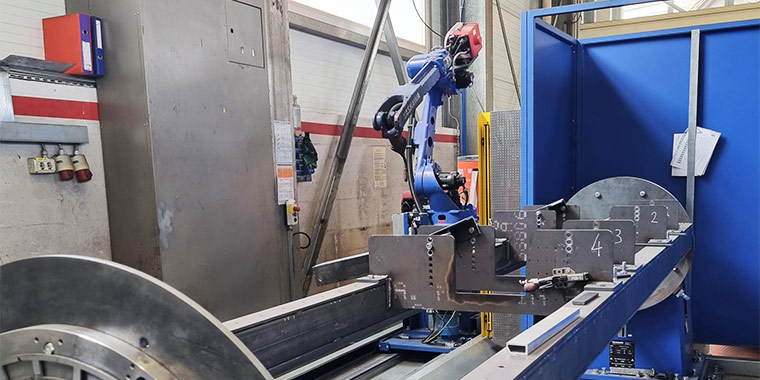
A 30kW CNC Beam and Channel Laser Cutter integrates all these processes into a single workstation. The machine utilizes a sophisticated rotary axis and a multi-axis cutting head that can traverse the entire profile of a structural member. Whether it is a standard I-beam or a custom-formed C-channel, the laser provides consistent results. The CNC system compensates for material deviations (such as slight bows or twists in the beam), ensuring that every bolt hole, cope, and notch is located with sub-millimeter accuracy. This level of precision is vital when hundreds of tons of steel must be assembled on-site in the middle of the ocean, where there is no room for “field adjustments.”
The Critical Role of ±45° Bevel Cutting
In the world of offshore engineering, the strength of a weld is non-negotiable. Most structural connections require Full Penetration Welds (FPW) or Partial Penetration Welds (PPW), both of which necessitate a specific edge geometry—typically a V, Y, K, or X-shaped bevel.
The ±45° beveling head is the “secret sauce” of this 30kW system. Traditionally, after a beam was cut to length, a secondary team would use handheld grinders or portable beveling machines to create the weld prep. This process is noisy, dusty, and inconsistent. By integrating 5-axis motion into the laser head, the 30kW machine can cut the beam to length and apply the required bevel angle in a single pass.
For the shipyards in Rosario, this means the finished part leaves the machine “weld-ready.” The ±45° range allows for the most common offshore welding prep angles (30°, 37.5°, and 45°) to be executed flawlessly. Because the laser is a non-contact tool, there is no tool wear, meaning the 100th bevel is just as sharp and accurate as the first. This consistency is a primary requirement for Lloyd’s Register or ABS (American Bureau of Shipping) certification in offshore construction.
Material Integrity and the Heat-Affected Zone (HAZ)
One of the greatest concerns in heavy-duty structural engineering is the Heat-Affected Zone. When steel is subjected to high heat, its metallurgical properties can change, potentially becoming brittle—a catastrophic risk in the cyclic loading environments of offshore platforms (waves, wind, and vibration).
As a fiber laser expert, I cannot overstate the importance of the 30kW source in this context. While it sounds counterintuitive, a higher-power laser actually reduces the HAZ. Because the 30kW beam travels much faster than a 6kW or 10kW beam, the thermal energy is concentrated for a shorter duration. The result is a narrower, more controlled heat signature. Furthermore, the precision of the fiber laser’s fiber-to-fiber delivery system ensures a high-quality beam profile (BPP), which results in smoother cut surfaces. This smoothness reduces the need for post-cut sanding, which is often required after plasma cutting to prevent stress-fracture points.
Strategic Integration in Rosario’s Supply Chain
The implementation of such a machine in Rosario creates a localized center of excellence. Currently, many complex offshore components are imported or outsourced to international yards. By housing 30kW technology locally, Rosario-based firms can offer “just-in-time” fabrication for projects in the South Atlantic.
Furthermore, the CNC software ecosystem allows for seamless integration with BIM (Building Information Modeling) and structural design software like Tekla Structures. Engineers can export 3D models directly to the laser cutter, ensuring that the physical part is a perfect “digital twin” of the design. This reduces scrap rates—a significant cost-saving measure when dealing with high-grade offshore structural steel.
Efficiency, Gas Dynamics, and Operational Costs
Operating a 30kW laser is an exercise in managing physics. At these power levels, the choice of assist gas becomes a strategic decision. While Oxygen is traditionally used for thick carbon steel to utilize the exothermic reaction, the 30kW power allows for “High-Pressure Air” or “Nitrogen” cutting on mid-range thicknesses. This results in an oxide-free edge, which is the gold standard for painting and coating. In the offshore industry, where specialized epoxy coatings are used to prevent salt-water corrosion, an oxide-free edge is essential for coating adhesion.
Moreover, the energy efficiency of fiber lasers (typically 35-40% wall-plug efficiency) compared to older CO2 lasers makes this a more sustainable choice for the industrial parks in Rosario. The reduction in secondary processing—grinding, cleaning, and manual layout—drastically lowers the “total cost per part,” making local fabrication more competitive on a global scale.
Addressing the Challenges of Offshore Environments
Offshore platforms must endure some of the harshest conditions on Earth. The structural integrity of the “Jacket” (the underwater portion) and the “Topside” (the living and working quarters) depends on the precision of the fit-up.
When a 30kW laser cuts a C-channel or an H-beam with a ±45° bevel, it ensures that the fit-up is tight. A tighter fit-up requires less weld filler metal, which reduces the overall weight of the structure and the time spent on welding. In offshore projects, where every kilogram of weight and every hour of labor is calculated into the multimillion-dollar budget, these efficiencies are transformative. The ability of the CNC system to handle long-format beams (often 12 meters or more) is perfectly suited for the large-scale girders used in platform decking and heli-pad support structures.
Conclusion: The Future of Argentine Heavy Industry
The 30kW Fiber Laser CNC Beam and Channel Cutter is more than just a tool; it is a statement of industrial intent. For the city of Rosario, adopting this technology means moving from traditional manufacturing into the era of “Industry 4.0.”
By mastering the art of high-power laser cutting and ±45° beveling, Rosario’s fabrication sector can provide the offshore industry with components that are stronger, more accurate, and produced at a fraction of the traditional lead time. As we look toward the future of energy—whether it be offshore wind farms in the Atlantic or the continued expansion of subsea oil and gas extraction—the precision and power of the 30kW fiber laser will be the foundation upon which these massive structures are built. In the hands of Rosario’s skilled engineers, this technology ensures that the next generation of offshore platforms will be safer, more efficient, and built to withstand the test of time and the sea.