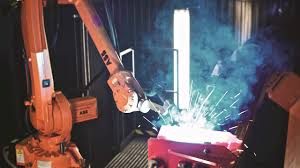
The Industrial Context: Queretaro’s Rise in Heavy Engineering
Queretaro has long been recognized as a premier destination for aerospace and automotive manufacturing. However, a new sector is claiming the spotlight: heavy-duty crane and infrastructure manufacturing. As global supply chains “nearshore” to Mexico, the demand for overhead bridge cranes, gantry systems, and heavy lifting equipment has skyrocketed.
Traditional methods of fabricating these giants—utilizing plasma cutting, oxy-fuel, or mechanical drilling—are no longer sufficient to meet the rigorous timelines and quality standards of modern industry. The 20kW fiber laser has emerged as the definitive solution. In the context of Queretaro’s competitive labor market and its proximity to major North American ports, the ability to produce high-precision structural members with minimal human intervention provides a decisive edge.
20kW Fiber Laser: The New Benchmark for Structural Steel
In the world of fiber lasers, power is the primary catalyst for both speed and capability. A 20kW source is uniquely positioned to handle the thicknesses required for heavy-duty crane girders. While 6kW or 10kW systems are standard for light fabrication, 20kW allows for the rapid “clean cutting” of carbon steel up to 50mm and beyond.
For crane manufacturers, the advantage lies in the Heat Affected Zone (HAZ). Traditional thermal cutting methods like plasma create a significant HAZ, which can alter the metallurgical properties of the I-beam, potentially leading to stress fractures under the immense loads cranes must carry. The 20kW fiber laser, through its high energy density and focused beam, traverses the material so quickly that heat transfer to the surrounding area is minimized. This preserves the structural integrity of the steel, ensuring that the I-beams maintain their rated load-bearing capacities without the need for post-cut grinding or heat treatment.
The Complexity of I-Beam Profiling
Cutting a flat sheet of metal is a two-dimensional challenge; profiling an I-beam is a three-dimensional feat of engineering. A Heavy-Duty I-Beam Laser Profiler must manage the geometry of the top and bottom flanges as well as the central web. This requires a multi-axis cutting head capable of rotating around the beam (often a 5-axis or 6-axis configuration) to perform intricate bevel cuts, bolt holes, and interlocking joints.
In crane manufacturing, the precision of these cuts is critical. Cranes are often modular, requiring perfect alignment for field assembly. When an I-beam is laser-profiled, the bolt holes are positioned with sub-millimeter accuracy, and the “fish-mouth” or “cope” cuts where girders meet end carriages are executed with a tolerance that traditional methods cannot match. This reduces the reliance on heavy welding to “fill the gaps,” leading to stronger, cleaner, and more aesthetically pleasing industrial products.
Zero-Waste Nesting: Economics Meets Sustainability
Perhaps the most significant advancement in recent years is the integration of AI-driven zero-waste nesting software. Structural steel, particularly high-grade I-beams and H-beams, represents a massive portion of a crane manufacturer’s COGS (Cost of Goods Sold). In a standard fabrication shop, “drop” or “scrap” can account for 15% to 20% of total material volume.
Zero-waste nesting algorithms analyze the entire production queue, not just individual jobs. The software “nests” different parts—such as gussets, mounting plates, and reinforcement ribs—into the “dead space” of the I-beam or onto the remnant sections of large plates.
In Queretaro’s high-volume environments, this technology allows for:
1. **Common-Line Cutting:** Two parts share a single cut line, reducing gas consumption and processing time.
2. **Remnant Management:** The system tracks every leftover piece of steel in a digital library, automatically prioritizing these “scraps” for smaller components in future jobs.
3. **Bridge Cutting:** Continuous cutting paths that minimize the number of “pierces,” which are the most time-consuming and wear-intensive part of the laser process.
Synergy with Crane Manufacturing: Quality and Safety
Cranes are safety-critical machines. A failure in a weld or a structural member can be catastrophic. The 20kW laser profiler enhances safety through precision. When parts are cut with laser accuracy, the fit-up for welding is nearly perfect. This leads to deeper weld penetration and a more uniform distribution of stress.
Furthermore, the ability to laser-mark parts during the cutting process is a game-changer for Queretaro’s large-scale factories. The profiler can etch part numbers, assembly instructions, and QR codes directly onto the steel. This ensures traceability throughout the lifespan of the crane—from the moment the beam is cut to its annual safety inspections ten years later.
Operational Excellence in the Bajío Region
Operating a 20kW laser in Queretaro comes with specific regional advantages. The local ecosystem has developed a robust support network for high-tech machinery. Technical colleges in the region are now producing “Photonics Technicians” rather than just general machinists, ensuring a pipeline of talent capable of maintaining these complex systems.
Moreover, the power stability in Queretaro’s industrial parks is among the best in Mexico, which is crucial for high-wattage fiber lasers. A 20kW system requires a stable, high-amperage draw; fluctuations can damage the sensitive ytterbium-doped fiber modules. The synergy between Queretaro’s infrastructure and these machines makes it the ideal location for “Heavy-Duty” automation.
The Shift from Plasma to Laser: A Technical Comparison
For decades, plasma was the king of the I-beam shop. It was cheap and fast. However, the 20kW fiber laser has flipped the script on ROI (Return on Investment). While the initial capital expenditure for a laser profiler is higher, the “cost per part” is significantly lower.
* **Gas Consumption:** Fiber lasers use nitrogen or oxygen, but the speed of 20kW means less gas is used per meter of cut compared to the high-volume air or specialty gases required for high-definition plasma.
* **Consumables:** Laser nozzles and protective windows last significantly longer than plasma electrodes and shields, which must be replaced frequently when piercing thick structural steel.
* **Secondary Operations:** This is the “hidden” winner. Plasma cuts often leave “dross” (slag) that must be chipped away manually. Laser cuts are virtually dross-free, allowing parts to move directly from the machine to the welding station.
The Future: AI and Integration
As we look toward the future of manufacturing in Queretaro, the 20kW I-beam profiler will become the central hub of a “Smart Factory.” We are already seeing the integration of these machines with ERP (Enterprise Resource Planning) systems. When a crane is designed in CAD software, the data is pushed directly to the laser, which then calculates the most efficient nesting pattern and orders the raw material from the warehouse.
This level of integration minimizes the “human error” factor. In crane manufacturing, where a single misplaced hole can ruin an expensive 12-meter I-beam, the reliability of a laser-automated workflow is invaluable.
Conclusion
The deployment of 20kW Heavy-Duty I-Beam Laser Profilers in Queretaro is a testament to Mexico’s growing sophistication in the global manufacturing hierarchy. By harnessing the power of 20,000 watts and the intelligence of zero-waste nesting, crane manufacturers are not just increasing their output; they are elevating the quality and safety of heavy lifting equipment.
In the competitive landscape of the Bajío, where precision, efficiency, and material stewardship are the keys to survival, the fiber laser is no longer a luxury—it is the foundational tool of the modern industrial age. For the crane industry, this means longer spans, higher capacities, and a faster path from the drawing board to the construction site. Queretaro is no longer just assembling the world’s machines; with these high-power lasers, it is carving them out of raw steel with the precision of a surgeon.