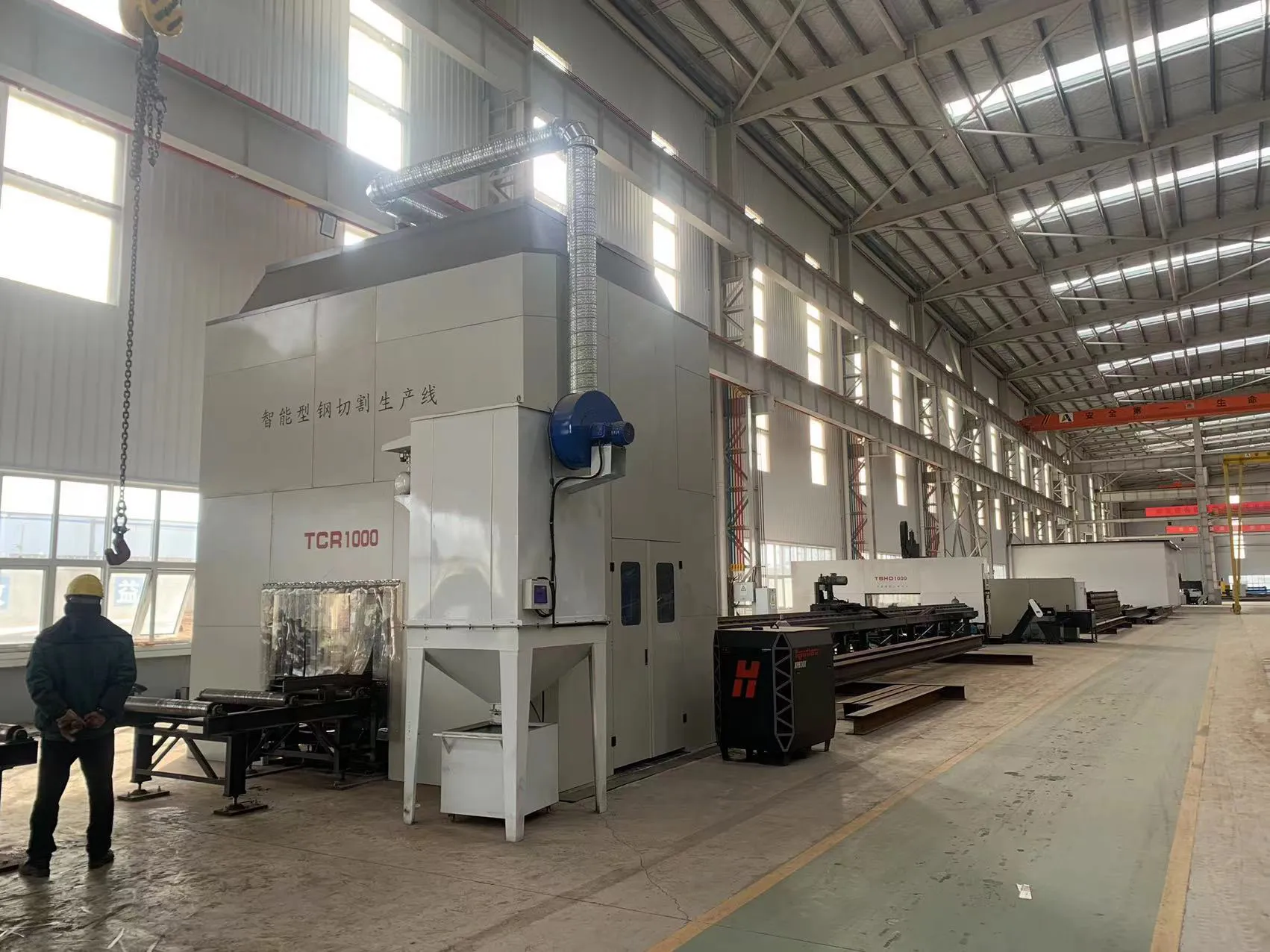
The Industrial Evolution of Rayong and the Rise of High-Power Fiber Lasers
Rayong has long been the beating heart of Thailand’s heavy industry. However, as the global supply chain pivots toward more complex, high-density storage solutions, the local manufacturing sector has faced a bottleneck: the limitations of traditional plasma cutting and mechanical sawing. Enter the 20kW Universal Profile Steel Laser System. In the context of storage racking—where uprights, beams, and bracing must bear monumental loads—the transition to ultra-high-power fiber lasers represents a quantum leap in capability.
A 20kW source is not merely about “more power”; it is about “power density” and the physics of the melt pool. For profile steel, which often involves varying wall thicknesses and structural irregularities, the 20kW threshold allows for a stable, high-speed vaporous cut that minimizes the Heat Affected Zone (HAZ). In the humid, coastal environment of Rayong, maintaining material integrity is paramount to prevent long-term oxidation and fatigue. The fiber laser’s ability to slice through thick-walled sections with surgical precision ensures that the base metallurgy of the racking remains uncompromised.
Engineering the ±45° Bevel: The Secret to Structural Integrity
In the storage racking industry, the strength of a structure is only as good as its weakest weld. Traditionally, after a profile was cut to length, it would require manual grinding or secondary machining to create the bevels necessary for deep-penetration welding. The 20kW Universal System eliminates this bottleneck through its integrated ±45° 3D beveling head.
This 5-axis system allows the laser head to tilt and rotate in real-time as it traverses the profile. Whether processing a square tube for a heavy-duty upright or a C-channel for a pallet beam, the system can execute V-type, Y-type, and X-type bevels in a single pass. For Rayong-based manufacturers supplying international logistics firms, this means meeting stringent ISO and AWS welding standards with ease. The bevels are mathematically perfect, ensuring that when two components meet, the fit-up is gapless. This precision significantly reduces the volume of welding consumables used and dramatically lowers the time required for the welding process itself.
Universal Profile Capability: Handling the Geometry of Support
Storage racking is rarely uniform. It requires a diverse mix of H-beams for heavy-duty foundations, hollow structural sections (HSS) for uprights, and L-shaped angles for bracing. A “Universal” system is defined by its chucking and loading versatility. The systems currently being deployed in Rayong feature multi-point pneumatic chucking systems that can adapt to asymmetrical profiles without deforming the material.
The 20kW laser’s high dynamic range allows it to transition from cutting a 12mm thick H-beam flange to a 3mm bracing strut without losing focus or beam quality. Advanced software algorithms compensate for the “twist and camber” often found in raw profile steel. By using touch-probes or laser-based sensing, the system maps the actual geometry of the steel in the machine and adjusts the cutting path in milliseconds. This ensures that every bolt hole and every connector slot is positioned with sub-millimeter accuracy, which is critical for the rapid onsite assembly of massive warehouse racks.
Efficiency and Throughput in the Rayong Manufacturing Corridor
Time is the most expensive commodity in the EEC. Traditional methods of profile processing—marking, sawing, drilling, and grinding—are labor-intensive and prone to human error. The 20kW fiber laser consolidates these four steps into one automated cycle. When compared to a standard 6kW or 12kW system, the 20kW variant doesn’t just cut faster; it cuts *cleaner* using high-pressure air or nitrogen, often eliminating the need for expensive oxygen-assisted cutting on thicknesses up to 20mm.
In a typical production shift in Rayong, a 20kW system can process three to four times the linear meters of a plasma system while maintaining a kerf width that is a fraction of the size. This speed is a game-changer for racking companies facing tight deadlines for the “Mega-Warehouses” springing up along the Chonburi-Rayong axis. Furthermore, the energy efficiency of modern fiber resonators means that despite the high power output, the wall-plug efficiency remains high, reducing the carbon footprint of the manufacturing facility—a key metric for modern ESG (Environmental, Social, and Governance) compliance.
The Synergy of Software and Industry 4.0 Integration
The hardware is only half of the story. The 20kW systems in Rayong are powered by sophisticated CAD/CAM nesting software designed specifically for 3D profiles. This software allows engineers to import complex assemblies directly from Tekla or SolidWorks and automatically generate the nesting patterns that minimize material waste.
In the storage racking sector, material costs can account for 70% of the total project cost. The ability to nest different parts on a single 12-meter profile, optimizing the “common line” cutting, can save 5-10% in raw material weight. Additionally, these systems are fully “Industry 4.0” ready. They provide real-time data back to the factory’s ERP system, tracking gas consumption, cutting time, and even predicting when the protective window in the laser head needs cleaning. For a high-volume factory in Rayong, this data-driven approach transforms the cutting room from a cost center into a highly predictable, optimized production engine.
Overcoming Challenges: Heat Management and Beam Stability
Processing at 20kW introduces significant thermal challenges. At these power levels, the heat generated can cause thin-walled profiles to warp if not managed correctly. The universal systems utilized in Rayong employ advanced cooling technologies, including chilled water circuits that stabilize the entire optical path from the resonator to the cutting nozzle.
Moreover, the “BPP” (Beam Parameter Product) of a 20kW source must be meticulously controlled. To maintain a stable cut over a 45° bevel, where the effective thickness of the material increases as the angle steepens, the system uses dynamic focal positioning. This means the laser’s “sweet spot” moves in real-time relative to the tilt of the head. This level of control ensures that even at the extreme 45° limit, the dross remains minimal and the surface finish remains smooth, ready for the powder-coating processes that are standard in the racking industry.
Conclusion: Setting the Standard for Southeast Asia’s Logistics Infrastructure
The deployment of 20kW Universal Profile Steel Laser Systems with ±45° beveling in Rayong is more than a regional upgrade; it is a signal of Thailand’s intent to lead in high-end structural manufacturing. For the storage racking industry, the benefits are clear: stronger joints, faster assembly, lower material waste, and the ability to handle the most demanding architectural geometries.
As warehouse heights increase and automated storage and retrieval systems (ASRS) become the norm, the demand for high-precision racking will only grow. The precision afforded by 20,000 watts of laser power ensures that these structures can be built higher, safer, and faster than ever before. In the competitive industrial ecosystem of Rayong, those who embrace this “bevel-ready” fiber laser technology are not just cutting steel—they are carving out a dominant position in the future of global logistics.