The Dawn of the 20kW Era in Structural Fabrication
For decades, the structural steel industry relied on plasma cutting, sawing, and manual drilling to process the heavy beams and channels required for industrial storage. While effective, these methods often lacked the precision required for the increasingly complex designs of modern automated storage and retrieval systems (AS/RS). The emergence of the 20kW fiber laser has changed the calculus of the fabrication shop.
As a fiber laser expert, I have witnessed the transition from 4kW to 6kW, and eventually the jump to the 10kW+ category. However, the 20kW threshold is where the technology truly begins to compete with—and surpass—traditional mechanical processing for heavy structural members. At 20,000 watts, the laser density is sufficient to maintain a stable keyhole even in thick carbon steels, allowing for clean, dross-free cuts on the flanges and webs of structural channels that are the backbone of the Charlotte logistics corridor’s racking industry.
Understanding the Mechanics: CNC Beam and Channel Processing
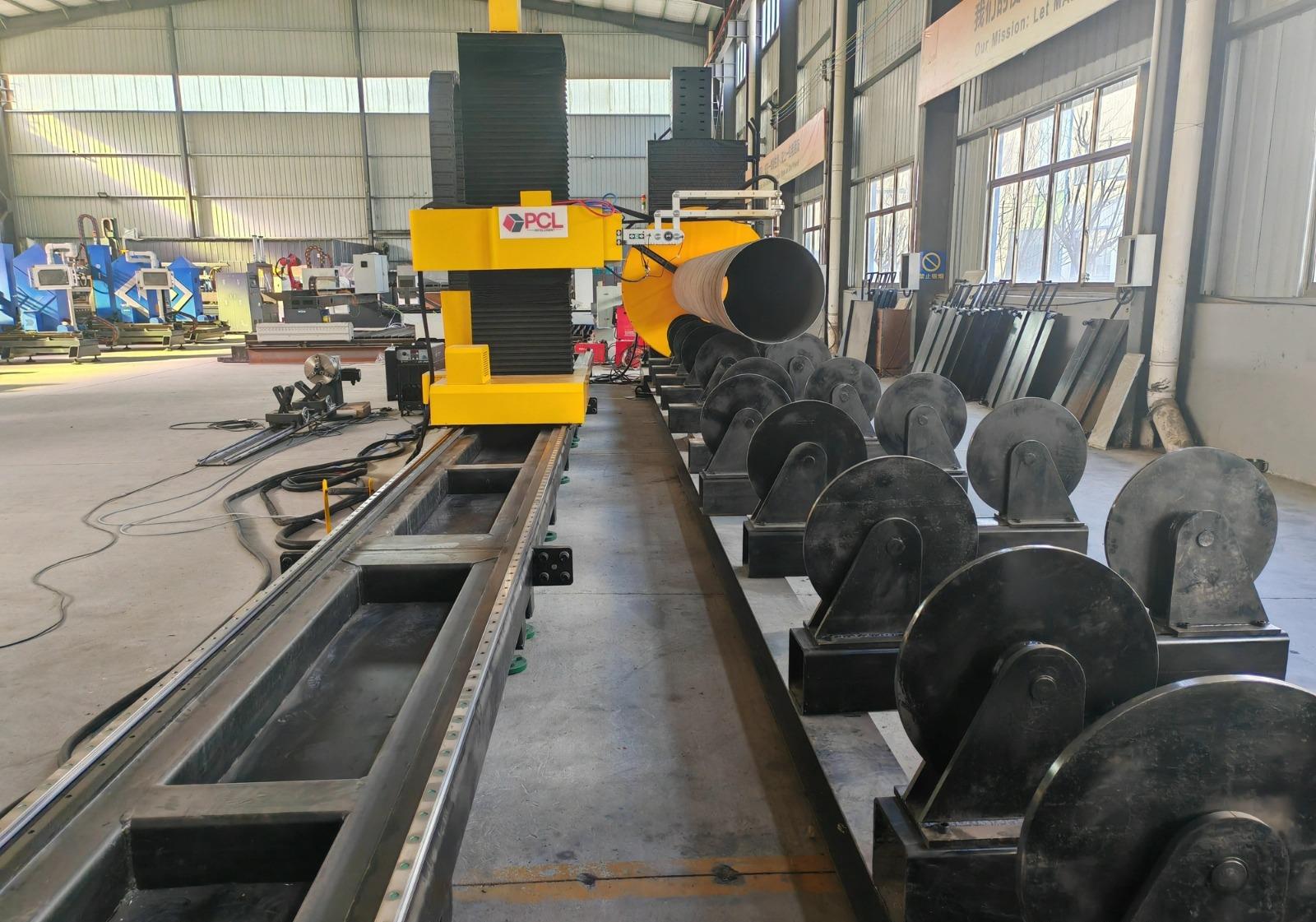
A CNC laser cutter designed for beams and channels is a different beast than a standard flat-bed laser. These machines utilize a 3D structural processing head and a sophisticated “chuck and roller” system. The workpiece—often a 40-foot structural beam—is rotated and moved longitudinally while the laser head moves in multiple axes (X, Y, Z, and rotational A/B axes).
For the storage racking industry, this means that a single machine can handle the entire fabrication sequence. It can cut the beam to length, plunge-cut bolt holes with tolerances of ±0.1mm, and etch part numbers for assembly. When processing C-channels for pallet rack uprights or H-beams for heavy-duty cantilever systems, the 20kW power source ensures that the laser penetrates the thickest sections of the material without the taper associated with lower-power sources.
The Game Changer: ±45° Bevel Cutting
The most significant advancement in this specific machine configuration is the ±45° bevel cutting head. In structural engineering, especially for racking that must support thousands of tons of inventory, the quality of the weld is paramount. Traditional straight cuts require a secondary operation—manual grinding—to create the V-groove or K-groove needed for full penetration welds.
The 20kW bevel head eliminates this bottleneck. By tilting the laser head up to 45 degrees, the machine can create complex bevels directly during the primary cutting cycle. Whether it is a “top-side” bevel or a “bottom-side” bevel, the CNC software calculates the necessary path adjustments to maintain focal consistency. This results in parts that are “weld-ready” the moment they leave the laser bed. For Charlotte-based manufacturers, this translates to a massive reduction in labor costs and a significant increase in structural integrity for the finished racking products.
Application in the Storage Racking Industry
Charlotte serves as a primary distribution node for the Southeast United States. Consequently, the demand for sophisticated storage solutions—from standard selective pallet racking to complex mezzanine structures—is at an all-time high.
1. **High-Rise AS/RS Systems:** These systems require extreme verticality and precision. Any deviation in a bolt hole or a beam-to-column connection is magnified over a 100-foot height. The 20kW laser’s ability to cut precise geometries in heavy-duty channels ensures that these systems are perfectly plumb.
2. **Cantilever Racks:** Used for storing lumber, piping, and steel, cantilever racks use heavy-walled tubing and C-channels. The 20kW laser can slice through these thick sections faster than a band saw, while simultaneously cutting the intricate shapes needed for the arm-locking mechanisms.
3. **Cold Storage Racking:** Materials used in cold storage often involve specialized alloys or thicker gauges to handle thermal contraction. The precision of fiber laser cutting reduces the Heat Affected Zone (HAZ), preserving the metallurgical properties of the steel near the cut edge.
Why Charlotte? The Strategic Advantage
The placement of a 20kW beam and channel laser in Charlotte is no coincidence. As a center for both manufacturing and logistics, the city sits at the intersection of major transit veins (I-77 and I-85). Local fabricators who invest in this technology gain a localized competitive advantage.
Shipping heavy structural steel is expensive. By having high-power laser capacity in-region, racking companies can source raw steel from nearby mills and process it locally. Furthermore, Charlotte’s growing pool of skilled technicians and engineers means that the complex CAD/CAM programming required for 5-axis laser cutting can be managed by a sophisticated local workforce.
Technical Superiority: 20kW vs. Plasma and Sawing
While plasma cutting has historically been the go-to for thick beams, it carries several disadvantages that the 20kW fiber laser solves:
* **The Kerf and Precision:** Plasma leaves a wide kerf and often a slight bevel even when a straight cut is intended. The 20kW laser maintains a microscopic kerf, allowing for intricate “puzzle-piece” fitment of racking components.
* **Operating Costs:** While the initial investment in a 20kW laser is higher, the cost-per-part is lower due to the speed of the cut and the lack of secondary finishing. A 20kW laser can cut 12mm steel up to five times faster than a 6kW unit.
* **Automation Integration:** CNC fiber lasers are inherently “Industry 4.0” ready. They integrate seamlessly with nesting software like Sigmanest or Lantek, which can optimize the layout of parts on a 40-foot beam to minimize scrap—a crucial factor when steel prices are volatile.
Software and the 3D Cutting Environment
Operating a 20kW beam cutter requires more than just raw power; it requires “intelligence.” The software must account for the physical realities of structural steel, which is rarely perfectly straight. High-end machines in this class utilize touch-probing or laser-scanning systems to “map” the actual profile of the beam before cutting.
If a C-channel has a slight twist or bow, the CNC controller adjusts the cutting path in real-time to ensure that every hole and bevel is positioned correctly relative to the beam’s actual geometry. This level of compensation is impossible with manual layout or traditional mechanical punching. For a racking manufacturer, this means that every upright and every cross-beam will line up perfectly during site installation, drastically reducing field-rework costs.
The Environmental and Safety Impact
In the modern manufacturing landscape, sustainability is becoming a key metric. 20kW fiber lasers are significantly more energy-efficient than older CO2 lasers or high-definition plasma systems when measured by the “energy-per-inch” of cut. Furthermore, the precision of the laser reduces material waste through superior nesting.
From a safety perspective, the enclosed nature of CNC fiber laser systems protects operators from the intense light and fumes associated with thermal cutting. In the Charlotte market, where OSHA compliance and worker safety are prioritized, moving away from manual torching and grinding to a fully enclosed laser environment is a major step forward in workplace ergonomics.
Conclusion: The Future of Structural Steel
The 20kW CNC Beam and Channel Laser Cutter with ±45° beveling is more than just a piece of machinery; it is a catalyst for industrial evolution. For the storage racking sector in Charlotte, it represents the ability to build bigger, safer, and more complex structures at a lower cost.
As a fiber laser expert, I see this technology as the definitive solution for the challenges of modern fabrication. By combining the extreme power of 20kW with the geometric flexibility of a 5-axis beveling head, manufacturers are no longer limited by the constraints of traditional tools. They are empowered to innovate, ensuring that the warehouses and distribution centers of tomorrow are built on a foundation of precision-engineered steel. Whether it is increasing the density of a pallet rack or ensuring the seismic stability of a mezzanine, the 20kW fiber laser is the tool that will drive the industry forward.