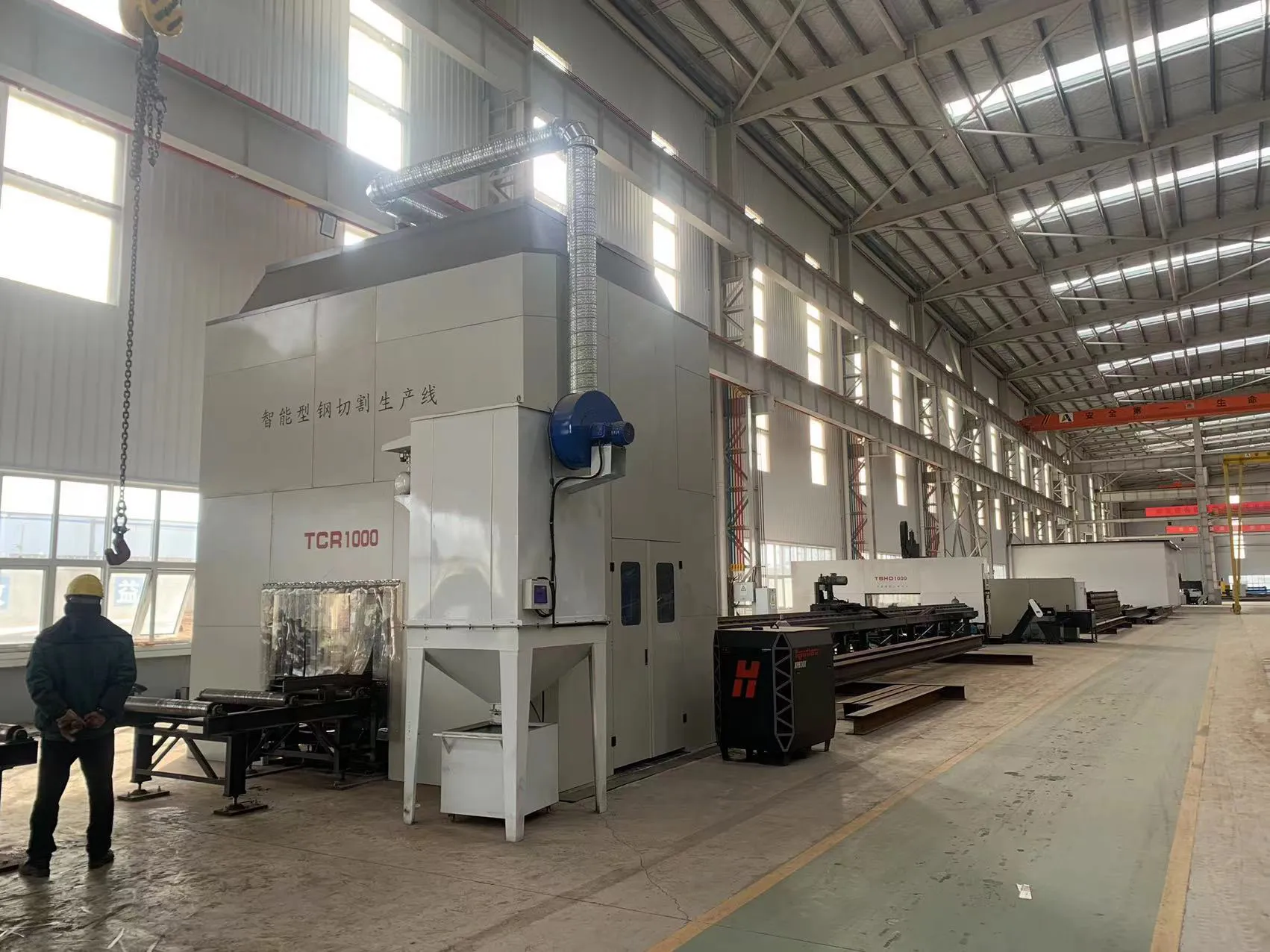
Field Engineering Report: Integration of 6000W Heavy-Duty I-Beam Laser Profilers in Katowice Airport Infrastructure
1. Project Overview and Site Context
This technical report evaluates the deployment and operational efficiency of the 6000W Heavy-Duty I-Beam Laser Profiler, equipped with automated unloading subsystems, within the context of the Katowice regional infrastructure expansion. Specifically, the analysis focuses on the fabrication of structural steel components for large-span terminal frameworks and aircraft maintenance hangars.
In the Silesian industrial corridor, particularly near Katowice, the demand for high-tolerance structural steel has transitioned from conventional plasma cutting and mechanical sawing toward high-wattage fiber laser profiling. The primary objective of this deployment was to satisfy the stringent requirements of Eurocode 3 for structural steelwork, focusing on the reduction of secondary machining and the optimization of material throughput for heavy-section I-beams (IPE and HEB profiles).
2. Technical Specifications of the 6000W Fiber Laser Source
The selection of a 6000W (6kW) fiber laser source is a calculated decision based on the material thickness-to-speed ratio required for airport-grade structural members. While higher wattages exist, the 6kW threshold represents the “optimal thermal equilibrium” for structural steel between 10mm and 25mm in wall thickness.
At 6000W, the laser achieves a power density sufficient to maintain a narrow kerf width, which is critical for the geometric precision of bolt holes and interlocking “bird-mouth” joints. The fiber source utilizes a multi-module architecture with redundant pump diodes, ensuring that the Beam Parameter Product (BPP) remains constant even during high-duty cycle operations. In Katowice’s facility, this translates to a consistent heat-affected zone (HAZ) of less than 0.2mm, preserving the metallurgical integrity of the S355J2+N steel commonly specified in Polish aviation projects.
3. Kinematics of Heavy-Duty I-Beam Profiling
Structural I-beams present unique kinematic challenges compared to flat-sheet or standard tube processing. The profiler utilized in this field study employs a multi-axis head capable of 360-degree rotation around the longitudinal axis of the beam, combined with a tilting A/B axis for beveling.
The system’s chuck configuration—a heavy-duty four-jaw pneumatic synchronization system—is designed to handle the massive eccentric loads of asymmetric beams. For the Katowice project, where 12-meter I-beams are standard, the machine’s ability to compensate for “camber and sweep” (common deformations in hot-rolled steel) via real-time inductive sensing is paramount. The CNC controller utilizes a “center-finding” algorithm that re-calculates the toolpath based on the actual physical centerline of the beam rather than the theoretical CAD model, ensuring that holes drilled in the flange are perfectly aligned with those in the web.
4. Automatic Unloading Technology: Solving the Throughput Bottleneck
The most significant advancement in this deployment is the integration of an Automatic Unloading System. In traditional heavy-section processing, the “bottleneck” is not the cutting speed, but the logistics of removing processed parts that may weigh upwards of 800kg.
4.1 Mechanical Synchronization
The automatic unloading unit consists of a series of heavy-duty hydraulic lifting platforms and lateral discharge chains. As the laser finishes the final cut of a profiled section, the unloading system’s PLC (Programmable Logic Controller) communicates with the laser’s CNC. The unloading rollers rise to support the finished part precisely at its center of gravity. This prevents “tip-down” scenarios where a falling part can damage the machine bed or the laser head itself.
4.2 Material Flow and Safety
In the Katowice facility, the automatic unloading system has reduced the cycle-to-cycle transition time by 45%. By automatically discharging finished beams onto a buffer rack, the profiler can immediately begin feeding the next raw length. This eliminates the need for overhead crane intervention for every part, significantly reducing the risk of workplace accidents and localized structural deformation caused by improper hoisting.
5. Impact on Airport Structural Engineering Precision
Airport terminals, such as those in the Katowice expansion, require complex “tree-column” structures where multiple I-beams meet at a single node. The precision offered by the 6000W laser is critical here for several reasons:
- Bolt Hole Tolerance: Laser-cut holes meet H11 tolerances without the need for reaming. This allows for immediate onsite assembly with high-strength friction grip (HSFG) bolts.
- Weld Preparation: The 6kW laser allows for automated beveling (V, X, and K cuts). This ensures deep penetration welds with minimal filler material, essential for the fatigue-resistant structures required in aviation environments.
- Marking and Traceability: The system utilizes the 6kW source at low power to etch heat numbers and assembly codes directly onto the parts. This ensures 100% traceability from the mill to the final airport structure, satisfying international safety audits.
6. Thermal Management and Kerf Dynamics
A critical observation in the field report involves the gas dynamics during the profiling of thick-web I-beams. We utilized oxygen (O2) as the assist gas for the majority of the S355 steel sections. At 6000W, the balance between laser power and gas pressure must be tuned to prevent “slag hanging” on the lower flange.
The implementation of “Frequency Modulated Piercing” on the 6kW system allowed us to penetrate 20mm webs in under 1.5 seconds without “blow-back” contamination of the protective lens. This speed is vital for maintaining the thermal profile of the beam; by moving quickly, the total heat input into the structural member is minimized, preventing the longitudinal warping that often plagues plasma-cut beams.
7. Software Integration: From BIM to CNC
The Katowice project leveraged an end-to-end digital workflow. Tekla Structures (BIM) models were exported as DSTV files, which were then processed by the laser’s nesting software. The software automatically identifies “cut-outs” and optimizes the nesting to minimize “skeleton” waste.
The synergy between the 6000W laser and the automatic unloading system is further enhanced by “Part-Sorting” logic in the software. The system identifies small parts (like gusset plates cut from the web) versus the main beam members and directs the unloading system to separate them into different collection bins, further streamlining the downstream assembly process.
8. Comparative Analysis: Laser vs. Conventional Methods
Prior to the introduction of the 6000W Laser Profiler, the Katowice site relied on a combination of band saws and drilling lines. The technical comparison is as follows:
| Parameter | Conventional (Saw/Drill) | 6000W Laser Profiler |
|---|---|---|
| Processing Time (Per Beam) | 120 Minutes | 18 Minutes |
| Hole Accuracy | ± 0.5mm | ± 0.1mm |
| Labor Requirement | 4 Operators | 1 Operator |
| Secondary Deburring | Required | Negligible |
9. Conclusion and Recommendations
The deployment of the 6000W Heavy-Duty I-Beam Laser Profiler with Automatic Unloading at the Katowice Airport project has demonstrated a paradigm shift in structural steel fabrication. The integration of high-wattage fiber laser technology with automated material handling addresses the three primary challenges of heavy engineering: precision, safety, and throughput.
For future phases of the Katowice expansion, it is recommended to further integrate the unloading system with AGV (Automated Guided Vehicles) to transport finished beams directly to the welding stations. Furthermore, the 6kW power level has proven to be the industrial “sweet spot,” providing the necessary torque for structural speed without the excessive energy consumption or infrastructure requirements of 12kW+ systems.
This field report confirms that the specified technology meets all current aerospace infrastructure standards and provides a scalable model for similar heavy-duty steel processing applications globally.
End of Report
Ref: KTW-SR-2024-08X













