1. Introduction: The Strategic Transition in Haiphong’s Wind Energy Sector
The industrial landscape of Haiphong, Vietnam, has rapidly evolved into a critical hub for the fabrication of offshore and onshore wind turbine components. As tower heights exceed 120 meters and nacelle weights increase, the structural integrity of internal support systems—specifically heavy-duty I-beams and H-beams—demands a shift from traditional plasma or mechanical fabrication to high-power laser profiling. This report examines the field deployment of a 30kW Fiber Laser Heavy-Duty I-Beam Laser Profiler equipped with Infinite Rotation 3D Head technology. The integration of this system addresses the specific metallurgical and geometric challenges inherent in Haiphong’s large-scale steel construction sector.
2. 30kW Fiber Laser Source: Energy Density and Thermal Management
The adoption of a 30kW fiber laser source represents a quantum leap in the processing of structural steels (typically Q355B or S355JR) used in wind turbine towers. At these power levels, the energy density at the focal point allows for “evaporation cutting” rather than simple melt-and-blow processes, even at thicknesses exceeding 30mm.
2.1 Kerf Dynamics and Surface Roughness
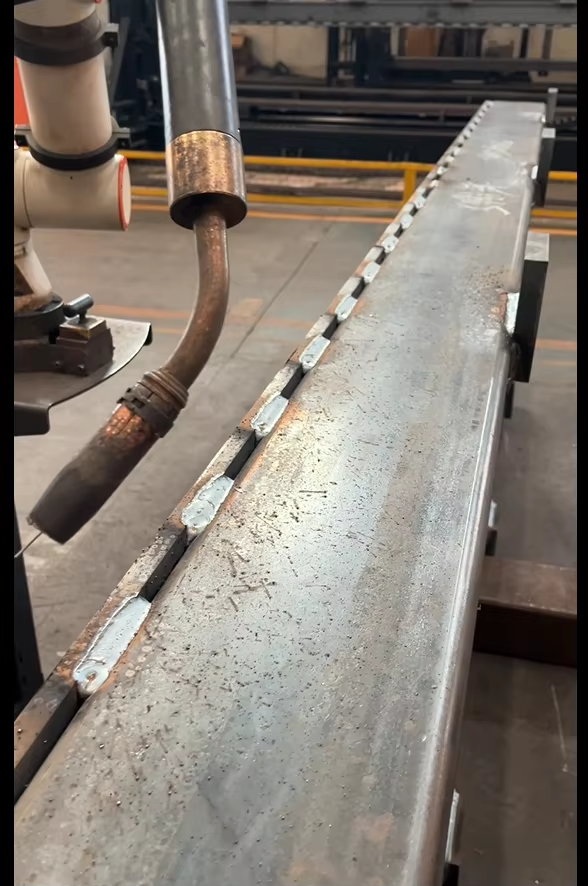
In the Haiphong wind sector, the internal platforms and tower internals require precise fit-up to ensure structural damping. A 30kW source provides the necessary photon flux to maintain a narrow kerf width (0.4mm–0.8mm), minimizing the Heat Affected Zone (HAZ). This is critical for maintaining the grain structure of the steel, preventing embrittlement at the cut edges which could lead to fatigue failure under the cyclic loading conditions of a wind turbine.
2.2 Assist Gas Synergy
Field data indicates that at 30kW, the use of High-Pressure Nitrogen or Oxygen-Nitrogen mixes optimizes the dross-free limit for heavy-duty flanges. In Haiphong’s high-humidity environment, the laser’s ability to produce a clean, oxide-free edge reduces post-processing requirements by 85%, allowing for immediate transition to the coating or welding stage.
3. Infinite Rotation 3D Head: Solving Geometric Constraints
The core innovation in this profiler is the Infinite Rotation 3D Head. Traditional 5-axis heads are often limited by cable-wrap constraints, requiring “unwinding” movements that interrupt the cut and introduce thermal inconsistencies. The infinite rotation (C-axis) capability, facilitated by high-torque slip-ring technology and advanced fiber management, allows for continuous, uninterrupted profiling of complex I-beam geometries.
3.1 Multi-Surface Intersections
Wind turbine tower internals require I-beams with complex “fish-mouth” cuts and penetrations that span both the web and the flanges. The 3D head utilizes B/C axis interpolation to maintain a perpendicular or specific beveled angle relative to the beam’s undulating surface. This is vital for the heavy-duty structural sections used in Haiphong, where beams often arrive with slight mill tolerances in straightness. The 3D head, coupled with laser-based sensing, real-time compensates for these deviations.
3.2 AWS-Compliant Weld Preparation
Efficiency in wind tower fabrication is dictated by welding speed. The Infinite Rotation 3D Head enables the execution of V, Y, X, and K-type bevels in a single pass. By achieving a ±45° tilt with infinite C-axis rotation, the machine produces precision bevels on the flanges of 1000mm+ I-beams. This eliminates the need for secondary grinding or manual oxy-fuel beveling, ensuring that the weld prep meets stringent American Welding Society (AWS) D1.1 standards for structural steel.
4. Heavy-Duty Profiler Kinematics and Structural Stability
Processing 12-meter to 18-meter I-beams weighing several tons requires a machine bed with extreme static and dynamic stiffness. The “Heavy-Duty” designation of this profiler refers to its reinforced plate-welded frame, which undergoes stress-relief annealing to ensure long-term geometric stability in the saline, industrial atmosphere of Haiphong.
4.1 Synchronized Dual-Drive and Clamping
The profiler employs a multi-point pneumatic chuck system or a synchronized heavy-duty roller bed. For wind turbine components, where the I-beam mass can cause significant inertia during rapid positioning, the use of high-inertia servo motors is mandatory. The synchronization between the feeding mechanism and the 3D head movement ensures that the dimensional accuracy of holes and notches across a 12-meter span is maintained within a ±0.5mm tolerance.
4.2 Real-Time Material Profiling
Large structural beams are rarely perfectly linear. The system incorporates a non-contact laser displacement sensor that maps the actual profile of the I-beam before and during the cut. This “mapping” data is fed back into the CNC, which adjusts the Z-axis height and the 3D head orientation in real-time. This prevents “collision-on-tilt” scenarios and ensures a consistent focal distance across the variable geometry of the beam.
5. Field Application: Wind Turbine Tower Internals
In the specific context of Haiphong’s manufacturing facilities, the profiler is used for the primary fabrication of tower door frames, cable tray supports, and internal service platforms. These components are subjected to high vibration and must be light-weight yet structurally rigid.
5.1 Speed Comparison: Laser vs. Traditional Plasma
Prior to the deployment of the 30kW laser, many Haiphong factories utilized CNC plasma for I-beam profiling. Plasma processing of a 25mm web typically reaches speeds of 1.2 m/min with a significant taper. The 30kW fiber laser achieves 3.5–4.5 m/min with near-zero taper. Furthermore, the laser eliminates the 2mm-3mm “over-cut” required for plasma to compensate for its larger kerf, resulting in a 3% material saving across large-scale projects.
5.2 Integration with Tekla and CAD/CAM Workflows
The automation of structural processing in Haiphong is driven by the integration of TEKLA structures with the laser’s nesting software. The software automatically extracts the DSTV or STEP files of the I-beams, recognizes the 3D bevel requirements, and generates the toolpath for the infinite rotation head. This “Digital Twin” approach ensures that every beam cut in the Haiphong facility fits perfectly into the tower assembly, reducing the “re-work” rate from 12% to less than 0.5%.
6. Environmental Considerations and Maintenance in Haiphong
Haiphong’s coastal location introduces high humidity and salt spray, which are detrimental to high-power optical systems. The 30kW profiler is equipped with a positive-pressure, climate-controlled enclosure for both the laser source and the cutting head. This prevents the ingress of corrosive particles into the fiber connectors and the internal optics of the 3D head.
6.1 Cooling System Requirements
At 30kW, the chilling requirements are substantial. The field installation utilizes a dual-circuit high-capacity chiller with ±0.1°C temperature stability. This is crucial for preventing “thermal lensing” in the 3D head optics, which can cause the focal point to shift during long-duration cuts on heavy-duty profiles. The use of deionized water with specialized additives is mandatory to prevent internal corrosion of the cooling channels.
7. Conclusion: The New Benchmark for Heavy Steel
The deployment of the 30kW Fiber Laser Heavy-Duty I-Beam Laser Profiler with Infinite Rotation 3D Head has redefined the throughput capabilities of the Haiphong wind energy sector. By consolidating cutting, beveling, and hole-drilling into a single automated process, the technology solves the dual challenges of precision and efficiency. As the industry moves toward larger, offshore wind structures, the ability of this system to process massive structural sections with sub-millimeter accuracy and AWS-grade weld preparation will remain the baseline for competitive steel fabrication in the region. The synergy between high-wattage fiber sources and unrestricted 3D kinematics represents the definitive future of heavy-duty structural steel processing.













