1.0 Executive Summary: Integration of High-Brightness 30kW Sources in Heavy Structural Fabrication
This technical field report evaluates the operational integration of a 30kW Fiber Laser 3D Structural Steel Processing Center within the heavy-lift crane manufacturing sector in Queretaro, Mexico. The transition from legacy plasma and mechanical sawing systems to 30kW fiber laser technology represents a fundamental shift in structural kinematics. At this power density, the interaction between the beam and heavy-gauge carbon steel (ASTM A36/A572) transcends traditional cutting speeds, moving into a regime of high-speed thermal ablation with minimal Heat Affected Zones (HAZ).
The Queretaro industrial corridor, characterized by its rigorous Tier-1 manufacturing standards for the aerospace and heavy machinery sectors, requires crane components—specifically main girders, end carriages, and trolley frames—to meet exacting tolerances for weld preparation and structural integrity. The implementation of 30kW 3D processing, coupled with Zero-Waste Nesting algorithms, addresses the dual challenges of volumetric throughput and material yield optimization in large-format structural profiles (H-beams, I-beams, and square tubing).
2.0 30kW Fiber Laser Kinematics and Photon Density
2.1 Power Density and Kerf Morphology
The 30kW fiber laser source provides a photon density previously unavailable in 3D structural processing. In the context of crane manufacturing, where flange thicknesses frequently exceed 25mm, the 30kW source allows for high-pressure nitrogen or oxygen-assisted cutting at speeds that prevent heat accumulation. By maintaining a feed rate that outpaces thermal conduction into the surrounding material, the 3D processing center preserves the metallurgical properties of the steel, a critical factor for load-bearing crane components subject to fatigue.
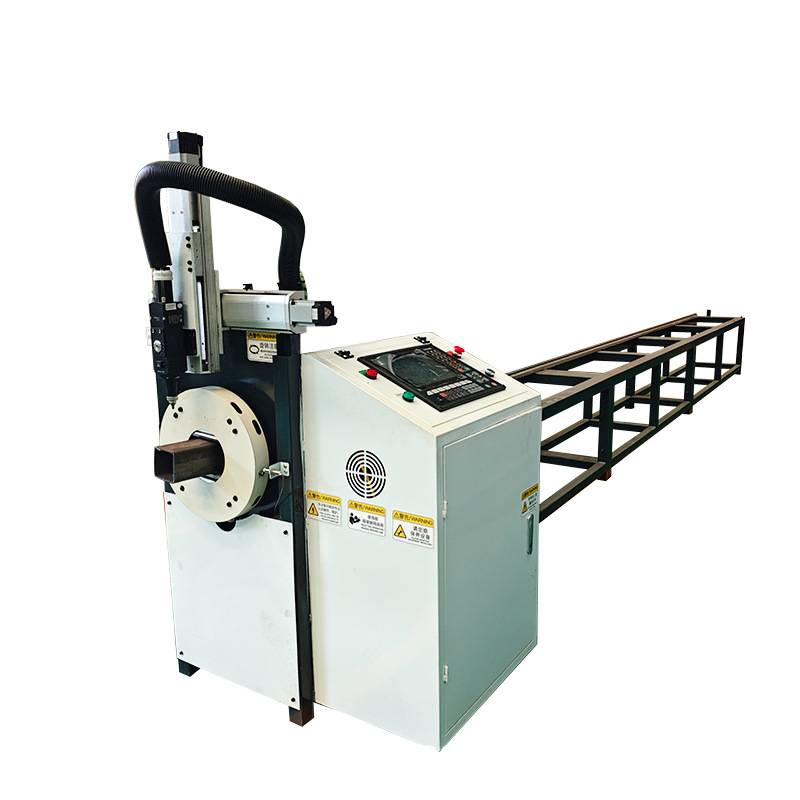
2.2 5-Axis 3D Cutting Head Dynamics
The 3D structural center utilizes a specialized 5-axis or 6-axis head capable of ±45° beveling. For crane girder fabrication, this eliminates secondary milling or grinding for weld preparation (V, X, or K-shaped joints). The technical advantage lies in the integration of the laser’s focal position control with the rotational axes of the head, ensuring that the beam remains perpendicular or at a precise programmed angle relative to the material surface, even when navigating the radius of a structural H-beam.
3.0 Application in Queretaro’s Crane Manufacturing Sector
3.1 Structural Components: Girders and End Trucks
In Queretaro’s crane fabrication facilities, the 30kW laser is primarily deployed for the precision cutting of box girder plates and the intricate profiling of end trucks. These components require high-precision bolt holes for motor mounts and wheel assemblies. Traditional methods often resulted in hole taper or eccentricity. The 30kW laser, through optimized piercing cycles and high-frequency pulse modulation, achieves hole-to-thickness ratios of 1:1 with sub-millimeter concentricity, ensuring perfect alignment during the final assembly of overhead bridge cranes.
3.2 Material Handling and Profile Variety
The processing center is designed to handle lengths up to 12 meters, typical for regional industrial requirements. The ability to process H-beams (HEA/HEB), C-channels (UPN), and large hollow sections (SHS) on a single platform reduces the internal logistics overhead. In the Queretaro facility, this has consolidated three separate machining stations into a single laser cell, significantly reducing the “work-in-progress” (WIP) footprint.
4.0 Zero-Waste Nesting Technology: Algorithmic Logic
4.1 Common Line Cutting and Remnant Management
Zero-Waste Nesting is not merely a geometric arrangement but a logic-driven software integration that maximizes the utilization of linear profiles. In structural steel, remnants are often discarded due to the difficulty of re-clamping short sections. The Zero-Waste algorithm implemented in this 30kW center utilizes “Common Line Cutting” for beam ends and “Micro-Joint Optimization” to ensure that the skeletal integrity of the profile is maintained until the final cut. This allows for the processing of parts right to the edge of the raw material stock.
4.2 Dynamic Nesting Across Multiple Profiles
The software evaluates the entire production queue for a crane project—including stiffeners, connection plates, and diaphragm plates—and nests them within the web and flange areas of the structural beams where possible, or optimizes the sequence of primary cuts to minimize “dead zones” near the chucks. In the evaluated Queretaro site, material utilization increased by 14.3% compared to manual nesting and conventional sawing methods.
5.0 Precision and Thermal Management in Heavy Sections
5.1 Mitigating Thermal Distortion
One of the primary engineering concerns in crane manufacturing is the “camber” or longitudinal deviation caused by heat input. Traditional oxy-fuel or plasma cutting generates significant heat, often requiring manual straightening post-cut. The 30kW laser’s high-speed processing reduces the total energy input per millimeter. Furthermore, the 3D processing center employs a “Distributed Cutting Path” logic, where the laser skips between non-adjacent zones to allow for thermal dissipation, ensuring that long structural members remain within the AISC (American Institute of Steel Construction) tolerance limits for straightness.
5.2 Edge Quality and Weldability
The 30kW source produces an oxide-free edge when used with nitrogen as the assist gas, even on 20mm+ sections. For crane manufacturers in Queretaro, this is vital. It allows for immediate welding without the need for shot blasting or chemical cleaning of the cut surface. The surface roughness (Rz) achieved is significantly lower than that of plasma, which reduces the risk of stress concentrators that could lead to crack initiation under the cyclic loading conditions typical of industrial cranes.
6.0 Synergies Between 30kW Fiber and Automatic Processing
6.1 Real-Time Sensing and Adaptive Control
The 3D processing center is equipped with capacitive height sensing and “Active Collision Avoidance.” Given that structural steel profiles like H-beams often have mill tolerances (twists or bows), the 30kW head uses a laser-based scanning system to map the actual profile in 3D space before the cut. The CNC controller then adjusts the cutting path in real-time to compensate for any deviations from the theoretical CAD model, ensuring that every bolt hole and bevel is positioned relative to the actual center-line of the beam.
6.2 Automated Loading and Unloading
To match the throughput of a 30kW source, the Queretaro installation features a heavy-duty automated longitudinal feed system. The synchronization between the laser’s “cutting gates” and the raw material feed ensures a continuous workflow. For crane manufacturers, this automation mitigates the safety risks associated with moving 10-ton beams manually, while the laser’s high processing speed ensures that the machine’s duty cycle remains above 85%.
7.0 Engineering Conclusion and ROI Evaluation
The deployment of the 30kW Fiber Laser 3D Structural Steel Processing Center in Queretaro represents a significant advancement in heavy engineering. The “Zero-Waste” capability directly offsets the rising costs of raw structural steel, while the 30kW power density addresses the bottleneck of processing heavy-gauge sections.
From a senior engineering perspective, the primary value is found in the “Total Process Consolidation.” By integrating cutting, drilling, bevelling, and marking into a single automated cycle with superior precision, the manufacturer eliminates cumulative tolerances that often plague large-scale crane assemblies. The metallurgical integrity of the components, preserved by the 30kW laser’s speed and reduced HAZ, ensures that the cranes manufactured in this region meet the highest global safety and performance standards for the next 25-30 years of operational life.
Technical Specifications Summary for Queretaro Site:
- Source: 30kW High-Brightness Fiber Laser
- Axis Configuration: 5-Axis 3D Head with Infinite Rotation
- Tolerance: ±0.05mm per linear meter
- Maximum Profile Size: 1200mm x 500mm (H-Beam)
- Nesting Efficiency: >96% utilization via Zero-Waste Algorithm
- Primary Application: Overhead Bridge Crane Girders and High-Precision End Trucks













