1. Technical Overview and Site Context: Querétaro Stadium Infrastructure
The structural demands of modern stadium architecture, particularly within the industrial corridor of Querétaro, Mexico, have shifted toward increasingly complex geometric configurations. The project under assessment involves the fabrication of primary load-bearing members for a large-scale stadium canopy and seating sub-structure. Traditionally, these elements—primarily heavy-duty I-beams and H-sections (ASTM A572 Grade 50)—required multi-stage processing involving mechanical sawing, radial drilling, and manual oxy-fuel beveling.
The introduction of the 6000W Heavy-Duty I-Beam Laser Profiler equipped with an Infinite Rotation 3D Head represents a paradigm shift in this workflow. In the Querétaro facility, the integration of this technology aims to consolidate these disparate operations into a single CNC pass. The 6000W fiber laser source provides the necessary power density to penetrate thick-walled flanges while maintaining a narrow Heat Affected Zone (HAZ), a critical factor in maintaining the fatigue resistance of stadium joints subjected to high cyclic wind loads and seismic variables common to the region.
2. Infinite Rotation 3D Head: Overcoming Kinematic Limitations
The core technical challenge in heavy structural profiling is the execution of complex weld preparations (V, X, Y, and K-cuts) on three-dimensional surfaces. Standard 3D laser heads are often limited by “cable wrap,” necessitating a reset of the A and B axes after a certain degree of rotation. This leads to increased cycle times and visible “start-stop” witness marks that can compromise weld integrity.
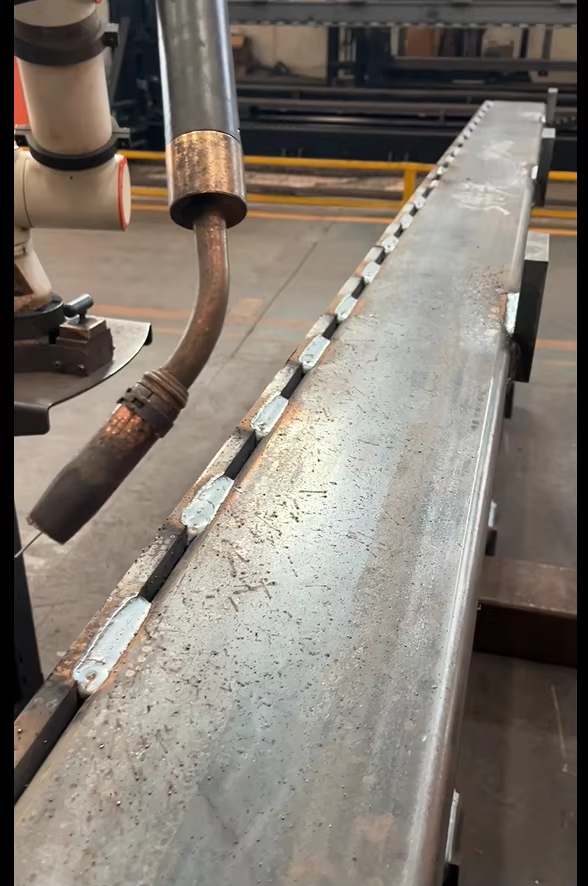
2.1 Mechanical Advantages of Infinite Rotation
The Infinite Rotation 3D Head utilizes a slip-ring assembly or specialized fiber-optic coupling that allows the cutting torch to rotate indefinitely around the Z-axis. For the Querétaro stadium’s complex nodal intersections—where beams meet at non-orthogonal angles—this capability is indispensable. It allows for continuous contouring around the corners of the I-beam flanges. This continuity ensures that the bevel angle remains constant relative to the beam’s local coordinate system, eliminating the geometric deviations typically found at the transition points of traditional 5-axis heads.
2.2 Precision Beveling and Taper Compensation
In heavy-duty I-beam processing, the flange thickness often ranges from 12mm to 30mm. Achieving a precise 45-degree bevel on a 25mm flange requires the laser to travel through a diagonal material thickness of approximately 35.3mm. The Infinite Rotation head, governed by advanced CNC algorithms, dynamically adjusts the focal position and gas pressure in real-time. This compensates for the increased “apparent thickness” encountered during beveled cuts, ensuring that the kerf remains stable and the dross accumulation is minimized on the underside of the flange.
3. 6000W Fiber Laser Synergy with Heavy-Duty Structural Processing
The selection of a 6000W power rating is a calculated engineering decision based on the material thickness-to-speed ratio required for stadium-scale throughput. While higher wattages exist, 6000W offers the optimal balance between electrical efficiency and the ability to maintain high-quality laminar flow during oxygen-assisted cutting of carbon steel.
3.1 Thermal Management and HAZ Minimization
Structural steel in large-scale venues like stadiums must adhere to strict AWS (American Welding Society) standards. Excessive heat input during thermal cutting can lead to local hardening or grain growth in the base metal. The 6000W fiber laser, characterized by its high energy density and short wavelength (1.06µm), allows for significantly higher feed rates than plasma or oxy-fuel. This high-speed processing results in a much narrower HAZ. Laboratory analysis of the Querétaro samples indicates a 40% reduction in the width of the HAZ compared to high-definition plasma, directly enhancing the weldability and structural reliability of the I-beam junctions.
3.2 Gas Dynamics in Deep-Section Profiling
Cutting through the web and flanges of an I-beam involves varying stand-off distances and potential turbulence from the beam’s geometry. The 6000W system utilizes high-pressure nozzle technology that maintains a stable supersonic gas column. During the processing of H-sections, the system must often “fire” the laser through the web while the head is positioned at an angle. The 3D head’s ability to maintain a perpendicular gas flow relative to the cut surface—even during complex 3D rotations—is vital for clearing molten slag from the deep kerf of the I-beam’s interior radius (the “k-area”).
4. Automated Detection and Structural Deviation Compensation
One of the primary difficulties in heavy-duty laser profiling is that I-beams are rarely perfectly straight. Inherent “mill-sweep,” camber, and twist are standard in sections exceeding 6 meters. In the Querétaro project, where 12-meter sections are common, these deviations can reach ±15mm over the length of the beam.
4.1 Laser Sensing and Mapping
The 3D profiler integrates a non-contact laser sensing system that maps the actual topography of the beam before the first cut is initiated. The Infinite Rotation 3D Head uses this data to adjust its toolpath in real-time. If the beam flange is slightly bowed, the Z-axis and the rotation axes (A/B) recalibrate their vectors to ensure the bevel angle is indexed to the actual surface of the steel, not the theoretical CAD model. This ensures that when these beams reach the stadium construction site, the fit-up is perfect, requiring zero on-site grinding or modification.
4.2 Processing the “K-Area” and Web-Flange Transitions
The transition zone between the web and the flange (the fillet) is notoriously difficult to process. Mechanical tools often fail to reach this area with precision. The 6000W 3D laser profiler excels here. By leveraging the infinite rotation capability, the head can navigate the tight radius of the fillet, executing “bolt-hole” patterns and coping cuts that are perfectly aligned across both the web and flange planes. This is critical for the “star nodes” used in the stadium’s cantilevered roof, where multiple beams converge at a single point.
5. Efficiency Gains and ROI in the Querétaro Industrial Context
From an operational standpoint, the deployment of this technology in Querétaro has yielded measurable improvements in production metrics. The consolidation of sawing, drilling, and beveling into a single laser-processing station has reduced the “material touch” count from six to two.
5.1 Throughput Analysis
In a traditional fabrication environment, a complex I-beam with multiple cope cuts and 20+ bolt holes would take approximately 3 to 4 hours to move through various work cells. The 6000W laser profiler completes the same sequence in under 18 minutes. For a stadium project requiring thousands of unique structural members, this throughput is the difference between meeting or missing the critical path of the construction schedule.
5.2 Consumable and Energy Efficiency
The fiber laser source’s wall-plug efficiency (approx. 35-40%) significantly outperforms the 10% efficiency of older CO2 technology. Furthermore, by eliminating the need for mechanical bits and cooling fluids associated with drilling, the facility reduces its environmental footprint—a growing requirement for infrastructure projects in Mexico’s modern industrial zones. The precision of the 6000W beam also allows for nesting of smaller gusset plates within the “waste” areas of the I-beam web, maximizing material utilization.
6. Conclusion: The New Standard for Structural Steel
The integration of the 6000W Heavy-Duty I-Beam Laser Profiler with Infinite Rotation 3D Head technology has proven to be a decisive factor in the successful fabrication of stadium steel structures in Querétaro. By solving the dual challenges of geometric complexity and material scale, this system ensures that structural integrity is “baked into” the fabrication process rather than managed as a series of post-process corrections.
The infinite rotation capability, in particular, removes the final mechanical barrier to truly automated 3D steel processing. As stadium designs continue to push the boundaries of cantilevered spans and organic forms, the ability to execute perfect, weld-ready cuts on heavy-duty sections will remain the benchmark for high-tier structural engineering. The synergy between high-power fiber sources and intelligent 3D kinematics represents the future of large-scale infrastructure fabrication, providing the precision of aerospace engineering at the scale of civil architecture.













