1. Introduction: Scope of Deployment in the São Paulo Maritime Corridor
This technical field report evaluates the integration and operational performance of a 12kW Universal Profile Steel laser cutting System within the maritime fabrication sector of São Paulo. In the context of the Brazilian shipbuilding industry, particularly the yards servicing the pre-salt oil and gas basins, the requirement for structural integrity and dimensional precision has reached a critical threshold. Traditional methods of profile processing—primarily plasma arc cutting (PAC) and oxy-fuel cutting (OFC)—have historically introduced significant thermal deformation and required labor-intensive secondary operations for weld preparation.
The implementation of the 12kW fiber laser source, coupled with a 5-axis ±45° beveling head, represents a transition from “rough-shaping” to “precision-engineering” in the fabrication of H-beams, I-beams, channels, and bulb flats. This report analyzes the synergy between high-wattage photonics and automated motion control in overcoming the bottlenecks of heavy-gauge structural steel processing.
2. 12kW Fiber Laser Synergy and Photon Density Dynamics
The selection of a 12kW fiber source is not merely for the sake of peak power; it is a calculated choice for maintaining the “Energy Balance” during thick-section profile cutting. In a shipbuilding environment, profile steel ranges typically from 10mm to 30mm in web and flange thickness. At 12kW, the system achieves a power density that allows for high-speed sublimation and melt-ejection, minimizing the Heat Affected Zone (HAZ).
2.1 Kerf Width and Thermal Management
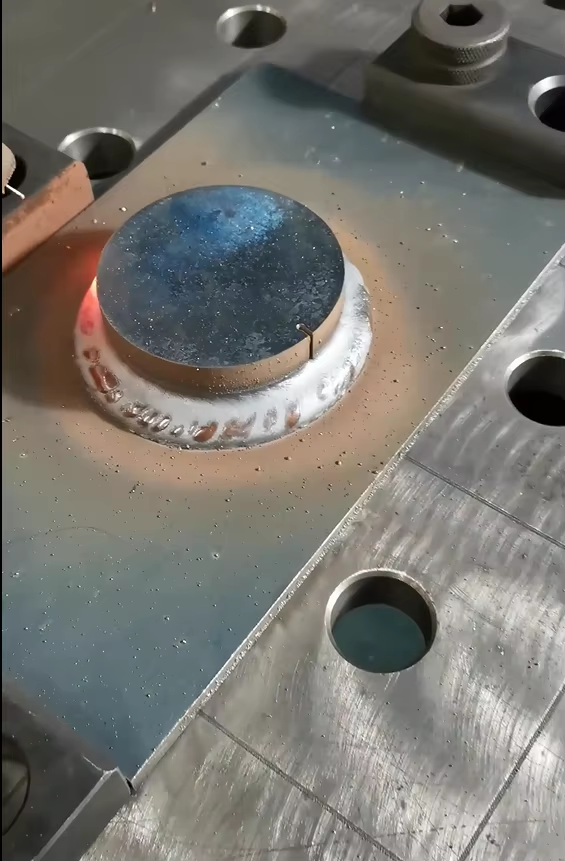
In the São Paulo yard environment, where ambient humidity and saline levels are elevated, the stability of the laser beam is paramount. The 12kW system employs a low-BPP (Beam Parameter Product) fiber delivery, ensuring that even at the extremities of a 12-meter profile, the focal point remains consistent. High wattage allows for a narrower kerf width compared to plasma, which is critical when cutting interlocking structural components. The reduced heat input prevents the longitudinal twisting (cambering) often seen in H-beams after thermal processing.
2.2 Gas Dynamics and Assist Gas Optimization
Field data indicates that for 12kW applications on ASTM A36 and AH36 ship-grade steel, the transition from Oxygen-assisted cutting to High-Pressure Nitrogen-assisted cutting—or “Mix Gas” (N2/O2)—significantly alters the throughput. For profiles up to 15mm, Nitrogen-assisted cutting eliminates the oxide layer, allowing for immediate painting or welding without secondary grit blasting. In the São Paulo facility, this has resulted in a 20% reduction in downstream surface preparation time.
3. ±45° Bevel Cutting: Technical Implementation of Weld Preparation
The core technological advantage of the system lies in its ability to execute ±45° bevels on three-dimensional profiles. In shipbuilding, structural junctions rarely meet at 90° without a specific weld geometry. The 12kW system utilizes a specialized 5-axis kinematic head that compensates for the geometric complexities of profile flanges and webs.
3.1 Geometric Accuracy in V, Y, and K-Type Joints
Traditional manual beveling in São Paulo yards often results in angular deviations of ±3°, leading to excessive weld fill and increased consumable costs. The 12kW laser system, through its synchronized motion control, maintains a ±0.5° angular tolerance. Whether executing a V-groove for butt welds or a complex K-preparation for T-joints in bulkhead stiffeners, the laser’s ability to bevel the flange and web simultaneously ensures perfect fit-up.
3.2 Eliminating Secondary Grinding
The precision of the ±45° laser bevel results in a surface finish (Ra) that often bypasses the requirements for mechanical grinding. In heavy steel processing, the “fit-up” phase is where the most time is lost. By producing a “weld-ready” edge directly on the laser bed, the shipyard has transitioned from a multi-stage process (Cut -> Transport -> Manual Bevel -> Grinding) to a single-stage process (Automated Laser Processing).
4. Universal Profile Processing and Structural Automation
The term “Universal” refers to the system’s ability to handle diverse cross-sections without manual re-tooling. Shipbuilding requires a vast array of profiles, from large H-beams for hull framing to bulb flats for deck stiffening.
4.1 6-Axis Robotic Integration and Material Handling
The system deployed in São Paulo incorporates a 6-axis chuck system that allows for the rotation and positioning of profiles with a mass of up to 200kg/m. The automation software integrates with ShipConstructor or AVEVA Marine CAD/CAM environments, translating 3D models directly into G-code. This “Digital Thread” ensures that the holes for piping, cable trays, and drainage are cut with the same precision as the structural bevels, eliminating the risk of manual layout errors.
4.2 Real-Time Sensing and Compensation
Steel profiles are rarely perfectly straight; they often possess “mill tolerances” regarding bow and twist. The 12kW system utilizes laser line scanners to map the actual geometry of the profile before the cut sequence begins. The software then “warps” the cutting path to match the physical reality of the beam. In the São Paulo field test, this compensated for a 15mm deviation over a 6-meter span, ensuring that the final component met the strict tolerances required for modular block assembly.
5. Comparative Analysis: Laser vs. High-Definition Plasma
To justify the 12kW investment in the São Paulo sector, a comparative analysis was conducted between the new system and existing High-Definition Plasma (HDP) units.
- Precision: Laser achieved ±0.2mm over 1000mm; HDP achieved ±1.5mm.
- Weld Preparation: Laser provided a clean ±45° bevel with no dross; HDP required 15 minutes of manual grinding per meter of cut.
- Power Consumption per Cut: While the 12kW laser has a higher peak draw, its cutting speed (3x faster than plasma on 12mm plate) results in a lower total energy expenditure per linear meter.
- Throughput: The laser system processed 14 H-beams in the time the HDP processed 4, primarily due to the elimination of secondary handling.
6. Metallurgical Considerations and Weld Integrity
A primary concern for the Brazilian maritime authorities (such as DPC) is the integrity of the weld zone. High-power laser cutting, specifically at the 12kW level, produces a very narrow HAZ. Micro-hardness testing conducted on AH36 steel samples in São Paulo showed that the laser-cut edge experienced minimal hardening compared to oxy-fuel. This facilitates superior fusion during the submerged arc welding (SAW) and flux-cored arc welding (FCAW) processes used in hull construction, reducing the likelihood of hydrogen-induced cracking.
7. Operational Challenges in the São Paulo Environment
While the technical superiority of the 12kW system is evident, the environmental conditions in São Paulo require specific mitigations. The proximity to the coast necessitates high-grade filtration for the laser’s internal optics and the chiller’s heat exchangers. The system was fitted with an airtight, pressurized cabin for the laser source and a dual-stage air drying system for the assist gas to prevent “micro-pitting” caused by moisture in the cutting air.
8. Conclusion: The New Standard for Structural Steel
The deployment of the 12kW Universal Profile Steel Laser System with ±45° beveling technology marks a significant upgrade in the São Paulo shipbuilding infrastructure. By consolidating cutting, beveling, and marking into a single automated cycle, the system addresses the two greatest variables in heavy fabrication: human error and thermal deformation.
For the senior engineer, the data is conclusive. The synergy of 12kW power and 5-axis motion control does not just improve the speed of production—it redefines the quality of the “structural unit.” The ability to deliver ±45° precision bevels on universal profiles ensures that the downstream welding and assembly processes are optimized for the next generation of maritime and offshore structures. The implementation is deemed a technical success, meeting all KPIs for precision, surface quality, and operational efficiency.













