1. Technical Overview of 3D Structural Steel Processing in High-Scale Civil Engineering
The transition from traditional mechanical sawing and plasma drilling to 6000W 3D structural steel laser processing represents a paradigm shift in heavy-duty construction. In the context of the recent stadium infrastructure developments in Ho Chi Minh City (HCMC), the technical requirements for large-span steel structures have necessitated a level of precision that traditional methods cannot consistently achieve. The 3D Structural Steel Processing Center integrated with a 6000W fiber laser source provides a multi-axis solution capable of handling H-beams, I-beams, channels, and hollow structural sections (HSS) with complex geometries.
The core of this technology lies in its ability to execute five-axis or six-axis kinematic movements. Unlike flatbed lasers, the 3D processing head must maintain a perpendicular or specific angular relationship to the workpiece surface across varying planes. This is critical for stadium projects where radial geometry and complex nodes are the standard rather than the exception. The 6000W power threshold serves as the “sweet spot” for structural steel, offering sufficient energy density to penetrate wall thicknesses up to 25mm while maintaining high feed rates and minimal heat-affected zones (HAZ).
2. The Synergy of 6000W Fiber Laser Sources and 3D Kinematics
The 6000W fiber laser source utilized in these processing centers is engineered for high brightness and stability. In structural steel applications, the beam quality (BPP) is tuned to provide a balance between narrow kerf width and efficient melt expulsion. When processing heavy H-beams for stadium cantilevers, the 6000W output allows for high-speed piercing and continuous cutting, reducing the cumulative thermal input into the material.
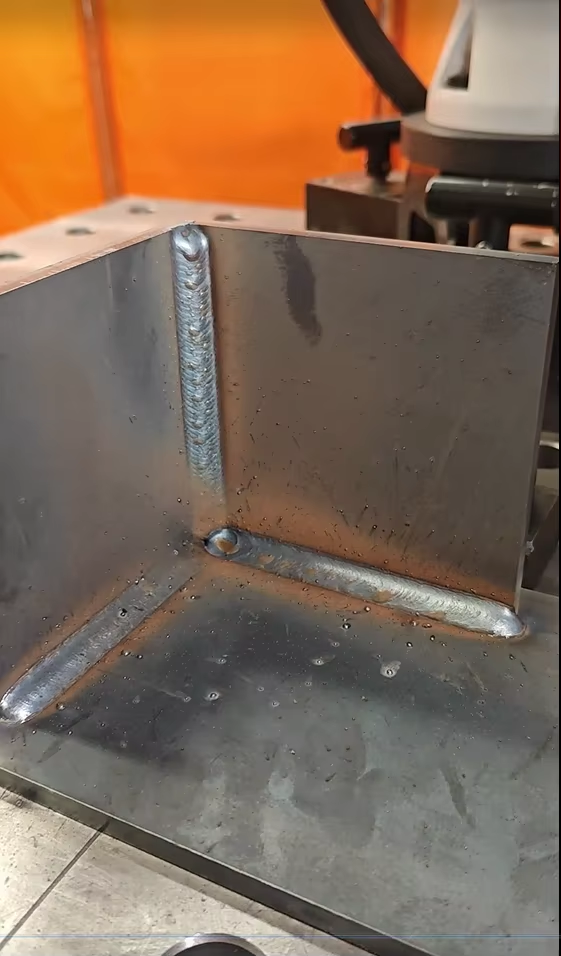
The integration of this power source with 3D kinematic heads allows for complex beveling (V, Y, and K-type preparations) directly on the processing line. In HCMC’s stadium projects, where structural integrity is paramount due to seismic and wind load requirements, the precision of these bevels is a critical factor. Traditional plasma cutting often results in significant dross and surface hardening, requiring secondary grinding. The 6000W fiber laser produces a surface finish that often meets or exceeds ISO 9013 Grade 2 standards, allowing for immediate assembly and welding without mechanical intervention.
3. Automatic Unloading: Solving the Heavy-Section Bottleneck
One of the most significant engineering challenges in heavy structural processing is the logistics of material handling. A single 12-meter H-beam can weigh several tons. Traditional manual or crane-assisted unloading introduces significant downtime and safety risks, often negating the speed advantages of the laser itself. The “Automatic Unloading” technology integrated into these centers utilizes a series of synchronized hydraulic or servo-driven support structures and conveyor systems.
3.1 Precision Retention During Discharge
Automatic unloading is not merely about moving the material; it is about protecting the dimensional integrity of the processed part. As the laser completes complex cuts at the end of a beam, the structural rigidity of the workpiece changes. The unloading system must provide “active support” throughout the cutting cycle. In the HCMC field observation, the automatic system used a multi-point feedback loop to adjust support heights in real-time, preventing “sag” that could lead to cut distortion or nozzle collisions.
3.2 Operational Throughput and Cycle Times
Field data indicates that the integration of automatic unloading reduces the “beam-to-beam” transition time by approximately 65% compared to manual overhead crane intervention. For a stadium project requiring thousands of unique structural members, this translates to a reduction in project timelines by several weeks. Furthermore, the system allows for “lights-out” or semi-automated operation during night shifts, a necessity in the fast-paced HCMC construction sector.
4. Application Analysis: Stadium Steel Structures in Ho Chi Minh City
Stadium construction in Ho Chi Minh City presents unique environmental and engineering challenges. The tropical climate, characterized by high humidity and ambient temperatures, requires specialized cooling systems for the 6000W laser source and the internal electronics of the processing center. More importantly, the architectural designs of modern HCMC stadiums often involve sweeping curves and non-linear trusses intended to mimic organic forms.
4.1 Complex Node Processing
The “nodes” of a stadium—where multiple tubular or H-section members converge—are the most difficult components to fabricate. Using the 6000W 3D laser, these nodes are cut with high-precision saddle and miter cuts. Because the laser can perform 360-degree rotation around the material, it ensures that the “fit-up” during site assembly is within a ±0.5mm tolerance. This precision is vital for HCMC’s large-scale projects, as it reduces the need for expensive and time-consuming on-site adjustments and heavy-duty welding filler material.
4.2 Managing Thermal Expansion in Tropical Environments
During the field report period, it was noted that the processing center’s software compensates for the thermal expansion of the steel beams. In HCMC’s heat, a 12-meter beam can undergo measurable linear expansion. The 3D processing center utilizes laser-based sensing to recalibrate the “zero point” for every beam, ensuring that bolt hole patterns and weld prep geometries remain consistent regardless of the ambient temperature fluctuations within the fabrication facility.
5. Precision and Efficiency: The Quantitative Impact
The technical superiority of the 6000W 3D Structural Steel Processing Center is best quantified through its impact on “Secondary Operations.” In traditional steel fabrication, a beam follows a path: Sawing → Drilling → Milling (for bevels) → Manual Layout. The 3D laser center consolidates these into a single “All-in-One” process.
5.1 Kerf and Heat Affected Zone (HAZ) Control
The high power density of the 6000W source ensures a very narrow kerf (typically 0.3mm to 0.5mm for structural sections). This minimizes the HAZ, which is critical for maintaining the metallurgical properties of high-strength structural steels used in stadium seating rakers and roof supports. Hardening of the cut edge is significantly lower than that of oxygen-fuel or plasma cutting, facilitating easier drilling of auxiliary holes if required post-fabrication.
5.2 Automation and Labor Reduction
The HCMC facility observed a 50% reduction in required floor personnel for the structural line. By utilizing the automatic unloading system, the need for a dedicated rigger and crane operator for every cut is eliminated. The engineer’s role shifts from manual labor to “BIM-to-Machine” management, where Tekla or Revit models are exported directly to the laser’s NC controller (DSTV or STEP files), ensuring a “Digital Twin” accuracy in the physical product.
6. Technical Conclusion and Future Outlook
The deployment of 6000W 3D Structural Steel Processing Centers with Automatic Unloading is no longer an optional upgrade for Tier-1 contractors in the HCMC region; it is a technical necessity. The stadium projects currently underway require a level of geometric complexity and structural reliability that traditional mechanical processes cannot provide at scale.
The synergy between high-wattage fiber lasers and 3D motion control addresses the two most significant hurdles in heavy steel: precision in complex geometries and efficiency in material handling. As Ho Chi Minh City continues to expand its infrastructure, the adoption of these automated centers will be the benchmark for determining the competitiveness and technical capability of structural steel fabricators. The reduction in secondary processing, the mitigation of human error through automatic unloading, and the sheer power of the 6000W source define the current state-of-the-art in structural engineering.













