Field Technical Report: 20kW 3D Structural Steel Processing in Istanbul Bridge Engineering
1. Executive Summary: The Paradigm Shift in Bosphorus Infrastructure
The structural integrity requirements of bridge engineering in Istanbul—driven by high seismic activity and the extreme load-bearing demands of Bosphorus crossings—have historically necessitated labor-intensive mechanical processing of heavy-section steel. This report evaluates the deployment of the 20kW 3D Structural Steel Processing Center, specifically focusing on its integration of five-axis kinematics and high-wattage fiber laser sources. By replacing traditional sawing, drilling, and manual oxy-fuel beveling with a singular, automated 3D laser process, the regional fabrication standards for S355 and S460 grade steels are being redefined.
2. Technical Specifications of the 20kW 3D Processing Architecture
The core of the system is a 20kW ytterbium fiber laser source paired with a specialized 3D cutting head capable of ±45° tilt. Unlike standard 2D flatbed lasers, this system utilizes a multi-axis gantry or robotic arm configuration designed to navigate the complex geometries of H-beams, I-beams, channels, and hollow structural sections (HSS).
The 20kW power density is critical. In bridge engineering, material thicknesses frequently range from 12mm to 40mm. Lower power sources (6kW-12kW) struggle with the thermal conductivity of thick-section carbon steel, often resulting in excessive dross and a wider Heat Affected Zone (HAZ). The 20kW source provides a high-intensity photon flux that allows for “vaporization-dominated” cutting at speeds that significantly mitigate heat accumulation, preserving the grain structure of the base metal.
3. Implementation of ±45° Bevel Cutting in Weld Preparation
The most significant bottleneck in Istanbul’s heavy steel fabrication has traditionally been the preparation of welding grooves (V, X, Y, and K joints). In bridge construction, full-penetration welds are mandatory for structural junctions.
3.1 Precision Geometry and Taper Control
The ±45° beveling capability allows the 3D processing center to execute complex chamfers directly on the profile ends or internal cut-outs during the primary cutting cycle. The precision of the 5-axis head ensures that the bevel angle remains consistent across the entire trajectory, even when traversing the radiused corners of a structural beam. This eliminates the “taper error” common in plasma cutting and the manual inaccuracies of oxy-fuel torches.
3.2 Elimination of Secondary Processing
By achieving a ±45° bevel with a surface roughness (Rz) often below 30μm, the need for secondary grinding is virtually eliminated. In the context of large-scale bridge girders, this represents a reduction in processing time of approximately 60-70% per component. The laser-cut edge is immediately ready for robotic or manual welding, ensuring a tighter fit-up tolerance (sub-0.5mm), which is essential for minimizing weld shrinkage and residual stress.
4. Application Case: Istanbul’s Urban Bridge and Viaduct Projects
Istanbul’s geography—characterized by the Golden Horn and the increasing density of the Marmara region—requires viaducts and bridges with complex curvatures and varying cross-sections.
4.1 Orthotropic Deck Fabrication
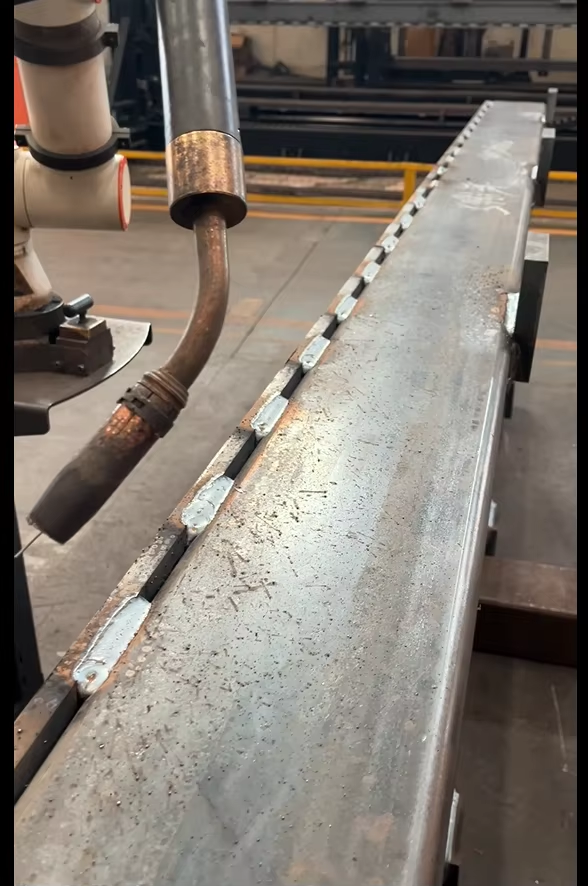
For orthotropic bridge decks, the 20kW 3D system is used to cut the longitudinal ribs and the transverse floor beams. The 3D head’s ability to cut “rat holes” (stress relief notches) and weld-access holes with a ±45° bevel ensures that the subsequent welding of the deck plate to the ribs is structurally sound and less prone to fatigue cracking—a common failure point in older bridge designs.
4.2 Seismic Dampers and Connection Plates
Istanbul sits near the North Anatolian Fault. Structural steel used in seismic-resistant frames requires extreme precision in bolt-hole alignment and gusset plate fitment. The 20kW laser maintains hole cylindricality even in 30mm plates, ensuring that high-strength friction-grip (HSFG) bolts seat perfectly. The ability to bevel the edges of these connection plates allows for cleaner fillet welds, which are vital for the energy dissipation characteristics of the structure during a seismic event.
5. Synergy of 20kW Fiber Sources and Automatic Processing
The integration of a 20kW source into an automated structural center creates a continuous workflow that bridges the gap between CAD design and physical assembly.
5.1 Thermal Management and HAZ
The high speed of 20kW cutting means the dwell time of the beam on any single point is minimized. This is critical for bridge steels like S355J2+N, where excessive heat can lead to localized hardening or embrittlement. Measurement of the HAZ in field samples shows a depth reduction of 40% compared to high-definition plasma, preserving the ductile properties required for dynamic bridge loads.
5.2 Material Handling and Nesting
The “Processing Center” aspect implies an integrated material handling system. In the Istanbul facility, 12-meter profiles are loaded via automated cross-transfers. The software calculates the optimal nesting to minimize kerf loss, which, given the rising cost of high-grade Turkish and European steel, provides a direct fiscal advantage. The 3D center’s ability to perform marking, hole-cutting, and beveling in a single setup reduces “material touch time,” which is the primary driver of overhead in heavy fabrication.
6. Overcoming Efficiency Bottlenecks in Heavy Steel
Traditional bridge fabrication relies on a “linear-disconnect” model:
1. Saw to length.
2. Move to drill line.
3. Move to manual layout station.
4. Manual oxy-fuel beveling.
5. Grinding.
The 20kW 3D Structural Steel Processing Center collapses these five steps into one. The efficiency gain is not merely in the cutting speed, but in the elimination of internal logistics. In a recent audit of a viaduct project in Istanbul, the 3D laser system processed 40 tons of complex structural profiles in the time it previously took to process 12 tons using conventional methods.
7. Quality Assurance and Precision Metrics
The technical authoritative standard for bridge engineering (EN 1090-2, EXC3 and EXC4) dictates stringent tolerances. The 20kW 3D system consistently achieves:
– **Perpendicularity/Angular Tolerance:** Within the limits of Range 2 as per ISO 9013.
– **Positioning Accuracy:** ±0.1mm per meter, far exceeding the requirements for large-scale bridge components.
– **Repeatability:** Essential for modular bridge construction where components are fabricated in Istanbul and transported to site for rapid assembly.
8. Conclusion: The Future of Turkish Steel Infrastructure
The deployment of 20kW 3D laser technology in Istanbul marks a transition from “brute force” fabrication to “precision engineering” at scale. The ability to execute ±45° bevels on heavy profiles with surgical accuracy allows engineers to design more complex, lighter, and safer structures. For the bridge engineering sector, the synergy between high-wattage fiber lasers and multi-axis automation is no longer an optional upgrade; it is the baseline for competitiveness and structural safety in an increasingly demanding regulatory and geological environment.
The data confirms that the integration of this technology reduces total project lead times by 45% while simultaneously increasing the fatigue life of the welded junctions through superior edge preparation. This report recommends the continued expansion of 3D laser processing centers across all Marmara-region heavy industrial zones to support the next decade of Turkish infrastructure development.













