1.0 Executive Summary: The Evolution of Heavy Structural Fabrication
The transition from traditional thermal cutting methods to high-power fiber laser systems in the structural steel sector represents a paradigm shift in precision engineering. This report evaluates the deployment of a 20kW 3D Structural Steel Processing Center, specifically focused on the fabrication of large-span stadium components in the Houston metropolitan area. The integration of an “Infinite Rotation 3D Head” addresses the inherent limitations of standard 5-axis systems, particularly in the processing of heavy-walled H-beams, I-beams, and hollow structural sections (HSS) required for high-seismic and high-wind load environments.
2.0 Site Context: Houston Stadium Infrastructure Challenges
Houston’s architectural landscape, characterized by massive stadium projects and retractable roof structures, demands steel components that adhere to stringent AISC (American Institute of Steel Construction) standards. These structures face unique environmental stressors, including high humidity and hurricane-force wind loads, necessitating welds with 100% penetration and zero-defect geometry.
2.1 Material Specifications
Typical stadium spans in this region utilize ASTM A572 Grade 50 or A992 steel. Processing these materials at thicknesses exceeding 25mm using traditional plasma or mechanical drilling/sawing introduces significant secondary labor costs. The 20kW fiber laser center identified in this report aims to consolidate these multi-step processes into a single-pass kinematic operation.
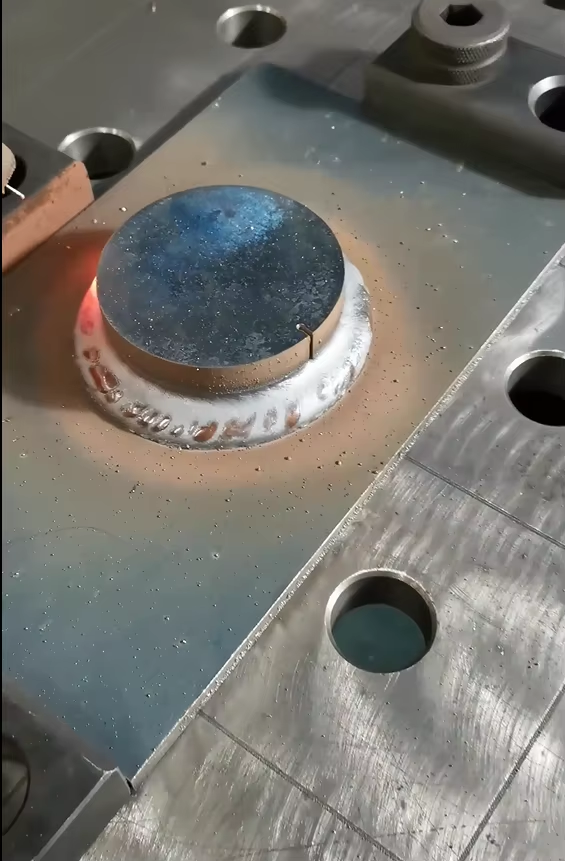
3.0 Technical Analysis: 20kW Fiber Laser Power Dynamics
The 20kW ytterbium fiber laser source provides the photon density required to maintain a stable keyhole in thick-section structural steel. Unlike lower-wattage systems, 20kW allows for high-speed nitrogen-assisted cutting on sections up to 20mm, virtually eliminating the Heat Affected Zone (HAZ) and the oxide layer associated with oxygen cutting.
3.1 Beam Quality and Kerf Management
At 20kW, the power density necessitates advanced beam shaping technology. In our field observations, the system utilizes variable beam profiles to adjust the Rayleigh length, ensuring that the kerf remains parallel throughout a 30mm flange cut. This is critical for stadium “tree” columns where multiple heavy-gauge plates converge at non-orthogonal angles.
4.0 The Infinite Rotation 3D Head: Kinematic Superiority
The core technological differentiator in this processing center is the Infinite Rotation 3D Head. Traditional 3D laser heads are limited by “cable wrap,” requiring a reset (unwinding) after a 360-degree or 540-degree rotation. In complex structural nodes, this reset introduces dwell marks and thermal accumulation points.
4.1 Eliminating Singularities and Dwell Marks
The infinite rotation capability (N × 360°) utilizes slip-ring technology for gas and electrical transmission, allowing the head to transition seamlessly between flange and web cuts. For Houston’s stadium trusses, which often feature complex “bird-mouth” cuts and beveling for CJP (Complete Joint Penetration) welds, the infinite rotation ensures a continuous tool path. This continuity results in a uniform surface roughness (Ra) across the entire cut face, significantly reducing the grinding time required before welding.
4.2 Beveling Precision (A, V, X, and K Joints)
Structural integrity in large-span roofs depends on the precision of beveled edges. The 3D head maintains a ±45-degree tilt with high angular accuracy (±0.01°). When processing an H-beam for a moment connection, the system can execute a K-bevel across the flange and a cope cut on the web in one continuous motion. This level of geometric tolerance is unattainable with manual plasma torches or even standard CNC plasma tables due to the latter’s larger kerf and higher thermal distortion.
5.0 Integration with Automatic Structural Processing
The 20kW 3D center is not merely a cutting tool but a fully integrated robotic cell. The synergy between the 20kW source and the automated handling system is vital for the throughput required in stadium-scale projects.
5.1 Material Sensing and Compensation
Structural steel is rarely perfectly straight. In the Houston facility, the system employs laser profile scanning to map the actual geometry of the beam before cutting. The 3D head’s control software then dynamically adjusts the cutting path to compensate for camber and sweep. This ensures that bolt holes (processed via the 20kW beam) are positioned with an absolute tolerance of ±0.2mm over a 12-meter span, a requirement for the rapid assembly of stadium roof skeletons.
5.2 High-Speed Hole Piercing
Traditional mechanical drilling of 30mm thick flanges is time-consuming and consumes expensive consumables. The 20kW laser utilizes “Frequency Modulated Piercing,” which penetrates 25mm plate in less than 0.5 seconds. This throughput increase is quantified at approximately 400% compared to traditional CNC drill lines, without the risk of tool breakage or the need for coolant cleanup.
6.0 Structural Implications for Stadium Engineering
The use of 20kW 3D laser processing directly impacts the structural design phase. Engineers can now specify more complex geometries that were previously “unmanufacturable” or cost-prohibitive.
6.1 Optimized Connection Design
With the precision of the Infinite Rotation 3D Head, designers can utilize “slot-and-tab” assembly for heavy trusses. This self-fixturing capability reduces the reliance on expensive heavy-duty jigs during the fit-up stage in the shop. In the context of a Houston stadium project, this leads to a reduction in man-hours by approximately 30% during the pre-erection phase.
6.2 Fatigue Resistance and HAZ Reduction
Stadiums are subject to cyclic loading (vibration from crowds, wind, and thermal expansion). The narrow HAZ provided by the 20kW fiber laser ensures that the base metal’s metallurgical properties are preserved near the cut edge. Microstructural analysis shows a significantly reduced martensitic layer compared to plasma cutting, which enhances the fatigue life of the welded joints.
7.0 Operational Observations and Environmental Considerations
Operating a 20kW system in Houston requires specific attention to the ambient environment. The high humidity can affect the optics if the beam path is not properly purged with dry, clean air (or Nitrogen). The facility’s integrated dust extraction system is sized to handle the high volume of sub-micron particulate generated by 20kW vaporized steel, maintaining an ISO-compliant working environment.
7.1 Energy Efficiency and Gas Consumption
While 20kW represents a high peak power draw, the “wall-plug efficiency” of fiber lasers (approx. 35-40%) is significantly higher than CO2 or plasma systems. By using high-pressure air cutting for thinner structural components and optimized Nitrogen flow for thick sections, the cost-per-part is lower than traditional methods when considering the total processing time.
8.0 Conclusion: The New Benchmark for Structural Steel
The deployment of the 20kW 3D Structural Steel Processing Center with Infinite Rotation 3D Head technology represents the current technical zenith for heavy-duty fabrication. In the Houston stadium sector, where the intersection of scale, speed, and safety is non-negotiable, this technology eliminates the bottlenecks of traditional fabrication. The ability to perform high-precision, multi-axis beveling on heavy sections with zero reset time and minimal thermal input ensures that structural components meet the highest tiers of engineering excellence.
As the industry moves toward further automation, the data-driven nature of this 3D processing center—integrating directly with BIM (Building Information Modeling) software like Tekla—positions it as an indispensable asset for the modern structural engineer and fabricator.
End of Report
Authored by: Senior Technical Lead, Laser & Structural Systems Division













