The Evolution of High-Power laser cutting in Leon’s Industrial Sector
The industrial landscape of Leon has undergone a significant transformation over the last decade, transitioning from traditional manufacturing methods to high-precision, automated technologies. At the forefront of this revolution is the 12kW precision laser system. As a hub for automotive, aerospace, and food processing industries, Leon demands fabrication standards that combine extreme speed with surgical accuracy. The introduction of 12kW fiber laser technology has redefined what is possible in stainless steel processing, offering a level of throughput that was previously unattainable with lower-wattage systems or plasma cutting alternatives.
In the context of modern engineering, laser cutting is no longer just a luxury for specialized prototypes; it is the backbone of mass production. The 12kW power threshold represents a “sweet spot” for regional manufacturers. It provides enough energy to penetrate thick stainless steel plates with ease while maintaining the agility required for intricate, thin-gauge components. This versatility is crucial for Leon’s diverse supply chain, which requires everything from heavy-duty structural brackets to high-finish aesthetic panels for the food and beverage industry.
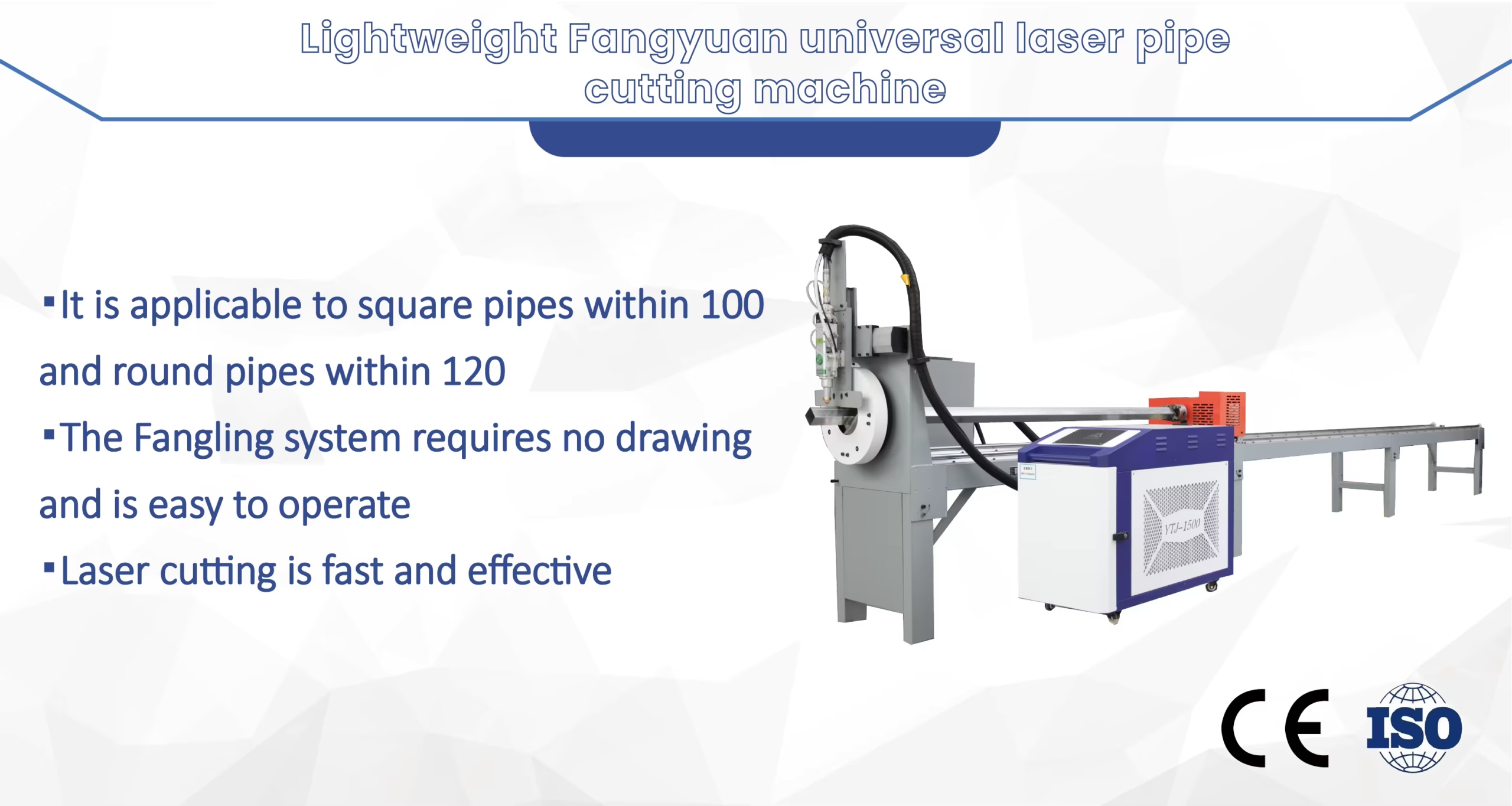 laser cutting machine“>
Technical Superiority of the 12kW Fiber Laser
The technical architecture of a 12kW precision laser system is engineered for stability and beam quality. Unlike CO2 lasers of the past, fiber lasers utilize solid-state technology to generate a beam that is delivered through a flexible fiber optic cable. At 12kW, the power density at the focal point is immense. This allows for a significantly higher cutting speed, particularly in stainless steel ranging from 3mm to 30mm in thickness. For the engineering firms in Leon, this translates to reduced lead times and lower costs per part.
Precision is maintained through advanced CNC controllers and high-performance linear motors. A 12kW system must manage extreme thermal loads, which is why these machines are equipped with sophisticated cooling systems and auto-focusing cutting heads. The “precision” aspect of the system refers to its ability to maintain tolerances within microns, even when operating at high velocities. This is essential when cutting stainless steel, as the material’s thermal conductivity and expansion rates require tight control over the heat input to prevent warping or dross accumulation.
Optimizing Stainless Steel Fabrication in Leon
Stainless steel is a preferred material in Leon’s industrial sectors due to its corrosion resistance and mechanical strength. However, it is notoriously difficult to machine and cut without the right equipment. The 12kW laser system addresses the inherent challenges of stainless steel—specifically its reflectivity and work-hardening properties. By using a high-energy beam, the laser cutting process vaporizes the metal so quickly that the surrounding material has little time to absorb heat, resulting in a minimal Heat Affected Zone (HAZ).
In Leon’s food processing and medical equipment sectors, the edge quality of stainless steel is non-negotiable. A 12kW system, when paired with nitrogen as an assist gas, produces an oxide-free, silver-bright edge that requires no secondary finishing. This “ready-to-weld” or “ready-to-ship” quality is a massive competitive advantage for local fabricators looking to reduce labor costs and improve cycle times.
The Role of Assist Gases: Nitrogen vs. Oxygen
When utilizing a 12kW laser for stainless steel, the choice of assist gas is a critical engineering decision. Nitrogen is the industry standard for precision applications. It acts as a mechanical force to blow the molten metal out of the kerf while preventing oxidation. Because the 12kW system provides such high power, it can maintain high-pressure nitrogen cutting at thicknesses that were previously only possible with oxygen.
Oxygen cutting, while useful for carbon steel, creates an oxidized edge on stainless steel that must be mechanically removed before painting or welding. In the high-stakes manufacturing environments of Leon, avoiding this secondary step is vital. The 12kW laser allows for “High-Pressure Nitrogen Cutting” on stainless steel up to 25mm and beyond, ensuring that the metallurgical properties of the edge remain identical to the rest of the plate.

Precision and Repeatability in Complex Geometries
One of the standout features of the 12kW precision system is its ability to handle complex geometries without sacrificing speed. In Leon’s automotive sector, parts often feature intricate hole patterns and tight radii. Traditional mechanical punching or lower-power lasers struggle with the “thermal buildup” that occurs during intricate cuts. The 12kW system uses advanced pulsing techniques and real-time power modulation to ensure that even the smallest details are crisp and accurate.
Repeatability is another cornerstone of precision engineering. A 12kW system integrated with high-end motion control ensures that the first part is identical to the thousandth part. For Leon-based manufacturers serving international OEMs, providing documented proof of dimensional accuracy is often a contractual requirement. Modern laser cutting systems often include integrated sensors that monitor the cut quality in real-time, automatically adjusting parameters if a deviation is detected.
Economic Impact and ROI for Leon Manufacturers
Investing in a 12kW precision laser system is a significant capital expenditure, but for a high-volume shop in Leon, the Return on Investment (ROI) is often realized within 18 to 24 months. The primary driver of this ROI is the “cost per part” reduction. Because a 12kW laser can cut 3 to 5 times faster than a 4kW or 6kW laser on medium-thickness stainless steel, the machine’s capacity is effectively tripled. This allows a shop to take on more work without increasing its footprint or doubling its workforce.
Furthermore, the energy efficiency of modern fiber lasers is significantly higher than that of older CO2 technology. A 12kW fiber laser converts electrical energy into light much more efficiently, leading to lower utility bills. In an era of rising energy costs, this operational efficiency is a key factor in maintaining a competitive edge in the regional market of Leon and the broader Bajío area.
Integrating Automation and Industry 4.0
To truly leverage the power of a 12kW system, many Leon-based companies are integrating automated loading and unloading systems. When a machine can cut a sheet of stainless steel in minutes, the bottleneck shifts from the laser cutting process to material handling. Automated towers and robotic sorting systems allow the laser to run “lights-out” during night shifts, maximizing the utilization of the asset.
Industry 4.0 integration also plays a role. These systems are connected to the factory’s ERP, providing real-time data on gas consumption, power usage, and cutting time. For engineers in Leon, this data is invaluable for accurate quoting and process optimization. By analyzing the “pierce time” and “cut speed” data, managers can fine-tune their operations to squeeze every bit of productivity out of the 12kW system.
Maintenance and Local Support in Leon
A precision machine is only as good as its maintenance schedule. In Leon, the availability of local technical support and spare parts is a major consideration for any engineering firm. A 12kW system requires specialized care, particularly regarding the optical path and the cooling unit. Regular calibration of the cutting head and monitoring of the protective windows are essential to prevent downtime.
The local industrial ecosystem in Leon has evolved to provide this support, with specialized technicians capable of servicing high-power fiber lasers. Preventive maintenance programs ensure that the laser cutting system operates at peak efficiency, preventing the “beam divergence” or “power drop” that can occur if the system is neglected. For stainless steel applications, where cut quality is paramount, keeping the optics pristine is the difference between a premium product and scrap metal.
Conclusion: The Future of Metal Fabrication in Leon
The 12kW precision laser system represents the pinnacle of current fabrication technology. For the city of Leon, it is an essential tool that enables local manufacturers to compete on a global stage. By mastering the nuances of stainless steel laser cutting—from gas selection to thermal management—Leon’s engineering community is well-positioned to lead the next wave of industrial growth. As the demand for more complex, high-strength, and high-finish components grows, the 12kW fiber laser will remain the definitive solution for those who refuse to compromise on speed or precision.
Whether it is for the production of heavy industrial tanks, precision automotive components, or elegant architectural features, the 12kW system provides the power and flexibility required to turn raw stainless steel into high-value engineered products. In the competitive landscape of Leon, this technology is not just an upgrade; it is a necessity for future-proofing any metal fabrication business.













