High-Power Precision: The 12kW Sheet Metal Laser in Toluca’s Industrial Sector
The industrial landscape of Toluca, State of Mexico, has evolved into one of the most significant manufacturing hubs in North America. As the automotive and aerospace sectors continue to expand, the demand for high-precision components—specifically those fabricated from aluminum alloys—has skyrocketed. At the center of this technological shift is the 12kW fiber laser cutting system. This high-power threshold represents a critical “sweet spot” for modern fabrication shops, offering a balance of extreme speed on thin materials and unparalleled penetration on thick sections.
Implementing a 12kW laser cutting solution requires more than just capital investment; it demands a deep understanding of material science, specifically regarding the unique challenges posed by aluminum. Unlike carbon steel, aluminum alloys possess high thermal conductivity and high reflectivity, factors that historically made laser cutting a difficult endeavor. However, with the advent of 12kW fiber technology, these barriers have been largely overcome, allowing Toluca-based manufacturers to achieve tolerances and finish qualities that were previously impossible.
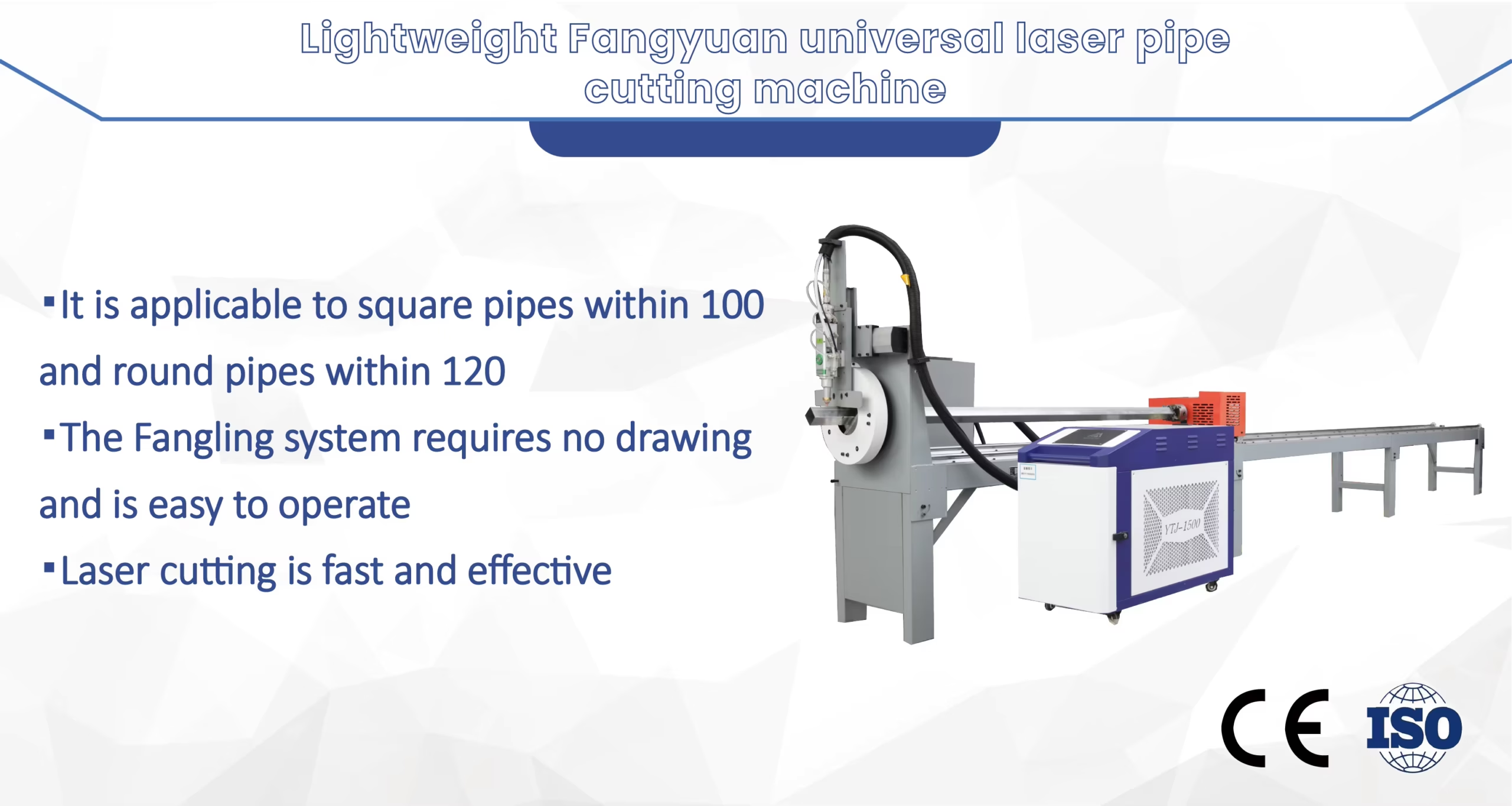 laser cutting machine MAK120″>
The Technical Superiority of 12kW Fiber Lasers
The transition from lower-wattage systems (such as 4kW or 6kW) to a 12kW power source is not merely an incremental upgrade; it is a paradigm shift in throughput. In the context of laser cutting, power density is the primary driver of efficiency. A 12kW beam concentrated into a microscopic focal point generates enough energy to vaporize aluminum instantly, reducing the Heat Affected Zone (HAZ) and preventing the material from absorbing excess heat, which often leads to warping in thinner sheets.
For Toluca’s Tier 1 and Tier 2 suppliers, this power translates to a significant reduction in “cost per part.” While the initial energy consumption of a 12kW machine is higher, the cutting speeds are often three to four times faster than a 6kW unit on mid-range aluminum thickness (6mm to 12mm). This means the machine spends less time per component, leading to lower overall electricity and auxiliary gas consumption per unit produced.
Processing Aluminum Alloys: Overcoming Reflectivity
Aluminum is notoriously reflective in its molten state. In the early days of CO2 lasers, back-reflections could travel back through the beam delivery system and destroy the resonator. Modern 12kW fiber lasers utilize isolators and advanced beam delivery optics that are immune to these reflections. When laser cutting aluminum alloys like the 5000 series (marine grade) or 6000 series (architectural/structural), the 12kW output ensures that the beam “pierces” the surface reflectivity instantly, establishing a stable keyhole for the cut.
In Toluca’s diverse manufacturing environment, consistency is key. Whether a shop is cutting 5052-H32 for electronic enclosures or 6061-T6 for structural brackets, the 12kW system provides the necessary overhead to maintain a stable plasma cloud during the cut. This stability is vital for achieving a smooth, “mirror-like” edge finish that requires little to no post-processing or deburring.

Environmental Considerations for Toluca: Altitude and Atmosphere
Operating high-power laser cutting equipment in Toluca presents unique environmental challenges, primarily due to its altitude of approximately 2,660 meters (8,727 feet) above sea level. The lower atmospheric pressure at this altitude affects the cooling efficiency of the laser’s chiller system and the dynamics of the assist gases. In a 12kW system, the heat load is substantial; therefore, the cooling system must be rated for high-altitude operation to ensure the laser source maintains a constant temperature.
Furthermore, the air density in Toluca affects the aerodynamics of the cutting head. When laser cutting with Nitrogen as an assist gas, the flow dynamics through the nozzle change slightly at higher altitudes. Engineering teams must calibrate the gas pressure and nozzle diameter to compensate for these atmospheric variations. A 12kW system provides the pressure-handling capabilities needed to drive high-volume Nitrogen through the cut, ensuring that dross is effectively blown away from the bottom of the aluminum sheet, even in the thinner air of the Mexican highlands.
Optimizing Assist Gas Strategies
The choice of assist gas is critical when laser cutting aluminum. For most 12kW applications in Toluca, Nitrogen is the preferred choice. Nitrogen acts as a mechanical force to eject molten material without reacting with the aluminum. This results in an oxide-free edge, which is essential if the parts are to be welded or powder-coated later. An oxidized edge on aluminum can lead to weld porosity and poor paint adhesion.
However, some heavy-duty applications might utilize “Air Cutting” with the 12kW laser. By using high-pressure compressed air (which is roughly 78% Nitrogen), shops can significantly reduce operational costs. While the edge may have a slight oxide layer, the 12kW power allows for extremely high speeds in air cutting, making it a viable option for internal structural components where aesthetic finish is secondary to production volume.
Maintenance and Longevity in High-Volume Production
A 12kW laser cutting machine is a high-performance instrument that requires a disciplined maintenance regimen, especially when processing aluminum. Aluminum dust is highly conductive and potentially explosive if not managed correctly. Toluca’s industrial facilities must ensure that their dust extraction systems are specifically rated for aluminum “fines.”
Key maintenance areas for a 12kW system include:
- Optical Cleanliness: At 12kW, even a microscopic speck of dust on the protective window can absorb enough energy to shatter the lens. Daily inspections in a clean-room environment are mandatory.
- Chiller Maintenance: The deionized water used to cool the 12kW source must be monitored for conductivity and contamination. In Toluca’s climate, ensuring the chiller’s heat exchanger is free of debris is vital for consistent beam quality.
- Nozzle Calibration: High-power cutting requires perfect centering of the beam through the nozzle. Any misalignment will cause turbulence in the assist gas, leading to a degraded cut quality on the aluminum alloy.
The Economic Impact for Toluca Manufacturers
The investment in a 12kW laser cutting platform is a strategic move for shops looking to compete on a global scale. In the Toluca-Lerma industrial corridor, the ability to turn around large orders of aluminum parts with 24-hour lead times is a significant competitive advantage. The 12kW laser reduces the “per-part” time so drastically that it often eliminates the need for a second or third shift, allowing companies to increase capacity without necessarily increasing headcount.
Moreover, the precision of the 12kW fiber laser allows for “nesting” strategies that were previously impossible. Because the beam is so stable and the HAZ is so small, parts can be placed closer together on the aluminum sheet, significantly increasing material utilization. Given the fluctuating price of aluminum alloys, saving even 5% in material waste can result in tens of thousands of dollars in annual savings.
Future-Proofing with 12kW Technology
As the industry moves toward Industry 4.0, 12kW laser cutting systems are increasingly integrated with automated loading and unloading systems. In Toluca, where labor costs are rising and the demand for technical precision is increasing, automation is the logical next step. A 12kW laser is so fast that manual loading often cannot keep up with the machine’s cycle time. Implementing automated pallet changers ensures that the “beam-on” time is maximized.
Furthermore, the software controlling these 12kW machines has become more intuitive. Real-time monitoring of the cutting process allows the machine to adjust parameters on the fly if it detects a potential “lost cut” or excessive dross. For a manufacturer in Toluca, this means less scrap and higher reliability, even when running unmanned “lights-out” shifts.
Conclusion
The 12kW sheet metal laser represents the pinnacle of current thermal cutting technology for aluminum alloys. For the industrial sector in Toluca, adopting this technology is not just about staying current—it is about leading the market in efficiency, quality, and versatility. By understanding the interplay between high-power fiber optics, the specific metallurgical properties of aluminum, and the local environmental conditions of the State of Mexico, fabricators can unlock new levels of productivity. As laser cutting continues to advance, the 12kW threshold remains the gold standard for those who refuse to compromise between speed and precision.













