Field Technical Report: Deployment of 6000W Universal Profile Laser Systems in Edmonton Stadium Infrastructure
1. Executive Summary: The Structural Shift in Northern Alberta
The construction of large-scale stadium projects in Edmonton, Alberta, presents unique engineering challenges, primarily governed by the extreme thermal fluctuations of the Canadian Prairies and the stringent load-bearing requirements of the National Building Code of Canada (NBCC). This report evaluates the operational integration of a 6000W Universal Profile Steel Laser System equipped with ±45° bevel cutting technology. Observations focus on the transition from traditional plasma and mechanical processing to high-density fiber laser oscillators, specifically regarding the fabrication of H-beams, I-beams, and hollow structural sections (HSS) used in cantilevered roof trusses and seismic-resistant frames.
2. The 6000W Fiber Source: Power Density and Kerf Dynamics
In the context of Edmonton’s heavy-duty steel requirements—where G40.21 350W grade steel is the standard—the 6000W fiber laser source offers a critical power-to-thickness ratio. While lower wattage systems (3kW-4kW) struggle with the reflective properties and dross accumulation on thicker flanges (exceeding 20mm), the 6000W threshold provides the necessary irradiance to maintain a stable vapor capillary (keyhole) during the cutting process.
Technical data indicates that at 6000W, the system achieves a significant reduction in the Heat Affected Zone (HAZ). For stadium structures, minimizing the HAZ is non-negotiable; excessive thermal input can lead to localized embrittlement, a catastrophic failure point in Edmonton’s -35°C winter design temperatures. The 6000W source allows for higher feed rates (mm/min), which inversely correlates with the thermal energy absorbed by the parent material, ensuring the grain structure of the steel remains within the specified metallurgical tolerances.
3. Kinematics of ±45° Bevel Cutting in Heavy Profiles
The core innovation under review is the integration of a 5-axis kinematic cutting head capable of ±45° beveling. Traditional structural fabrication requires a two-step process: a perpendicular cut followed by manual grinding or mechanical milling to create a welding prep (V, Y, or K-type joints).
3.1. Precision Weld Preparation
In stadium architecture, such as the intricate nodes of a geodesic dome or the tension rings of a suspended roof, the fit-up precision must be within ±0.5mm. The ±45° bevel system executes the primary cut and the weld chamfer simultaneously. By utilizing a high-precision B-axis and C-axis rotation on the cutting head, the system compensates for the material thickness variations inherent in hot-rolled steel.
3.2. Solving Complex Geometry Intersections
Edmonton stadium designs often utilize “fish-mouth” cuts where HSS members intersect at oblique angles. Manual calculation of these intersections is prone to error. The Universal Profile Laser, driven by advanced CAD/CAM algorithms, calculates the variable bevel angle required along the circumference of the cut to ensure a constant root gap for the welder. This level of geometric accuracy reduces the volume of filler metal required by up to 30%, significantly lowering the project’s carbon footprint and labor costs.
4. Automation and Structural Synergy
The “Universal” aspect of the system refers to its ability to handle varied profiles (Channels, Angles, I-Beams, and Rectangular Tubing) without manual jigging changes. In the Edmonton field study, the synergy between the 6000W source and automated loading/unloading buffers was evaluated for “Just-In-Time” (JIT) delivery to the construction site.
4.1. Real-time Sensing and Compensation
Profile steel is rarely perfectly straight. Bow, twist, and camber are common in long-span members. The system utilizes laser-based profiling sensors to map the actual deformation of the beam before the first piercing. The 6000W head then dynamically adjusts its Z-axis height and its rotational coordinates to match the “as-is” geometry of the steel. For Edmonton’s large-scale stadium trusses, where a single beam may span 12 meters, this auto-compensation ensures that bolt holes and bevels are perfectly aligned across the entire length, eliminating the need for field-corrections (reaming) during erection.
5. Impact on Welding Efficiency and Structural Integrity
The transition to laser-beveled edges has a direct impact on the Submerged Arc Welding (SAW) and Flux-Cored Arc Welding (FCAW) processes used in Edmonton’s heavy fabrication shops.
5.1. Surface Morphology of the Cut
Laser-cut edges exhibit a surface roughness (Ra) significantly lower than plasma-cut edges. A 6000W laser, optimized with nitrogen or oxygen assist gases, produces a surface that is “welding-ready.” In plasma cutting, the resulting nitrided layer must often be ground away to prevent porosity in the weld. The laser process bypasses this, ensuring the chemical integrity of the fusion zone.
5.2. Consistent Root Face Management
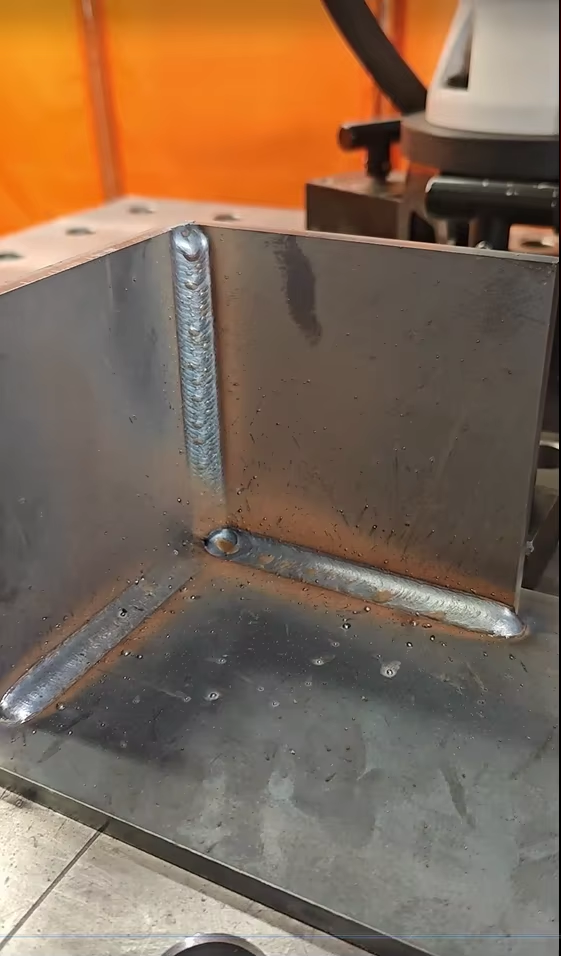
For full-penetration welds required in stadium columns, the consistency of the root face (the “land”) is vital. The ±45° bevel system maintains a tolerance of ±0.2mm on the land dimension. This consistency allows for the use of robotic welding cells, as the weld path becomes highly predictable. In the Edmonton context, where skilled welding labor is at a premium, the ability to automate the subsequent welding phase via laser-precision prep is a major economic driver.
6. Environmental Considerations: The Edmonton Variable
Operating a 6000W laser in Northern climates necessitates specific infrastructure. The “Universal” system in this report includes an integrated thermal management unit to stabilize the resonator and the fiber delivery cable.
Furthermore, the indoor fabrication environment in Edmonton benefits from the laser’s reduced noise and fume profile compared to plasma. The precision of the 6000W beam also results in a narrower kerf, which reduces material waste (scrap). In a project requiring 10,000 tons of structural steel, a 2% increase in nesting efficiency—enabled by the laser’s ability to perform common-line cutting on profiles—translates to significant cost mitigation.
7. Technical Bottlenecks and Mitigation
While the 6000W system is superior in most metrics, two primary bottlenecks were identified:
1. Material Composition: Variations in the silicon and manganese content of the steel can affect laser absorption. Mitigation: Implementation of an adaptive power control loop that adjusts wattage based on back-reflection sensors.
2. Data Overhead: 3D beveling generates massive datasets. Mitigation: Upgrading the local controller to a 64-bit architecture with high-speed bus communication to the servo drives to prevent “stuttering” during complex 5-axis movements.
8. Conclusion: The New Standard for Stadium Fabrication
The deployment of a 6000W Universal Profile Steel Laser System with ±45° beveling represents a fundamental upgrade in structural engineering capabilities for the Edmonton region. By consolidating cutting, beveling, and hole-drilling into a single automated process, fabricators can meet the aggressive timelines and safety factors required for modern stadium infrastructure. The precision of the ±45° bevel specifically addresses the critical need for high-quality weld joints in cold-weather environments, ensuring that the structural integrity of Edmonton’s landmarks is built on a foundation of microscopic precision and metallurgical excellence.
Field Report End.













