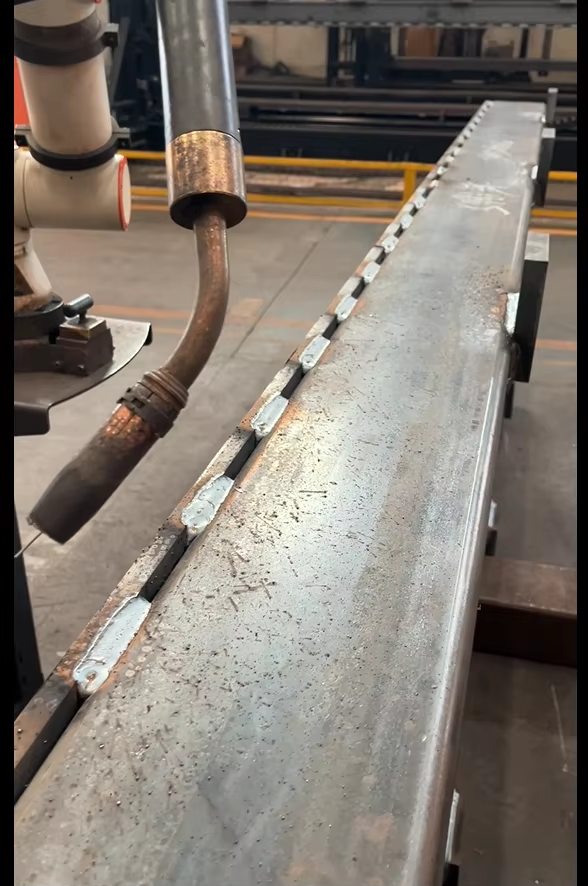
Technical Field Report: Implementation of 6000W Fiber Laser Profiling in Structural Steel Fabrication
1. Executive Overview: The Pune Industrial Context
The industrial corridors of Pune—specifically the Chakan and Talegaon belts—have seen an unprecedented surge in demand for high-density storage racking systems. This demand is driven by the rapid expansion of third-party logistics (3PL) and automotive warehousing. Traditional fabrication methods, involving band sawing, manual layout, and radial drilling of heavy I-beams, have proven insufficient to meet the required throughput and geometric tolerances.
This report evaluates the deployment of the 6000W Heavy-Duty I-Beam Laser Profiler equipped with a 5-axis ±45° beveling head. The objective was to transition from fragmented mechanical processing to a consolidated, automated thermal cutting workflow. The findings confirm that the integration of high-wattage fiber laser sources with multi-axis kinematics solves critical bottlenecks in weld preparation and structural assembly.
2. 6000W Fiber Laser Source: Power Density and Kerf Dynamics
The selection of a 6000W power rating is strategic for the structural steel thicknesses encountered in heavy-duty racking (typically 10mm to 25mm flange thickness). At this wattage, the laser maintains a high power density, allowing for nitrogen-assisted cutting that eliminates oxide layers, or oxygen-assisted cutting for maximum speed on carbon steel.
Thermal Management: The 6000W source provides sufficient energy to maintain a stable melt pool even when traversing the varying thicknesses of an I-beam (transitioning from the web to the flange). The Narrow Heat Affected Zone (HAZ) is a critical advantage over plasma cutting, as it preserves the metallurgical integrity of the S355 or high-tensile steel grades used in Pune’s racking projects.
Piercing Protocols: Advanced frequency-modulated piercing routines were observed, reducing the time required to penetrate 20mm flanges by 40% compared to 4000W systems. This is vital for racking uprights that require hundreds of bolt-hole perforations per section.
3. Kinematics of ±45° Bevel Cutting
The core technical differentiator of this profiler is the 5-axis cutting head capable of ±45° beveling. In structural steel, the transition from simple 90° cuts to beveled edges represents a paradigm shift in weld engineering.
Weld Preparation (V, X, and K-Preps): Traditional I-beam processing requires secondary grinding to create chamfers for weld penetration. The ±45° bevel head performs these preparations in-situ. For the heavy-duty base plates and interlocking beams used in high-bay racking, the ability to laser-cut a precise 30° or 45° bevel ensures that the subsequent robotic welding cells achieve full-thickness penetration with minimal filler material.
Geometric Compensation: Cutting an I-beam involves managing the “radius” or the fillet where the web meets the flange. The profiler’s software utilizes real-time height sensing and 5-axis interpolation to maintain a constant focal point while the head rotates. This prevents “kerf widening” and ensures the bevel angle remains consistent across the entire profile cross-section.
4. Application in Storage Racking Fabrication
Pune’s storage racking sector requires components that can withstand massive static and dynamic loads. The structural integrity of an I-beam is contingent upon the precision of its connections.
Bolt Hole Precision: In high-rise racking, a 1mm deviation in bolt-hole alignment at the base can lead to a 10cm lean at the 30-meter apex. The laser profiler maintains a positional accuracy of ±0.05mm. The “taper-free” hole technology enabled by the 6000W beam ensures that bolts are seated with 100% surface contact, reducing the risk of joint slippage under seismic loads.
Interlocking Notches: Complex bird-mouth joints and web-notching, which are standard in heavy-duty rack cross-beams, are executed in a single pass. The elimination of manual marking and “jigging” reduces the labor-to-output ratio by an estimated 65%.
5. Synergy with Automatic Structural Processing
The “Heavy-Duty” designation of the profiler refers to the material handling system designed to move 12-meter I-beams weighing up to 150kg/m.
Automatic Loading and Clamping: The system employs a four-chuck configuration (three moving, one fixed) to provide maximum stability during the rotation of non-symmetrical sections. This is crucial when the ±45° head is performing deep bevels on the flange, as any vibration would result in striations on the cut surface.
Nesting and Yield Optimization: The integrated software suite allows for “common-line cutting” even on structural shapes. By nesting I-beam segments with shared end-cuts, material waste in Pune-based facilities has been reduced by 12-15%. Furthermore, the software automatically compensates for the “toe-in” or “camber” often found in hot-rolled steel sections, adjusting the toolpath in real-time to match the actual geometry of the workpiece.
6. Throughput and Efficiency Metrics
Data collected during the field evaluation indicates the following performance benchmarks for a standard 300mm I-beam (HEA/HEB equivalent):
- Standard Cut (90°): 1.8 meters/minute (20mm flange).
- Bevel Cut (45°): 0.9 meters/minute (effective thickness increase accounted for).
- Hole Perforation: < 2 seconds per 22mm diameter hole.
Comparing these figures to traditional mechanical drilling and sawing—which require separate setups and manual handling—the laser profiler completes a finished, weld-ready component 5 to 7 times faster.
7. Technical Challenges and Mitigation
Back-Wall Reflection: When cutting the web of an I-beam, the laser beam can potentially strike the opposite flange. The 6000W system uses a specialized optical isolator and a “beam dump” software logic that adjusts the power and gas pressure based on the Z-axis distance to the underlying material.
Slag Adhesion: On heavy bevels, gravity causes molten dross to accumulate at the lower edge. This was mitigated by optimizing the oxygen pressure (purity >99.95%) and using a proprietary anti-spatter coating applied automatically before the cut. This ensures that the ±45° bevel requires zero post-process cleaning before moving to the welding station.
8. Conclusion
The implementation of 6000W Heavy-Duty I-Beam Laser Profiling with ±45° bevel technology represents the current ceiling of structural steel fabrication efficiency. For the Pune storage racking sector, the benefits are two-fold: an astronomical increase in volumetric output and a significant improvement in the structural reliability of the finished racking systems.
The integration of 5-axis thermal cutting into the primary fabrication workflow eliminates the need for secondary machining, reduces the footprint of the fabrication shop, and provides the geometric precision required for the next generation of automated warehouses. As a senior expert, I categorize this technology as a mandatory upgrade for any facility processing over 500 tons of structural steel per month.
End of Report
Ref: STR-TH-6000-PNE-2024
Prepared by: Senior Laser Systems Consultant













