1.0 Executive Summary: High-Power Laser Integration in North African Heavy Industry
This technical report evaluates the operational deployment of a 30kW Fiber Laser 3D Structural Steel Processing Center within the crane manufacturing sector in Casablanca, Morocco. The transition from conventional oxy-fuel and plasma cutting to ultra-high-power fiber laser technology represents a critical shift in structural engineering. The integration of a 5-axis cutting head capable of ±45° beveling addresses the historical bottleneck of weld preparation in high-tensile strength steel components used in gantry and overhead crane assemblies.
2.0 Site Context: Casablanca Crane Manufacturing Requirements
The industrial landscape in Casablanca, specifically surrounding the Port of Casablanca and the expanded logistics hubs, demands heavy-lift equipment with rigorous structural integrity. Crane girders, end carriages, and boom sections are typically fabricated from S355JR or S355J2+N structural steel. These components require deep-penetration welding, which necessitates precise edge geometries. Prior to the installation of the 30kW 3D system, the facility relied on manual mechanical beveling and CNC plasma, which introduced significant thermal deformation and required extensive secondary grinding to achieve weld-ready surfaces.
2.1 Material Specifications and Thickness Parameters
The 30kW source is calibrated for processing structural profiles (H-beams, I-beams, and C-channels) and thick-walled rectangular hollow sections (RHS) up to 25mm thickness for 3D profiles and 50mm for plate. In crane manufacturing, where the strength-to-weight ratio is paramount, the ability to process high-strength alloys with minimal Heat Affected Zones (HAZ) is essential for fatigue resistance.
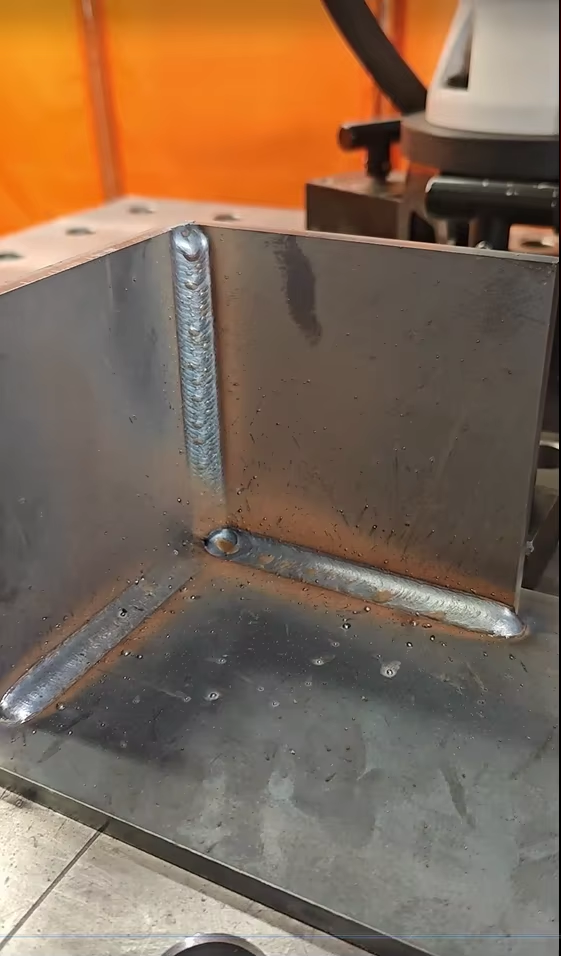
3.0 Technical Analysis of the 30kW Fiber Laser Source
The 30kW fiber laser source provides a power density previously unavailable for 3D structural processing. This power level allows for “high-speed melt-extraction” even in thick-section structural members. The primary advantage observed in the Casablanca facility is the increase in cutting speed across 16mm to 25mm structural webs, which is 300% faster than 12kW systems and 600% faster than plasma equivalents.
3.1 Beam Parameter Product (BPP) and Kerf Control
At 30kW, managing the Beam Parameter Product (BPP) is critical. The system utilizes advanced optical collimation to maintain a stable focal point across the entire Z-axis travel of the 3D head. For structural steel, the kerf width is maintained between 0.8mm and 1.2mm, allowing for tighter tolerances in interlocking joint designs—a feature that simplifies the jigging and fixturing of massive crane box girders.
4.0 Dynamics of ±45° 3D Bevel Cutting
The core innovation of this processing center is the 5-axis 3D head. In crane manufacturing, the transition points between the main girder and the end carriages are subject to extreme torsional stress. Precise beveling is required for Full Penetration (FP) welds.
4.1 Solving the Precision-Efficiency Paradox
Traditional beveling involves a two-step process: cutting the profile to length and then secondary machining or grinding the bevel. The 30kW 3D laser performs these concurrently. The ±45° range allows for the creation of V, Y, X, and K-type preparations in a single pass. In the Casablanca field test, the 3D head demonstrated the ability to maintain a consistent root face of 1mm ±0.2mm on a 20mm S355 plate, which is optimal for automated robotic welding systems.
4.2 Geometric Compensation for Structural Profiles
Structural steel beams are rarely perfectly straight. The 3D processing center utilizes a high-speed laser scanning system to map the actual geometry of the beam (detecting camber, sweep, and twist) before cutting. The CNC controller then dynamically adjusts the ±45° head’s trajectory in real-time. This ensures that the bevel angle remains relative to the actual surface of the material, not just the theoretical CAD model, ensuring zero-gap fit-up during assembly.
5.0 Application Specifics: Crane Girder Fabrication
The manufacturing of gantry cranes involves long-span box girders. These are fabricated by welding four plates together or by modifying large I-beams. The 30kW system’s ability to cut complex apertures for service access and motor mounts directly into the web—while simultaneously beveling the edges for the flange-to-web connection—reduces total processing time by an estimated 70%.
5.1 Mitigating Thermal Deformation
One of the technical challenges in Casablanca’s high-ambient temperature environment is managing the thermal expansion of long structural members (up to 12 meters). The 30kW laser’s high feed rate significantly reduces the total heat input into the part. Compared to oxy-fuel, the HAZ is reduced by 85%, which preserves the metallurgical properties of the S355 steel and prevents the “bowing” effect often seen in long-span crane components.
6.0 Workflow Synergy and Automation
The 3D Structural Steel Processing Center is not merely a cutting tool but a logistical node. The integration includes an automated loading system capable of handling 6-ton structural bundles. In the Casablanca facility, the synchronization between the 30kW source and the material handling system allows for “lights-out” processing of secondary bracing members.
6.1 Software Integration: From BIM to Cut
The facility utilizes Tekla Structures for crane design. The processing center’s software directly imports IFC or DSTV files, automatically assigning bevels based on the weld symbols defined in the engineering model. This eliminates manual programming errors and ensures that the ±45° cuts are executed exactly where the structural engineer requires them for load distribution.
7.0 Metallurgical and Quality Inspection Results
Post-process inspection of the cut surfaces in the Casablanca plant reveals a surface roughness (Rz) within the ISO 9013 Range 2 and 3. For crane manufacturing, this is vital because it eliminates the need for edge dressing before painting or galvanizing. Hardness testing across the cut edge shows a minimal increase (less than 30 HV10), ensuring that the edges do not become brittle—a common failure point in cranes subjected to cyclic loading.
7.1 Nitrogen vs. Oxygen Assist Gases
While 30kW allows for high-speed nitrogen cutting (oxide-free), the Casablanca facility primarily utilizes high-pressure oxygen for structural sections above 20mm to optimize the exothermic reaction and reduce gas consumption. The system’s gas mixing station allows for precise control over the assist gas purity, which is critical for maintaining the stability of the ±45° bevel at the exit point of the cut.
8.0 Economic and Operational Impact
The implementation of the 30kW 3D laser center has redefined the CAPEX/OPEX equation for the Casablanca site. Although the initial investment is significant, the removal of three secondary processes—manual marking, mechanical beveling, and hole drilling—has resulted in a 40% reduction in the cost-per-part for crane end-carriages. Furthermore, the precision of the laser-cut bevels has reduced weld wire consumption by 15% due to the elimination of over-welding in wide-gap joints.
9.0 Conclusion
The deployment of the 30kW Fiber Laser 3D Structural Steel Processing Center in Casablanca establishes a new benchmark for heavy-duty fabrication in the region. The synergy between extreme power density and 5-axis kinematic precision addresses the specific mechanical requirements of crane manufacturing. By mastering the ±45° beveling process, the facility has achieved a level of structural reliability and production throughput that conventional methods cannot replicate. As the Moroccan infrastructure sector continues to expand, this technology will be the cornerstone of high-capacity structural steel production.
End of Report
Authored by: Senior Technical Consultant, Laser Systems & Structural Engineering













