The Industrial Evolution: Why 12kW Fiber Power Matters in Edmonton
Edmonton, Alberta, has long been the backbone of Canada’s heavy industrial manufacturing. As the gateway to the North, the city’s fabrication shops are tasked with producing the most robust machinery on earth—equipment destined for the oil sands of Fort McMurray and the deep mines of the Rockies. For decades, this meant relying on plasma cutting or oxy-fuel systems for thick structural steel. However, the arrival of the 12kW fiber laser has redefined what is possible.
A 12kW fiber laser source provides an energy density that plasma cannot match. While plasma is effective for “parting” thick metal, it often leaves a wide heat-affected zone (HAZ) and a drossy edge that requires significant post-processing. The 12kW fiber laser, conversely, uses a highly concentrated beam to vaporize steel almost instantly. This power level is the “sweet spot” for mining machinery, where material thicknesses for structural beams often range from 12mm to 25mm. At 12kW, the laser maintains a high feed rate through these thicknesses, ensuring that the crystalline structure of the steel remains stable, which is vital for components subject to the extreme vibrations and cyclic loading of mining operations.
The Architecture of the Heavy-Duty I-Beam Profiler
Unlike standard flatbed lasers designed for sheet metal, an I-Beam Profiler is a specialized 3D kinematic system. The machine is engineered to handle “long-stock” profiles, often reaching lengths of 12 meters or more. In the context of heavy-duty mining machinery, the “heavy-duty” designation refers to the machine’s ability to support the massive linear weight of structural H-beams and I-beams that can weigh hundreds of pounds per foot.
The system typically utilizes a series of high-torque chucks and support rollers that rotate and feed the beam through the cutting zone. The precision required here is immense. When you are cutting a 40-foot I-beam to be used in a primary crusher frame, a deviation of even a few millimeters can lead to catastrophic misalignment during final assembly. The heavy-duty profiler uses synchronized servo motors to ensure that as the beam rotates, the laser head maintains a perfect focal point relative to the flange and the web of the beam.
Mastering the ±45° Bevel: The End of Secondary Operations
Perhaps the most significant advancement for Edmonton’s mining fabricators is the ±45° bevel cutting capability. In heavy equipment manufacturing, pieces are rarely joined with simple butt welds. To ensure full penetration and structural rigidity, edges must be beveled into V, Y, or K-joint configurations.
Historically, this was a manual process. A fabricator would cut the beam to length, then use a hand-held plasma torch or a gas-powered beveling “crawler” to grind the angle. This process is labor-intensive, loud, and inherently imprecise.
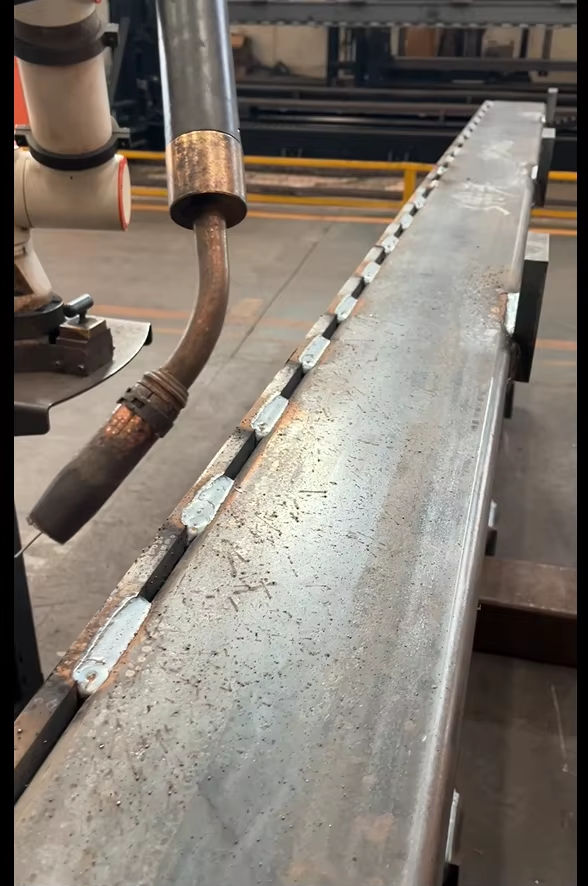
The 5-axis laser head on a 12kW profiler changes the math entirely. By articulating the head up to 45 degrees in any direction, the laser can cut the profile and the weld prep bevel simultaneously. This means a beam comes off the machine ready to be moved directly to the welding station. For an Edmonton shop producing twenty conveyor frames a month, the savings in man-hours alone can pay for the machine’s overhead within the first year of operation. Furthermore, the precision of a laser bevel ensures that the fit-up is tight, reducing the amount of weld wire required and minimizing the risk of weld failure in the field.
Applications in Mining Machinery: From Chutes to Chassis
The mining industry demands equipment that can withstand abrasion, impact, and extreme thermal cycling. The 12kW I-Beam profiler is uniquely suited for several key applications:
1. **Mainframe Fabrication:** Large-scale mining trucks and loaders require frames built from high-strength structural beams. The laser’s ability to cut complex bolt patterns, weight-reduction windows, and interlocking joints into these beams ensures a level of structural harmony that manual methods cannot achieve.
2. **Sizing and Crushing Equipment:** The vibration in a sizer is violent. The precision of laser-cut slots and tabs allows for “puzzle-piece” assembly, where the mechanical fit provides strength even before the first weld bead is laid.
3. **Material Handling Systems:** Conveyor galleries and chutes in the oil sands are often massive. Using a 12kW laser to profile the heavy channels and I-beams ensures that these long-run structures are perfectly straight, reducing wear on belts and rollers.
4. **Hardened Steel Processing:** Mining involves AR (Abrasion Resistant) steels like Hardox. These materials are notoriously difficult to drill or mill. The 12kW fiber laser pierces through AR400 and AR500 structural sections with ease, allowing for the inclusion of mounting holes and complex geometries that were previously avoided by designers due to cost.
The Economic Impact on the Edmonton Manufacturing Hub
Edmonton’s competitive advantage lies in its proximity to the work sites. However, the cost of labor in Alberta is among the highest in North America. To remain competitive against international fabricators, local shops must embrace automation.
A 12kW I-Beam Profiler acts as a force multiplier. It allows a single operator to perform the work that previously required a layout specialist, a saw operator, a drill press operator, and a grinder. By consolidating these four steps into one CNC-controlled process, Edmonton shops can quote shorter lead times and higher quality.
Moreover, the “nesting” capabilities of modern laser software allow for the optimization of structural members. By intelligently placing cuts across a 12-meter beam, the software minimizes “drops” or scrap material. In an era where steel prices are volatile, saving 5% to 10% on raw material can be the difference between a profitable contract and a loss.
Technical Considerations: Optics, Gas, and Maintenance
Operating a 12kW system in a climate like Edmonton’s—where temperatures can swing from -30°C in the winter to +30°C in the summer—requires a robust infrastructure. The laser source itself must be housed in a climate-controlled enclosure, and the chiller system must be high-performance to dissipate the heat generated by the 12,000 watts of light energy.
The choice of assist gas is also critical. When cutting structural beams for mining, Oxygen is typically used for carbon steel to take advantage of the exothermic reaction, which increases cutting speed. However, for a “clean” weld-ready edge without an oxide layer, Nitrogen is preferred. A 12kW system has the “brute force” to Nitrogen-cut through significant thicknesses, which is a major advantage for shops that prioritize paint adhesion and weld quality.
Finally, the 5-axis head is a masterpiece of engineering. It must be shielded from the dust and slag inherent in heavy-duty cutting. Modern systems use a “covered” design for the bellows and high-speed sensors to detect potential collisions with the beam’s flanges—a common hazard when working with structural sections that may have slight factory deformations.
Conclusion: The Future of Alberta’s Heavy Fabrication
The 12kW Heavy-Duty I-Beam Laser Profiler is more than just a cutting tool; it is a strategic investment in the future of Alberta’s industrial capacity. For the mining machinery sector, the requirements for “bigger, stronger, and faster” are not going away. As mining operations push into deeper and harsher environments, the equipment supporting them must be built with a level of precision that only fiber laser technology can provide.
By adopting ±45° bevel cutting, Edmonton fabricators are not just cutting steel; they are refining the entire workflow of heavy fabrication. They are eliminating errors, protecting their margins, and ensuring that the machinery “Made in Alberta” remains the gold standard for the global mining industry. In the high-stakes world of heavy equipment, where downtime is measured in millions of dollars, the precision of a 12kW laser-cut beam is the ultimate insurance policy.