

We use analytical cookies to improve your experience on our website


In the competitive world of structural steel, precision isn’t just a goal—it’s a requirement. Our cutting-edge CNC solutions, ranging from high-power fiber lasers to multi-axis robotic beam lines, are engineered to eliminate manual layout errors and drastic secondary grinding. By integrating automated beveling and bolt-hole processing, we help fabricators reduce labor costs and accelerate project timelines. Whether you’re processing heavy plates or complex I-beams, our technology ensures «weld-ready» edges and 100% component compatibility for even the most demanding infrastructure projects.
The global demand for complex infrastructure—from sprawling industrial warehouses to intricate architectural landmarks—has pushed steel fabrication to its limits. For fabricators, the bottleneck is rarely the assembly; it’s the cutting. If the initial cuts on an H-beam or a thick carbon steel plate are off by even a few millimeters, the downstream costs in welding and fit-up can be disastrous.
Modern steel structure cutting solutions have evolved beyond simple «parting off» tools. They are now integrated systems designed to balance structural integrity with high-volume throughput.
For decades, manual oxy-fuel torches were the backbone of the yard. While reliable, they rely too heavily on operator skill and require extensive secondary grinding. In today’s competitive market, «good enough» is a liability.
Industry leaders are now pivoting toward multi-axis CNC robotic systems and high-definition plasma technology. The goal isn’t just to cut a shape; it’s to prepare the edge for the next stage of production. This means integrated beveling for weld preparation, precise bolt-hole drilling, and marking—all in a single pass.
While fiber lasers were once reserved for sheet metal, the power surge in 12kW to 30kW resonators has changed the game for structural steel.
Why it works: The Heat Affected Zone (HAZ) is minimal, meaning the metallurgical properties of the steel remain intact.
The Advantage: For gusset plates, base plates, and intricate connection brackets, the fiber laser offers a level of «bolt-ready» precision that plasma struggle to match.
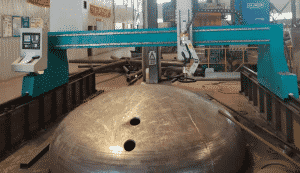
High-Definition (HD) Plasma remains the most cost-effective solution for the bread-and-butter of structural steel: heavy plates and profiles.
The Bevel Factor: Modern plasma heads can pivot up to 45 or 50 degrees. This allows for V, X, and Y-type weld preparations to be cut directly on the machine.
Operational Efficiency: Plasma excels in the 15mm to 50mm thickness range, providing a balance of speed and edge quality that keeps the assembly line moving without the massive investment required for ultra-high-power lasers.
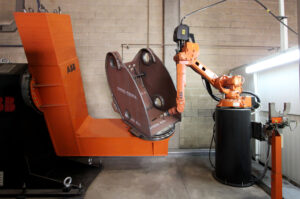
The most significant «AI-killer» in a real fabrication shop is the robotic beam line. Steel structures aren’t just flat plates; they are I-beams, C-channels, and square tubes.
Traditional sawing and drilling are linear and slow. A robotic profile cutting solution uses 3D scanning to detect the actual dimensions of a beam (accounting for mill tolerances) and then carves out copes, notches, and holes with six-axis freedom. This eliminates the need for manual layout and drastically reduces the «Human Error» margin.
An often-overlooked part of the «solution» isn’t the hardware, but the nesting software. Truly efficient steel cutting minimizes scrap.
«Dumb» cutting follows a list. «Smart» cutting uses advanced algorithms to nest parts across multiple beams or plates, considering grain direction and heat distribution. When integrated with an ERP system, the cutting floor becomes a data-driven hub, allowing for real-time tracking of every flange and web.
A common «rookie» mistake in structural cutting is ignoring thermal expansion. High-heat processes like oxy-fuel or standard plasma can warp long structural members.
Advanced solutions now include water-bed cutting or underwater plasma cutting to rapidly dissipate heat. For fabricators working on high-rise tension members or bridge components, controlling this thermal profile is not optional—it is a safety requirement.
There is no «one-size-fits-all» in steel structure cutting. The right solution depends on your specific output:
If you do high-volume, standardized warehouse frames, a CNC High-Speed Drill and Saw line might be the fastest.
If you handle custom, complex architectural steel, a Robotic Plasma Cell offers the most flexibility.
The future of structural steel isn’t just about cutting faster; it’s about cutting smarter. By reducing secondary processes—grinding, re-drilling, and manual beveling—you don’t just save time; you build a more resilient business model.
Чтобы обеспечить максимальное время безотказной работы оборудования и 100% совместимость компонентов, ознакомьтесь с нашими профессиональными рекомендациями по закупкам ниже.
Системы ЧПУ основаны на точных номерах деталей. Пожалуйста, проверьте артикул в вашем оригинальном техническом руководстве или на этикетке OEM. Даже детали, которые выглядят идентичными, могут иметь разные версии прошивки или внутренние допуски, влияющие на производительность.
Мы внедрили протокол «Двойной проверки». Мы запрашиваем фотографии вашей существующей детали и заводской таблички станка. Это позволяет нашим старшим инженерам визуально подтвердить типы разъемов, порты проводки и монтажные размеры, прежде чем мы завершим отгрузку.
Условия электроснабжения в промышленности различаются в зависимости от страны. Убедитесь, что компонент поддерживает ваше местное напряжение (220 В/380 В/440 В) и частоту (50/60 Гц). Установка компонента на 220 В в систему на 380 В без трансформатора приведет к катастрофическому отказу.
Мы используем перевозчиков первого уровня (DHL, FedEx, UPS) для международных перевозок. Хотя стандартная обработка занимает 48 часов, пожалуйста, проконсультируйтесь с нами в случае аварийных ситуаций, связанных с простоем оборудования. Мы можем приоритизировать ваш заказ, чтобы обеспечить максимально быстрое таможенное оформление и транспортировку.
Высокоточные детали ЧПУ требуют профессиональной калибровки. Мы рекомендуем установку сертифицированными специалистами. Неправильное обращение с платами, чувствительными к статическому электричеству, или неправильный крутящий момент на механических деталях может привести к аннулированию гарантии и повреждению системы.
Все детали проходят тщательную противоударную упаковку. Тем не менее, вы должны проверить внешнюю пломбу при получении. Если вы заметили какую-либо деформацию коробки или влагу, задокументируйте это с помощью видео/фотографий перед открытием, чтобы защитить свои права на страховое возмещение.
Наши обязательства не заканчиваются доставкой. На оригинальные запасные части предоставляется гарантия 6-12 месяцев. Мы ведем цифровой журнал ваших серийных номеров, что позволяет нашей технической команде оказывать удаленную помощь в устранении неполадок, когда это необходимо.



С нашего высокотехнологичного производственного предприятия непосредственно на вашу глобальную площадку. PCL WeldCut обеспечивает надежную упаковку, профессиональную обработку и надежную международную логистику для защиты вашего оборудования на протяжении всего пути.
Fill out the form below, and we will be in touch shortly.
