The Industrial Evolution of Rayong: Embracing 12kW Fiber Technology
Rayong has long been the pulsating heart of Thailand’s Eastern Economic Corridor (EEC), serving as a hub for automotive, petrochemical, and heavy machinery production. Within this industrial landscape, crane manufacturing stands as a critical pillar, supporting the infrastructure and logistics required for global trade. However, the traditional methods of fabricating massive crane girders and support structures—primarily involving manual layout, band saws, and oxygen-fuel or plasma cutting—have reached their efficiency limits.
The introduction of the 12kW CNC Beam and Channel Laser Cutter marks a technological leap. In the world of fiber lasers, 12,000 watts is a “sweet spot” for heavy industry. It provides the photon density necessary to pierce through thick structural steel with surgical precision while maintaining feed rates that make mass production viable. For Rayong-based manufacturers, this technology is not just an upgrade; it is a fundamental shift toward “Thailand 4.0” automation, ensuring that local crane production can compete with global heavyweights in terms of both quality and price.
The Mechanics of the Infinite Rotation 3D Head
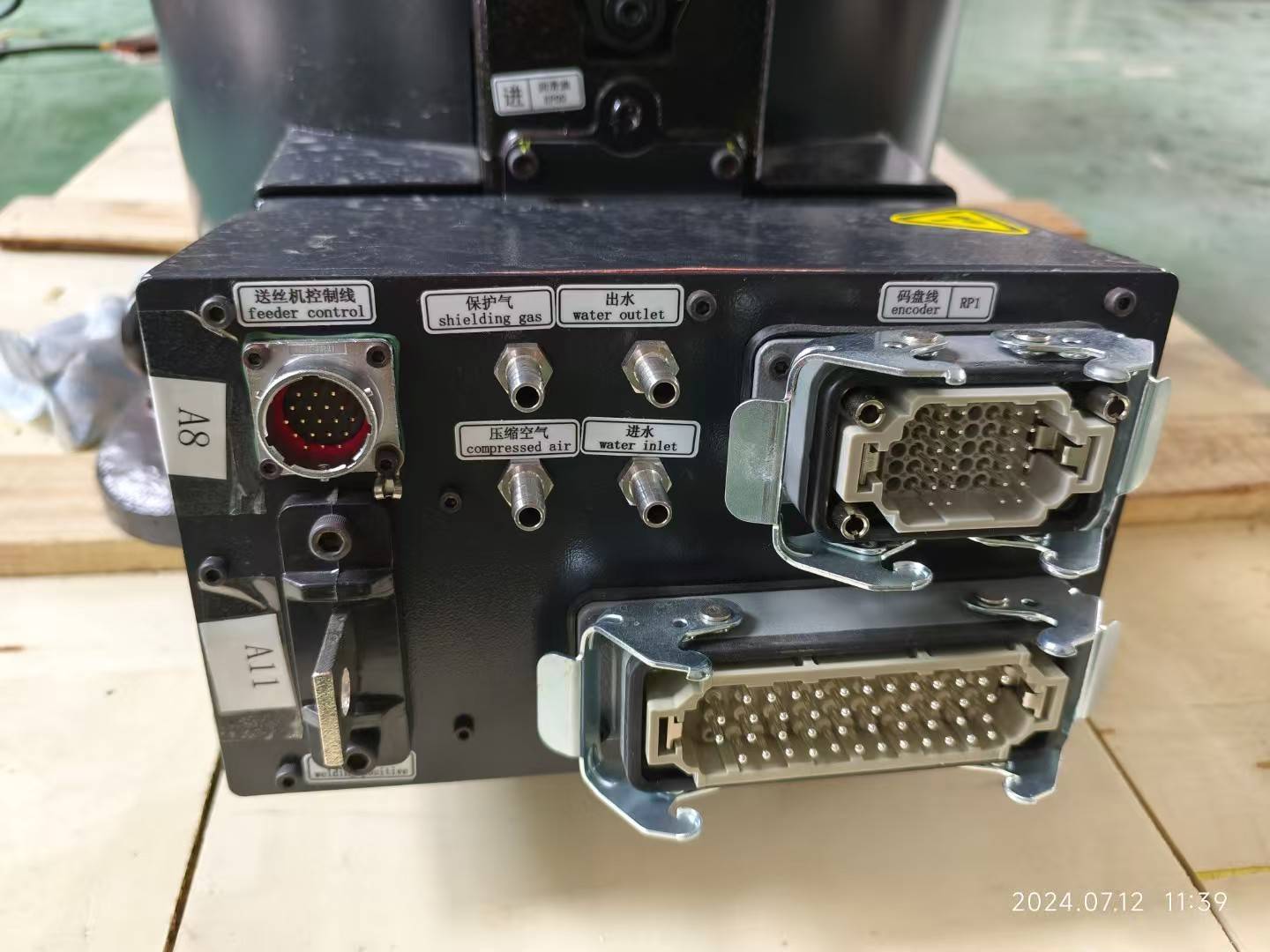
Perhaps the most transformative component of this system is the infinite rotation 3D laser head. Traditional laser cutters are often limited by “umbilical” cables that restrict the rotation of the cutting head, requiring the machine to “unwind” after a certain number of degrees. In the context of beam processing, where a laser must navigate the flanges and webs of an H-beam or the complex corners of a U-channel, this limitation is a major productivity killer.
The infinite rotation head utilizes advanced slip-ring technology and a multi-axis CNC interface (typically 5-axis or more) to allow the head to rotate 360 degrees and beyond without interruption. This allows for:
- Seamless Beveling: Creating V, X, Y, and K-shaped bevels for weld preparation in a single pass.
- Complex Geometry: Cutting interlocking notches and saddle cuts for pipe-to-beam joints that fit perfectly without manual grinding.
- Side-Wall Processing: The ability to tilt the head up to 45 or even 50 degrees to cut through the thickness of a beam flange from an angle, which is essential for structural weight reduction and specialized rigging points.
Optimizing Crane Manufacturing: Precision and Structural Integrity
Cranes—whether overhead bridge cranes, gantry cranes, or jib cranes—rely on the absolute structural integrity of their long-span members. A deviation of even a few millimeters in the bolt holes of a crane girder or the fitment of an end carriage can lead to catastrophic structural fatigue over time.
The 12kW fiber laser offers a positioning accuracy of ±0.05mm, a feat impossible with plasma or manual methods. In Rayong’s crane factories, this precision translates directly to:
1. Perfect Alignment: Bolt holes for motor mounts and rail clips are cut with such accuracy that assembly becomes a “Lego-like” process, eliminating the need for on-site re-drilling.
2. Reduced Heat Affected Zone (HAZ): 12kW lasers cut so rapidly that the heat does not have time to dissipate into the surrounding material. This preserves the metallurgical properties of high-tensile structural steel (like S355 or equivalent), ensuring the beams don’t become brittle at the cut edges.
3. Complex Web Notching: Crane girders often require internal stiffeners. The 3D head can cut precise slots into the webs of large beams, allowing stiffener plates to be slotted in and welded with minimal gap, maximizing the strength-to-weight ratio of the crane.
Processing Beams and Channels: The 12kW Advantage
While 3kW or 6kW lasers are sufficient for thin sheet metal, crane manufacturing involves heavy-duty sections. An H-beam used in a 50-ton gantry crane may have a flange thickness exceeding 20mm.
A 12kW source provides the “punch” to clear the kerf of molten metal in these thick sections. Using oxygen as a cutting gas, the 12kW system achieves a smooth, mirror-like finish on thick carbon steel. For the U-channels and C-channels used in smaller hoists and trolleys, the laser can be used with nitrogen for high-speed “fly-cutting,” where the beam moves at incredible velocities, significantly outperforming mechanical drills or punches.
Furthermore, the CNC software accompanying these machines includes sophisticated nesting algorithms specifically for long profiles. It can calculate the best way to cut multiple parts from a 12-meter beam to minimize scrap, a crucial factor in an era of fluctuating steel prices in the Southeast Asian market.
Workflow Integration: From CAD to Finished Girder
The digital thread in modern Rayong facilities starts with a 3D CAD model (often from Tekla or SolidWorks). The 12kW CNC Beam Cutter’s software imports these files directly. The “Infinite Rotation” capability is handled by the CAM post-processor, which automatically calculates the head’s path to avoid collisions with the beam’s flanges while maintaining the focal point on the material surface.
This automation removes the human error factor. Traditionally, a layout artist would mark a beam with chalk and a tape measure. With the CNC laser, the machine’s “touch-probe” or laser-sensing system first scans the beam to detect any natural deviations or “twists” in the steel. The CNC then compensates for these deviations in real-time, ensuring that the cut is perfectly square to the beam’s actual geometry, not just its theoretical model.
Economic Impact for Rayong’s Engineering Sector
The ROI (Return on Investment) for a 12kW 3D laser in Rayong is driven by three main factors: labor, secondary processing, and throughput.
In the past, a single H-beam might require four different workers: one for measuring, one for sawing, one for drilling, and one for grinding the bevels. The 12kW CNC laser collapses these four stages into a single station operated by one technician. The time saved on secondary grinding alone—since the laser leaves a weld-ready edge—can reduce the total fabrication time of a crane bridge by up to 40%.
Moreover, as Rayong positions itself as an export hub, having “Laser-Cut Precision” on a specification sheet is a significant marketing advantage. International clients in the mining, shipping, and construction sectors demand documented precision and safety, which these machines provide through digital logging and consistent execution.
Safety and Environmental Considerations
Operating a 12kW laser requires a sophisticated safety infrastructure. These machines are typically housed in large, fully enclosed cabins to protect workers from Class 4 laser reflections. In the humid and salty air of Rayong’s coastal industrial zones, the machines are equipped with refrigerated chillers and dust extraction systems with HEPA filtration. This not only protects the sensitive optics of the fiber laser but also ensures that the factory floor remains free of the hazardous dust associated with plasma cutting, creating a healthier environment for the Thai workforce.
Conclusion: The Future of Lifting in Thailand
The deployment of 12kW CNC Beam and Channel Laser Cutters with Infinite Rotation 3D Heads is a transformative event for crane manufacturing in Rayong. It represents the perfect marriage of raw power and delicate precision. By automating the most difficult aspects of structural steel fabrication—the complex bevels and heavy-section cuts—manufacturers can produce safer, stronger, and more efficient lifting equipment.
As the EEC continues to expand, the demand for high-capacity cranes will only grow. Rayong’s manufacturers, armed with 12kW fiber technology, are now uniquely positioned to lead the region, moving from traditional fabrication to high-tech engineering excellence. The “infinite” capability of the 3D head is not just a mechanical feature; it is a symbol of the limitless potential for industrial growth in Thailand’s premier manufacturing province.